Paving the Way for Autocracy’s Return Would Betray July Uprising, Liberation War Martyrs: PM
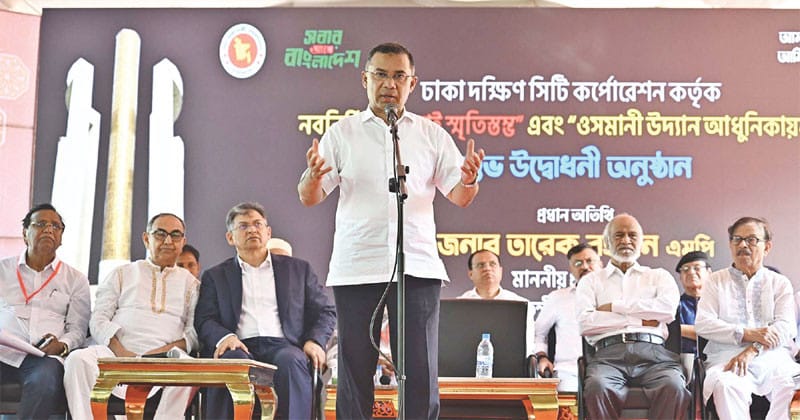
Prime Minister Tarique Rahman emphasised that opposition strictly for the sake of opposing risks creating a political vacuum that could enable the return of autocracy, which would constitute a direct betrayal of the martyrs of the 1971 Liberation War and the July mass uprising. Speaking as the chief guest at the inauguration of the newly constructed ‘July Memorial’ and the modernised Osmani Udyan in Dhaka, he urged all political factions to abandon outdated confrontation. He underscored that while opposing government policies is a fundamental right of opposition parties, it must be driven by constructive motives aimed at national progress rather than mere political rivalry.
The PM pointed out that the Bangladesh Nationalist Party (BNP) obtained the public mandate to govern through popular votes. At the same time, other political parties assumed their respective positions in the parliamentary opposition. He rejected the misconception that only the ruling administration represents the populace, asserting that both government and opposition parliamentarians share the solemn responsibility of championing public welfare. The primary duty of all representatives within Parliament, he noted, is to deliberate on vital national interests, present sound logical arguments, and establish effective public policies through constructive dialogue, consensus, and democratic parliamentary processes.
Addressing the absence of several political figures at the memorial event, PM Tarique Rahman expressed regret over missed opportunities for national unity despite political differences. He mentioned that opposition leaders had been formally invited to honour the families of the martyrs and the injured fighters of the July uprising. ‘Despite political distance from the government, there was an opportunity for them to stand by the July martyr families and injured fighters,’ he remarked. He stressed that embracing the spirit of the uprising requires setting aside partisan divides to stand alongside those whose supreme sacrifices granted current political leaders their recognition and mandate.
Reflecting on the country’s constitutional evolution, the PM recalled that BNP founder President Ziaur Rahman restored multi-party democracy in Bangladesh, while former PM Khaleda Zia introduced the parliamentary system. He asserted that sustaining democracy demands collective effort across political lines, particularly on core developmental priorities such as employment generation, public safety, national sovereignty, healthcare access, and quality education for future generations. Regarding constitutional amendments and structural reforms, he noted that political parties are fully entitled to their respective stances. Still, decisions must ultimately be finalised through rigorous parliamentary debate to ensure stability for ordinary citizens.
Highlighting urban development and environmental sustainability during the Osmani Udyan inauguration, the PM cautioned that infrastructure expansion must not occur at the expense of ecological balance. Preserving existing trees, natural habitats, and local ecosystems must remain a central priority for all future public architecture and civil engineering projects, he stated. Drawing from his recent visits to state hospitals, schools, and government residential areas, he urged public sector employees to set high standards of cleanliness. He reiterated that sanitary environments in healthcare facilities are non-negotiable for patient recovery and called on every citizen to maintain public infrastructure like Osmani Udyan actively.
PM Tarique Rahman further reaffirmed his administration’s commitment to supporting the victims of the movement, stating that the BNP government is actively arranging specialised medical treatment for the injured alongside financial support and employment for martyrs’ families. Following his address, the PM officially inaugurated the ‘July Memorial’ jointly with Md. Mokbul Hossain, father of martyred Abu Sayed; Mir Mostafizur Rahman, father of martyred Mir Mahfuzur Rahman Mugdho; Sanjida Khan Dipti, mother of martyred Shahriar Khan Anas; and Mohammad Shafiul Alam, father of martyred Wasim Akram. He subsequently planted a sapling, inspected the modernised park facilities, and visited the adjoining public library.
The memorial event was presided over by Dhaka South City Corporation Administrator Abus Salam and attended by senior government ministers, political leaders, and martyrs’ family members. Key speakers included PM’s Political Adviser Mirza Abbas, Home Minister Salahuddin Ahmed, Local Government Minister Abdul Moin Khan, State Minister Mir Shahed Alam, Nagorik Oikya President Mahmudur Rahman Mannah, and Workers Party General Secretary Saiful Huq. Martyrs’ parents Mir Mostafizur Rahman and Sanjida Khan Dipti also shared emotional testimonials. Cabinet members, lawmakers, and civil aviation and railway ministers were present to pay tribute to the fallen fighters and offer support to surviving relatives.
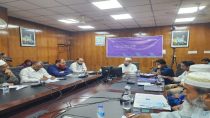
Later in the day, during an interactive session with officials at the Dhaka South City Corporation head office in Nagar Bhaban, the PM made a passionate plea for urban cleanliness centred on child welfare. ‘Leaving everyone else aside, let us build a healthy environment and a healthy city for our own children. Let us all make that effort together,’ he urged. He noted that children regularly travel across various neighbourhood zones, schools, and playgrounds, making comprehensive citywide cleanliness essential to protect them from disease. He called on municipal workers to maintain high self-confidence and strong determination to resolve long-standing waste management challenges.
Concluding his civic address, PM Tarique Rahman emphasised that sustained daily effort and continuous self-evaluation are necessary to transform the capital into a truly livable metropolis. He shared an anecdote involving a top executive of a South Korean company operating in Bangladesh, who observed that Dhaka’s cleanliness had noticeably improved recently. ‘He did not say there has been massive change; he said it has improved somewhat. That means change is possible. If we all try together, we can do even better,’ the PM remarked, encouraging city officials to maintain rigorous internal accountability while executing ongoing municipal maintenance projects.