Prime Minister’s UN Speech Reflected Bangladesh’s National Interests and Aspirations: President
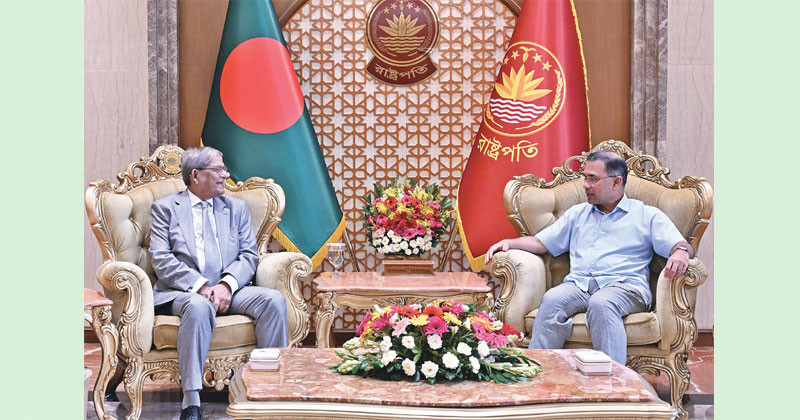
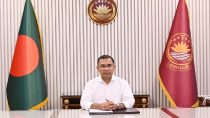
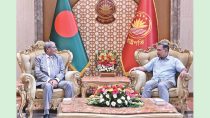
Prime Minister Mr. Tarique Rahman paid a courtesy call on Mr. Mirza Fakhrul Islam Alamgir at Bangabhaban. It was their first meeting since Mr. Alamgir took office as President. The Prime Minister met the President there on Tuesday afternoon. The President’s Press Secretary, Mr. Md. Sarwar Alam, shared this information.
The Prime Minister arrived at Bangabhaban around 3 PM, and the President welcomed him. The President then introduced the Prime Minister to his Military Secretary, Secretary, Press Secretary and other senior officials. During the meeting, the Prime Minister briefed the President on his recent visit to the United States. He spoke about the session of the UN General Assembly and his meetings with heads of state and government of various countries. He also mentioned his meetings with the UN Secretary General and other top officials, and with senior representatives of international economic and development partner organizations.
The President congratulated the Prime Minister on his speech at the 81st session of the UN General Assembly. He called the speech “farsighted, firm and full of direction.” He said the speech reflected Bangladesh’s national interests and aspirations. He also said it clearly presented Bangladesh’s position on major global issues. The President hopes the speech will strengthen Bangladesh’s dignity and position in the international arena.
The President said the visit has played an important role in strengthening the country’s position abroad. He said it has also protected public interests and helped expand bilateral and multilateral relations. The two leaders also discussed various issues of national and state interest. The President warmly thanked the Prime Minister for coming to Bangabhaban.
Last Thursday, Prime Minister Mr. Tarique Rahman gave his first speech in Bangla for Bangladesh at the general debate of the 81st UN General Assembly session. He gave it at the UN Headquarters in New York. He said no state can grow strong if it keeps its citizens powerless. He said the country must move development forward through democracy, human rights, good governance, accountability and political stability.
The Prime Minister said new doors of opportunity have opened for Bangladesh. He said the government is using the demographic dividend to turn the working population into skilled human resources. It is also creating many jobs and building Bangladesh into a manufacturing hub. He stressed opportunities for young entrepreneurs, researchers and innovators. He said the government has set aside 50 million dollars this fiscal year to support startups.
Focus on economic empowerment: The Prime Minister said the government wants democracy in the economy as well as in voting. He said this will help every family and citizen enjoy the benefits of growth and prosperity. He said women are more than half of the country’s population. So the government has put women’s education, jobs and entrepreneurship at the front of its plans.
He said the government has expanded cash funding for women entrepreneurs, especially in small and medium industries. It has also opened free education for women up to the graduate level. The government has started social protection programs for economically weaker people. These include the Family Card, Farmers Card, Sports Card and e-Health Card. He said the Family Card, issued in the name of the woman head of a family, is a symbol of women’s economic empowerment. He also said the government plans to combine these cards into one Universal Card.
Education and skilled human resources: The Prime Minister said the government gives special priority to education, health and sports. He said the education sector has received the highest budget in the country’s history. The government plans to raise education spending to 5 percent of GDP step by step within the next five years. He said the government has prepared a curriculum that focuses on technical and practical education, so students can find jobs.
He said the government has started giving bags, school uniforms and free lunch to primary school students from class one. To build sports as a career, the government has added Sports as a subject in the syllabus. He said more than 2 million students joined a month long football tournament held across the country last June. He said the government is working to reduce the development gap between cities and villages, and to ensure inclusive and sustainable development. He also said that 73 percent of the activities in the 31 point program given to the people directly match the UN’s “Leave No One Behind” principle, and 27 percent match it indirectly.
Bangladesh First: Bangladesh for All: The Prime Minister said the government aims to build a safe and peaceful Bangladesh. In it, young people can fulfill their dreams, women can live with confidence, and every child can grow to their full potential. He welcomed local and foreign investment and partnership. He said Bangladesh is working to continue development based on democracy, human rights, good governance, accountability and stability. With the pledge “Bangladesh First: Bangladesh for All,” he again backed the UN’s principles and values for world peace.
Call to end technology gaps: The Prime Minister said the world is entering a new era of artificial intelligence, biotechnology and science. But he said access to technology is still not equal for everyone. He said Bangladesh does not want today’s digital divide to become tomorrow’s Artificial Intelligence divide. He called for technology transfer, skill building and affordable access to modern technology for developing countries. He also said the UN needs effective policies so the world can use the growth of AI and social media in a positive way.
International support for LDC graduation: The Prime Minister said Bangladesh is waiting to graduate from the LDC group. To make this graduation last, he said the country needs steady international support. This includes assured funding, better market access, technology transfer and capacity building. He stressed regional trade, connectivity and cooperation. He said no country can move ahead alone in today’s world. He added that the COVID-19 pandemic also showed how important cooperation, empathy and mutual reliance are.
Bangladesh for a peaceful and humane world: The Prime Minister spoke about displacement, humanitarian crises, energy insecurity and economic pressure caused by conflicts in many countries. He said leaders must solve conflicts through talks, diplomacy and mutual cooperation. He said equality, fairness, shared interests, respect and dignity should be the base of all bilateral and multilateral relations. He called on the UN to play a central role in building a world order based on understanding.
He repeated Bangladesh’s commitment to full and general disarmament, stopping the spread of nuclear weapons and arms control. He also supported the rightful claims of the Palestinian people, including an independent Palestinian state.
Wants a lasting solution to the Rohingya crisis: The Prime Minister said Bangladesh has sheltered more than 1.2 million Rohingya for over nine years. Myanmar forced them out of their homes. He said this has put heavy pressure on the country’s resources, environment, security and local communities. He said the crisis began in Myanmar, so its solution also lies there. He called the safe return of the displaced Rohingya to Myanmar the only solution.
He asked the UN and the international community for strong and effective support. He said life saving aid for the Rohingya must continue until they return home.
Focus on climate justice: The Prime Minister spoke about Bangladesh’s risk from the harmful effects of climate change. He called for stronger global action on climate justice, climate finance and adaptation support at COP31. He said the government has taken up a plan to plant 250 million trees in the next five years. It will also raise the use of clean and solar energy. To fight floods and drought, it will dig 20,000 kilometers of canals across the country.
He also spoke about the Teesta Master Plan and the Padma Barrage project. These aim to save water and increase the flow of fresh water. He also promised to cooperate on transboundary water management.
Safe migration and peacekeeping: The Prime Minister repeated Bangladesh’s commitment to regular, safe and orderly migration. He called for stronger international cooperation to protect the rights, dignity and welfare of migrants. He spoke about Bangladesh’s role in UN peacekeeping. He said Bangladeshi peacekeepers serve humanity in many countries. He said the role of Bangladeshi women in peacekeeping missions reflects the country’s commitment to the “Women, Peace and Security” agenda.
He also mentioned the theme of the 81st UN General Assembly session: “Restoring Trust, Managing Transformation: A United Nations That Delivers for All.” He again stated Bangladesh’s firm commitment to multilateralism.