Pre-Jumu’ah Khutbah: Arson, sabotage and public disorder constitute treason
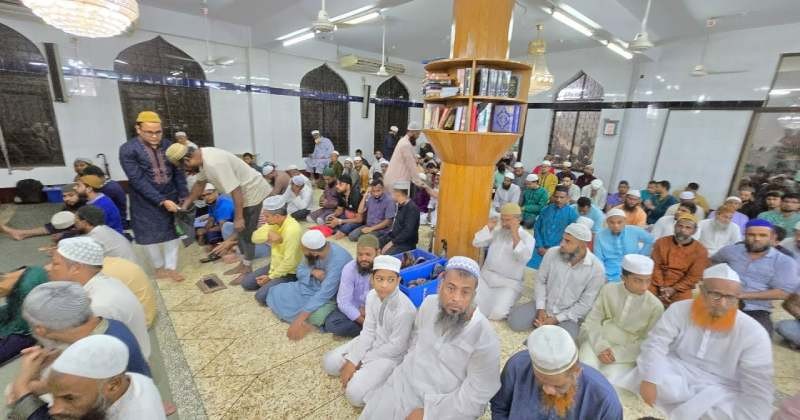
Mufti Abdur Rahim Kasemi, khatib of the historic Baitul Mamur Jame Mosque in Mirpur, spoke in his talk before the Friday sermon today. He said people who set fires, vandalize and destroy public property are enemies of Islam and humanity. In Islam, arson, destroying state property and disturbing public safety are great sins and amount to treason. Those who take part in such terrible crimes are enemies of the state, religion and humanity.
He said Islam has ordered that such people be dealt with firmly. The Prophet Muhammad (PBUH) warned of a terrible punishment in the afterlife for those who spread chaos and carry out sabotage. Islamic Shariah also says they must be stopped wherever they are found. People of all religions and communities must unite to face them, save the country, the nation and humanity from their destructive acts, and bring back a normal atmosphere.
Mr. Kasemi said no Muslim can do such work, because Allah does not like arson and disorder. He said Allah’s curse falls on such people. Allah says in the Holy Quran that He does not like those who create disorder (Surah Baqarah, verse 205). On their punishment, Allah says in another verse that those who fight against Allah and His Messenger and try to spread disorder in the land will be killed, crucified, have their right hand and left foot cut off, or be expelled from the country (Surah Maidah, verse 33).
He also quoted the Prophet (PBUH), who said that fitna (confusion and disorder) is asleep, and Allah’s curse falls on anyone who wakes it up (Kashful Khafa, volume 2, page 327). Mr. Kasemi prayed that Allah gives everyone the strength to stay away from all such criminal acts. Amin.
Mr. Mufti Dr. Morshed Alam Salehi, khatib of Shyamoli Shahi Mosque in Mohammadpur, also spoke today in his talk before the Friday sermon. He said building peace, safety, justice and harmony among people is one of the main goals of Islam. He said Islam is a way of life that builds peace in the individual, the family and society. It also orders people to stop all injustice, oppression, terrorism and lawlessness. Protecting the life, property and honor of people is a basic teaching of Islam.
He said Allah says in the Holy Quran that whoever kills a person, other than for a life or for spreading disorder in the land, it is as if he killed all of humanity. Whoever saves a life, it is as if he saved all of humanity (Surah Al Maidah, verse 32). Allah also says in another verse that people should not spread disorder in the land after peace has been set up (Surah Al Araf, verse 56). This means that creating chaos, violence and unrest in society is condemned in Islam.
Mr. Salehi said the Prophet (PBUH) said a true Muslim is one from whose tongue and hand other Muslims are safe (Sahih Bukhari, Hadith 10, Sahih Muslim, Hadith 40). In another Hadith, he said people should not envy each other, should not hold hatred and should not cut ties. Instead, they should become brothers as servants of Allah (Sahih Bukhari, Hadith 6065, Sahih Muslim, Hadith 2559).
He said that to stop violence and lawlessness, it is important to set up justice, protect the rights of others, avoid rumors and provocation, show patience in disagreements and ensure fair trial of crimes. Taking the law into one’s own hands is never acceptable. He said law enforcement agencies alone cannot build a peaceful society. Families, educational institutions, religious leaders, the media and social groups must all play a responsible role. A humane society free of violence and lawlessness can be built only by following the moral teachings of the Quran and Sunnah.
Mr. Shaikhul Hadith Mufti Foyzullah Jibon Puri, khatib of Baitun Noor Jame Mosque in Mugda North Manda, Dhaka, also spoke today in his talk before the sermon. He said human life needs a complete and flawless ideal to become meaningful, orderly and beneficial. Many thinkers, reformers and philosophers in history tried to guide human life from their own views. But because of human limits, outside influences and the limits of their time, no ideal made by humans could be final for all times and all places.
He said the life and Sunnah of the Prophet Muhammad (PBUH) hold a unique and unmatched place. His life is not limited to religious rituals. It is a living and complete guide to faith, worship, morality, family life, social order, state policy and economy. The Quran gives the main rules and directions for life, and the Prophet’s Sunnah explains those rules in a practical and living way. So taking the Prophet’s ideal as the highest standard is not just a matter of emotion. It rests on clear divine evidence, historical facts and deep reasoning.
Mr. Puri said the Holy Quran clearly orders people to follow the Prophet (PBUH). In Surah Al Ahzab, verse 21, Allah says that in the Messenger of Allah there is an excellent example for those who hope for Allah and the Day of Judgment and remember Allah often. About his highest character, Surah Al Qalam, verse 4, says that he stands on a great moral character. When Hazrat Ayesha (RA) was asked about the Prophet’s character, she said, “Kana khuluquhul Quran,” meaning his character was the Quran. The Prophet (PBUH) was the living picture of every virtue, moral and way of life the Quran teaches. Mr. Puri prayed that Allah gives everyone the strength to put the Prophet’s ideal into practice. Amin.