

Sandbars Disrupt Four Padma River Routes in Faridpur, Rajbari, Madaripur and Shariatpur, Trigger Calls for Urgent Dredging
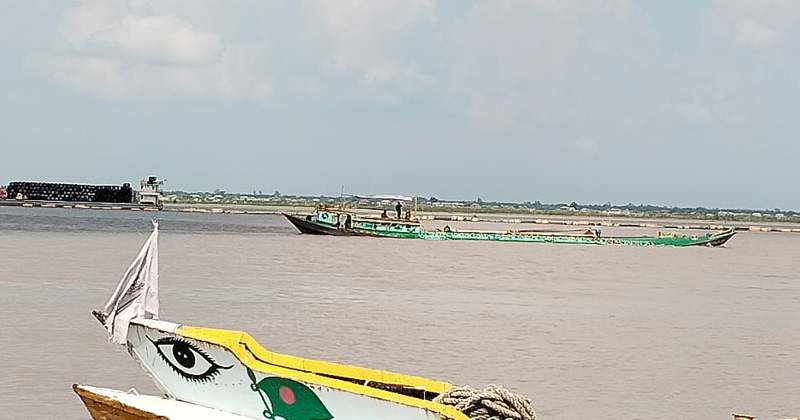
Boat and ship movement along a roughly 76 kilometer stretch of the Padma River has been badly disrupted by sandbars forming across the waterway that connects Faridpur, Rajbari, Madaripur, and Shariatpur districts. Calls are growing louder for the Bangladesh Inland Water Transport Authority, known as BIWTA, to speed up dredging and remove the sand.
Even before the dry season has fully begun, falling water levels have already forced cargo and passenger vessels to move slowly through at least 50 kilometers of the river at several points. This has pushed up both fuel and transport costs. Some dredging work is underway, but those involved in river transport say it is moving far too slowly to solve the problem.
River transport sources say this stretch of the Padma is one of the main routes for river based goods and passenger transport in the southwestern region of the country. The captain of the cargo vessel Jhatka Sharif number 2 said the riverbed has risen with sandbars in recent days, causing the bottoms of boats to get stuck, and in some cases even the propellers hit the sandbars.
The captain of the MV Al Baraka, coming from Chandpur, told Daily Inqilab that silt buildup on the riverbed has made it difficult for vessels drawing a normal draft to pass through. The captain of the MV Rayhan Navy Company, a large vessel arriving from Chittagong, said the sudden and rapid drop in the Padma’s water level has caused ship bottoms to get stuck in the riverbed itself.
As a result, vessels are being forced to take long, winding alternate routes instead of the regular path. Vessel owners say their costs have multiplied several times over due to these detours and the extra time required. Many ship masters say the fast drop in the Padma’s water level has forced them to take far longer routes.
They say fuel waste has increased by about fifty percent, and fuel prices are rising at the same time. They add that extra diesel is being spent both because vessels cannot travel in a straight line and because of the effort needed to free vessels stuck on sandbars.
Reduced river depth has also cut vessel capacity sharply. Ships now often travel at half their normal load or less, which owners say threatens to seriously damage the transport sector. Missed delivery schedules are causing perishable goods to spoil, leading to financial losses for traders.
Keeping this 76 kilometer stretch of the Padma navigable is now seen as an urgent responsibility for BIWTA. Boat operators, traders, and vessel owners say the current slow pace of dredging cannot solve the navigability crisis. They are calling on BIWTA to deploy modern dredgers quickly and intensify excavation work, and to move beyond temporary sand removal toward a sustainable river training project that keeps the river’s course stable.
They warn that without immediate and effective action, river communication across these four southwestern districts could collapse entirely, directly affecting the region’s overall economy.
During an on site visit to the Faridpur river port ghat area on Saturday, September 26, sub lease holder Mr. Mujibur Mia said that at the current rate of water loss in the Padma, a large sand hill will likely appear at the port within a month, which would leave at least three to four hundred vessel owners without work.
Mr. Shaheen Mia, a labor supervisor at the river port, said hard times are approaching for the porters and laborers there. He said that if the ghat becomes inoperable, at least a thousand family members connected to around three hundred porters will be forced into a life of severe hardship.
Officials connected to BIWTA’s dredging operations said some dredging work is continuing at both the upper and lower sections of the CNB ghat in order to keep the port functional.
Meanwhile, shopkeepers Rahman and Robin, along with fisherman Enayet, from the Goldangi Bridge area, said that although government money is being spent on fuel for dredging, the work brings little benefit to the state while benefiting those who illegally extract Padma’s sand and soil. They explained that even though the sand removal is funded publicly, the extracted sand ends up in storage yards owned by locally influential individuals. They said it is because of these sand looters that at least four wards in the North Channel and Dikrichar unions of Faridpur Sadar upazila have lost about ten lakh acres of farmland and nearly a thousand homes to river erosion.