Bangladesh to Add 3,000 MW of Solar Power to National Grid by Next Year on Prime Minister’s Directive
Solar Power Offers Hope for Barishal and the Western Zone In Bangladesh
Energy experts expect a range of government and private-sector initiatives to produce positive results in expanding renewable energy in the western region, including Barishal, as Bangladesh seeks to overcome its ongoing power crisis under the prime minister’s directive. Solar power is already beginning to benefit not only agriculture but also industry, business and the broader socioeconomic system.
The Power Division has undertaken intensive measures to add at least 3,000 megawatts of solar power to the national grid by next year. The government is also working to source at least 10 per cent of the current peak-hour demand of around 2,200 MW served by the Western Zone Power Distribution Company (WZPDCL) and rural electricity cooperatives from solar and other renewable energy sources within the current fiscal year, according to responsible sources at the Power Division and WZPDCL.
The government is treating the issue as a high priority and has taken various initiatives in both the public and private sectors. As a result, 25 MW of solar power generated by 555 public and private establishments in the western zone has already been connected to the national grid for use during peak hours.
On September 1, a notice was issued announcing that the government would purchase electricity generated by privately installed rooftop solar systems in Barishal and other parts of the western region at Tk 10.50 per unit. This will allow individuals and organisations to sell solar power alongside purchasing electricity from the Bangladesh Power Development Board (PDB) or distribution companies, offsetting the cost of their own electricity consumption and gaining direct financial benefits.
Prime Minister Tarique Rahman has already called for greater focus on renewable energy and reducing the use of fossil fuels. In line with this directive, the Power Division has begun working to purchase solar electricity from any individual or organisation generating it at Tk 10.50 per unit.
Bangladesh currently has an installed power generation capacity of around 29,000 MW, while peak summer demand exceeds 18,000 MW. Although approximately 2,000 MW of electricity is already generated from renewable sources through on-grid and off-grid solar systems, it still accounts for a very small share of total power generation.
According to the Power Division, if the current pace of economic growth and industrialisation continues, electricity demand could rise by an average of 6 per cent annually, reaching 25,000–30,000 MW by 2030.
However, heavy dependence on imported fossil fuels for power generation is placing long-term pressure on the economy, the environment and energy security. Experts also believe that volatility in global energy markets, supply risks and the effects of climate change are making the future of the power and energy sector increasingly uncertain. They say there is no alternative to making the power generation system more efficient, sustainable and diversified to meet future demand.
Taking these factors into account, the government has set a target of sourcing at least 20 per cent of total electricity generation from renewable energy and connecting it to the national grid by 2030. By 2035, renewable energy is expected to meet at least 35 per cent of demand. The government has also pledged, in line with its election manifesto, to gradually reduce dependence on fossil fuels and build a green, sustainable energy-based economy.
Based on assessments of feasibility and practical potential, the country’s renewable energy targets include 5,500 MW of rooftop solar power, 4,500 MW of ground-mounted solar power and 450–500 MW from wind, waste, hydropower, floating solar and agrivoltaics.
Given Bangladesh’s limited land availability and high population density, rooftop solar power has been given the highest priority in expanding renewable energy. Interest in installing rooftop solar systems in both the public and private sectors is also growing following the recent expansion of net metering.
Under the net metering system, private investors can install solar systems and sell surplus electricity to distribution companies at the government-set rate of Tk 10.50 per unit.
Meanwhile, following the prime minister’s recent directive, the government has launched a green financing programme offering loans at an interest rate of just 5 per cent to develop renewable energy systems for various purposes, including solar-powered pumps for agriculture.
The global fossil fuel crisis is increasingly affecting Bangladesh as well. Rising carbon emissions from fossil fuels are also increasing environmental risks. Meanwhile, inadequate electricity supplies are intensifying difficulties in agriculture, industry, business and other socioeconomic sectors.
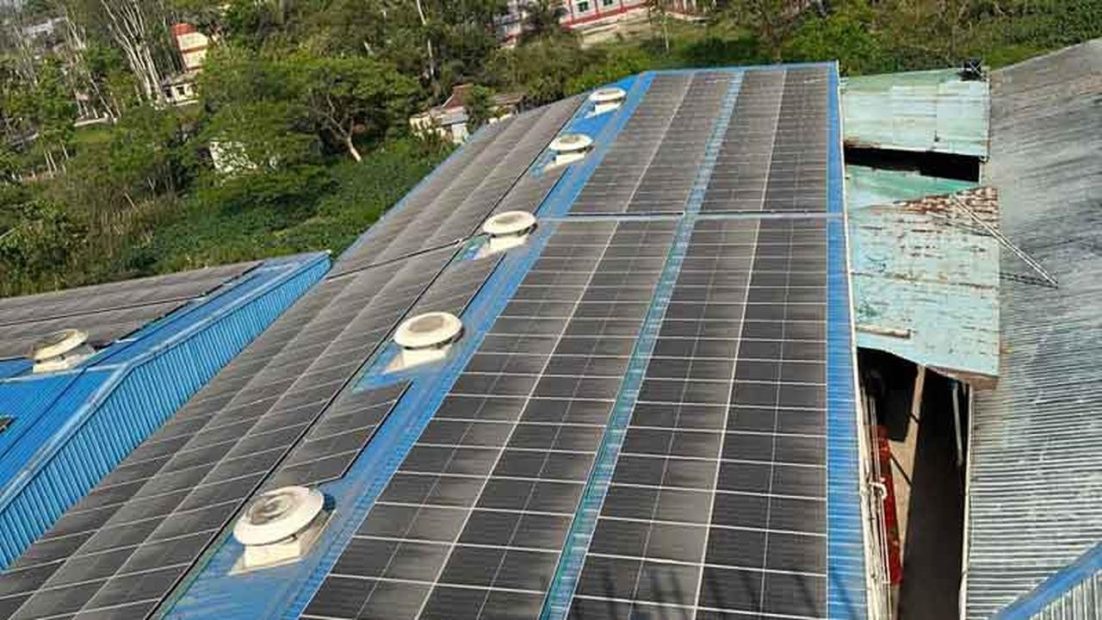
To address the situation, special emphasis is being placed on solar power generation across the country, including Barishal and the western power zone. In Barishal, an industrial establishment called Padma Blowing, part of the Apsonin Group, has installed a rooftop solar system with a capacity of around 6.5 MW and is supplying electricity to the national grid during off-peak hours.
Work has also begun to appoint private-sector service providers with the aim of connecting 3,000 MW of rooftop solar capacity to the national grid in the region by next February. According to reports, 1,011 organisations have already applied to be listed as service providers, and their applications are being evaluated.
WZPDCL has also begun work to install rooftop solar systems at its own facilities. In addition, work is underway to install 1.748 MW-peak solar systems on the rooftops of district and divisional administration offices across the region.
WZPDCL is also holding discussions to install solar systems with a combined capacity of around 18 MW-peak on vacant land and rooftops belonging to other organisations.
Meanwhile, plans to generate 23.35 MW of solar power at five more establishments are under process. Recently, agreements were signed to install rooftop solar systems with capacities of 1.78 MW at Khulna Shipyard and 1.39 MW at Petromax Limited.
A feasibility study has also been completed for installing a 15 MW solar system on land owned by WZPDCL, the power distribution company serving the western region.