South Asia’s Politics of the Streets, State and Hegemony
Dr. Md. Abu Hasan
In an article titled “Why do young people keep taking to the streets”, published earlier in Daily Inqilab, I asked a question. The reasons for protest differ across South Asian countries, so why are the results so alike? There I tried to explain how job insecurity, slow institutions and the loss of young people’s precious time turn scattered anger into political resistance. I also brought in the idea of the “Seven Sided Iron Structure” to show how different centres of power feed each other. Now the question needs one more step. What does the state do after young people come to the streets?
Does the state listen to the complaints and fix its policies and institutions, or does it treat the whole event as a problem of control? A bigger question is this. When a movement brings new leaders to power, how much does the old system change in character? If administrative control, political patronage, concentration of wealth and control over information stay untouched, even new leaders can fall into the old trap.
In May 2026, a remark by India’s Chief Justice Mr. Surya Kant caused a debate, and the name “Cockroach Janata Party” became known. Later he made it clear that his criticism did not target all jobless young people. He said he used the words “cockroach” and “parasite” about people with fake certificates. Even before that, the youth movement had turned the insulting label into a symbol of mockery and protest. Bangladesh’s quota movement of 2024 also had a turn like this.
When the then fascist Prime Minister Ms. Sheikh Hasina called protesters “children of Razakars”, young people took to the streets of Dhaka at night. They chanted, “Who am I, who are you? Razakar, Razakar! Who said it, who said it? Autocrat, autocrat!” The label meant to put protesters down became a political language of protest. The language of contempt used by the powerful sometimes becomes a weapon of protest in the hands of the people under attack.
The first big test for the Cockroach movement came in July. Claims of paper leaks and irregularities in India’s 2026 medical entrance exam left the future of about 2 million candidates unsure. The movement grew strong, with demands for accountability, including the resignation of Education Minister Mr. Dharmendra Pradhan. After several weeks of protests, hunger strikes and political pressure, the Education Minister had to resign in July. This was a big success for the movement. A youth movement that began with a mocking label built organised pressure and forced a Union Minister to step down.
But one minister’s exit does not end corruption in the exam system. Without trials for the paper leak, clear exam management and real steps to stop future irregularities, this win stays incomplete.
In October, young people in India came back to the streets, this time over the role of the Election Commission. Reports said about 130 million names were dropped from voter lists in various states in the name of revising them. The Election Commission says the dropped names include dead people, people who moved away and people it could not find. Opposition parties and protesters charge that this process is also removing valid voters. Earlier this month, YouTuber Mr. Dhruv Rathee and actor Mr. Prakash Raj joined a protest in Bengaluru, where slogans mixed political charges with the language of mockery.
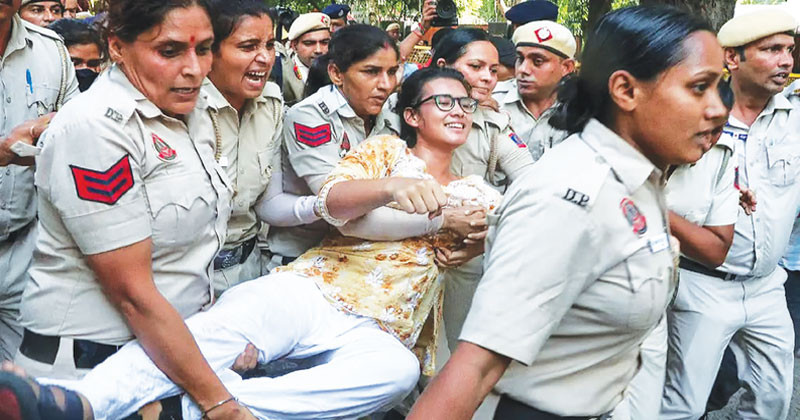
A few days later, police in Delhi detained more than 7,000 people to stop a protest. Barricades went up in many areas, metro services faced disruption, and authorities limited internet service. Mr. Dhruv Rathee was released that night, and three leaders of the movement were released the next day. After that, protests and detentions went on for several days in a row.
In Bangladesh’s July uprising, a student movement that began over government job quotas turned into a large political resistance within a few weeks. A 2025 report from the United Nations human rights office says about 1,400 people died between July 1 and August 15, 2024. It also found serious facts about deadly force by security forces, arbitrary detention and torture. In Nepal too, the government fell in 2025 after state force and deaths in a youth movement. In the next election, Mr. Balendra Shah’s Rastriya Swatantra Party won 182 seats in the 275 seat parliament.
It would be wrong to conclude from these two countries that police killings bring success to a movement. Deaths raise anger, widen the base of a movement and weaken a government’s legitimacy. But the fall of a ruler also depends on long standing discontent, political isolation, the organised strength of the movement and the breakdown of the ruler’s ability to hold power. Repression sometimes shows the strength of a state and sometimes signals its crisis of legitimacy. When force unites anger instead of removing fear, it backfires.
New leaders do not automatically remove the old ways of using power. In April 2026, Nepal removed Labour Minister Mr. Deepak Kumar Sah. The charge was that he used his post to keep his wife as a member of the health insurance board. This is an example of accountability, and it also reminds us that the risk of old habits of power remains among young leaders too.
In Bangladesh, several organisers of the movement joined the interim government, and a debate about their role came up later. The lesson is clear. The moral strength of a movement does not guarantee the ability to run a government or to bring structural reform.
India’s experience raises another hard question. People are unhappy about unemployment, the cost of living, inequality and the concentration of wealth. So how does the BJP keep its political support? The BJP’s base rests on religious nationalism, welfare programmes, a strong party organisation, a story of national security, Mr. Narendra Modi’s personality centred image and the weakness of the opposition. Chatham House analysis says local livelihoods and economic worries played a big role in the 2024 election. It also says the Hindutva story did not get the same response in every region and community.
In that election, the BJP won 240 seats and lost its single party majority. It formed the government with the help of its allies. Still, the Hindutva story stays politically strong, because it can turn people’s economic anger in another direction. When questions come up about wealth inequality or the quality of public services, leaders can shift the talk to religious identity or a supposed enemy. This hides the questions about powerful business groups.
The debate over political closeness and special favours around the Adani Group, the bribery charges filed in the United States and the group’s denial of those charges have raised questions about the link between corporations and the state. Critics of one sided, pro government coverage by channels like Republic TV are part of India’s debate on media freedom. Freedom House’s 2026 assessment also raised worries about pressure on journalists, civil groups and critics of the government. It also noted rising discrimination against Muslims.
This discrimination does not stay only in election stories. It shows up in daily life too. In the Jyotinagar colony in Chitpur, Kolkata, five public water taps have been shut since late July 2026. About 5,000 residents now face regular water shortages. Most residents of the area are Muslim. In an Alt News report from September 12, residents charged that the water was cut to build pressure for their eviction. Locals call this the “Karbala of water”.
When people claim they are denied basic civic services, and when that is tied to religious identity and fear of eviction, it raises questions of civic equality.
In this setting, a comparison with Bangladesh’s fascist Hasina era can naturally come up. There are similarities in the concentration of power, intolerance of opponents, influence over information and media, and questions about the neutrality of institutions. But there are clear differences too in electoral competition and institutional reality. Here Mr. Gramsci’s idea of hegemony becomes useful. Rulers win acceptance for their leadership when they can present their own interest as the wider interest of society and shape people’s common sense and cultural life.
When consent grows weak, rulers lean more on administrative barriers, surveillance and force. In a modern state, consent and coercion run side by side. The real question is how much acceptance power can build and how it responds to opposition (Gramsci, 1971). Mr. Weber’s idea of legitimate authority also reminds us of something. Having legal power is not the same as citizens seeing that power as fair.
Looking at these experiences together, the question of the “Seven Sided Iron Structure” returns. Its seven areas are political and family authority, bureaucratic control, the economic power of influential business groups, institutions that work for the privileged, influence over information and public opinion, foreign backing, and informal use of force. These areas are not equally active in every country or period. But some of them strengthen each other. So even when a leader or a government leaves, powerful groups find new ways to keep real power.
The research of Mr. Acemoglu and Mr. Robinson (2008) studies how elite groups try to keep real power after a formal change in political power. So electing new leaders is not enough. The country also needs inclusive institutions, clear hiring and public procurement, an effective justice system, a free media, job oriented education, social protection and guaranteed civil rights.
Here the political economy of time also returns. In Bangladesh in 2024, the unemployment rate among graduates was 13.5 percent. About 20.3 percent of people aged 15 to 29 were outside education, jobs or training. Anger over high inflation, inequality in income and wealth, money laundering and charges of irregularities in the banking sector added to this. Together, these raised young people’s uncertainty about their future.
According to the “tunnel effect” of Mr. Hirschman and Mr. Rothschild (1973), another person’s progress first raises hope for one’s own improvement. But if one’s own condition does not change after a long wait, that hope turns into anger. Many young people in South Asia have had this experience. Years of preparation, waiting for jobs or protesting for fair treatment do not only cause economic loss. They also take away precious time in life. When this waiting joins with discrimination and distrust in institutions, personal frustration turns into political discontent.
Sri Lanka’s mass resistance in 2022 showed how fast an economic crisis can break consent for a ruler. Anger against the Rajapaksa family built up amid shortages of fuel, food and daily necessities and a rising cost of living. In the next election, the win of the National People’s Power alliance showed a big break in support for the old political elite. But the World Bank’s October 2026 assessment shows a gap. The economy has returned to its output level from before the crisis, yet the poverty rate in 2025 was an estimated 16.9 percent. This means the benefits of recovery have not reached everyone equally.
Pakistan’s experience is different. There are regular elections and rival parties, yet the long lasting influence of the military establishment keeps the authority of civilian governments limited. Freedom House’s 2026 assessment also speaks of the military’s wide influence over elections, government formation and policy making. This experience shows that power built on control does not stay only inside elected governments. Institutions outside elections can also shape political decisions.
So can the Cockroaches do it? The success in July showed that when mockery and popularity on social media turn into an organised movement, they can shape the decisions of those in power. The October protest showed that the movement can return to the streets on a new issue. But lasting change needs more. It needs a clear programme on jobs, the cost of living, election transparency and civil rights. It needs a wider alliance that goes beyond divisions of religion, race and class. It also needs accountability for the movement’s own leaders.
A win on the streets only opens the door to power. Walking through that door and changing the rules of power is a separate fight. A government can change, but if institutions, interests and power relations do not change, old habits return in a new form. A state that fears the voice of its citizens has to depend on control. A state that takes citizens’ criticism as a chance to fix its own mistakes can build a base of consent.
So the question before young people in South Asia is this. Can new leaders build institutions that give back lost time, wasted chances and broken trust? And will those who stand against control today allow themselves to face accountability when they reach power tomorrow?
Author: Associate Professor, Shaheed Buddhijibi Government College, Rajshahi