Terminal parking on roads: Disorder swallows the benefits of development in Chittagong
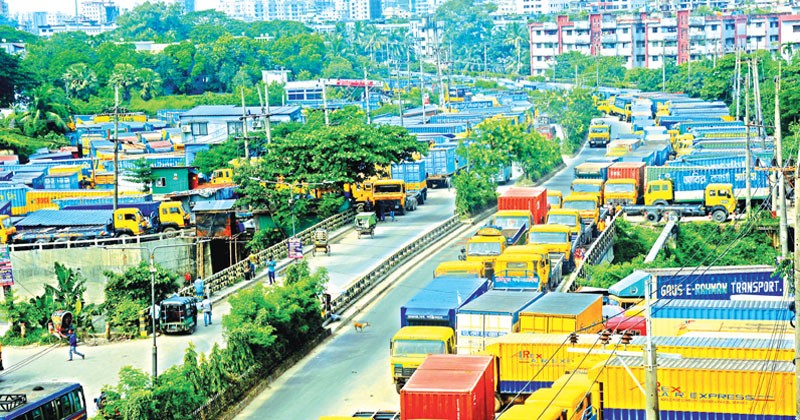
Port Connecting Road in Chittagong was widened at a cost of about Tk 150 crore. From Bandar Nimtala to Borpol, hundreds of trucks, covered vans and lorries stand parked on both sides. It does not look like a road. It looks like a terminal for heavy vehicles. Vehicles move slowly through the narrow empty strip in the middle.
The road, known as the “lifeline of the economy,” has come to a standstill. It links Chittagong Port with the Dhaka Chittagong highway through City Gate. Every day, 12 to 15 thousand vehicles use it, and 80 percent of them are heavy vehicles carrying import and export goods. Two ramps of the elevated expressway at Nimtala have opened. Because of illegal parking all along the road, vehicles heading to the expressway also get stuck. So the widening of the road gives no benefit.
Like this road, most roads in the city have been taken over. Illegal parking in some places and shops or business use in others have turned roads into disorderly terminals for buses, tempos and trucks. Thousands of crores of taka are spent on road development, but people get no benefit. In the last one and a half decades, Tk 17,500 crore was spent on widening and developing city roads. Chittagong Development Authority (CDA) spent Tk 12,358 crore on 24 projects. Chittagong City Corporation (CCC) spent Tk 4,974 crore on 15 projects. The city now has 1,442 km of roads. A CDA survey says part of 97 percent of the roads is occupied.
This occupation slows down traffic. Because of Chittagong Port, almost every road in the city sees heavy jams day and night. This hurts import and export work. Heavy jams happen in other areas too. Even after big development, the city is not free from jams. A research report by the National Bureau of Economic Research of the United States says Chittagong ranks 12th in the list of the world’s 20 slowest cities. This does not suit the country’s main port city and commercial capital at all.
Recently, the city corporation ran regular eviction drives in busy areas and cleared roads and footpaths of hawkers. It also removed illegal structures from some roads. Order has returned to these areas, and people move with ease. But the unannounced terminals built by taking over roads were not removed. Parking along the roads has not stopped. So these roads have no order, and vehicles get stuck in jams.
On the main road from Katgarh to Patenga, there are several private container depots on both sides. Hundreds of heavy vehicles are parked on the main road around these depots. The airport road is the same. Near the Boat Club, opposite Shah Amanat Airport, vehicles crowd the road around a private depot. Vehicles of the Patenga Terminal of Chittagong Port are also kept on the road. From Katgarh to GM Plant gate, city service buses and minibuses are parked on both sides. The city has no terminal for them.
On the main road from Chittagong EPZ to Saltgola Crossing, part of the road is like a terminal. To enter the NCT and CCT terminals of Chittagong Port, hundreds of lorries, trailers and covered vans line up over a big part of the road. The rest of the road suffers heavy jams. The jam is so bad that a five minute trip takes one and a half to two hours. At times the jam stretches toward the airport through EPZ, Bandartila and Cement Crossing, up to the Steel Mill. In the other direction, it stretches through the port and Fakirhat, up to Agrabad.
Looking at Chittagong Port Toll Road, one cannot tell if it is a road or a terminal. Hundreds of heavy vehicles are parked there. Hundreds of vehicles crowd the whole road around Ichak’s depot. In some parts, broken down trucks and covered vans lie abandoned. This blocks traffic. Both sides of the nearly one km long flyover next to the toll road also have illegal parking.
Patenga City Outer Ring Road is not spared from illegal parking. Vehicles heading to private depots in Patenga park on that road. On Majhirghat Road, covered vans take over one side from Kadamtali to Barik Building. Near Barik Building, long scrap carrying trucks of KSRM are parked, taking over the road.
On the same road, from Dewanhat to Agrabad Chowmuhani, there are auto parts shops on both sides. Rows of cars are parked in front of the shops. Workers fit car parts and repair cars on the road. Jam on that part is now an everyday thing. A market sits on Agrabad Access Road. In several places, building materials occupy the road. Sagorika and Ongkolkar bus terminals are on Port Connecting Road. Long distance bus counters stand beside Station Road and some other roads, and buses are parked on the road in front of them.
Fruit traders occupy the footpath and part of the road near Sholoshahar Gate 2. Hawkers occupy the stretch from Bahaddarhat Mosque to Water Development Board. Iron pipe business runs on the footpath of Dhaka Trunk Road. Iron tools lie scattered on the footpath from Shubhapur Bus Stand to Barik Building Mor.
At Agrabad Badamtali, a market for shoes, shirts, pants and other goods, known as “Bank Market,” has grown fully over the footpath and road. Almost every road in the city has a raw market. There are also tempo and taxi stands. These block normal traffic and cause suffering for the public. Fruit and dry fish shopkeepers hold the Karnaphuli Bridge area. Brick and sand business runs on the footpath at Chawkbazar. Fruit traders hold the footpath at the old railway station.
The country’s second largest metropolis has no central bus terminal. No terminal has been built for city service buses either. Five to six thousand heavy vehicles come and go every day at Chittagong Port with import and export goods. Thousands of heavy vehicles come to the private depots built around the port in Patenga and Halishahar. There are not enough terminals near the port for so many vehicles. So these vehicles are forced to park on roads. Depots are built beside roads and do not have enough space for vehicles, so vehicles park on the road. Heavy vehicles also park on the Bayezid Fouzdarhat Link Road.
Urban expert Engineer Mr. Subhash Barua said unplanned development denies city people the benefit of development. He said order must come to the city to get the benefit. For this, enough terminals must be built in the port area. Bus terminals built on roads must move out of the city. Markets on roads must be removed. City service public transport must be brought to order. Passengers getting on and off anywhere must stop.
CDA Chairman Engineer Mr. Belayet Hossain said the new master plan being made by CDA includes plans to build a central bus terminal and a truck terminal. He hoped that in the coming days there will be no room to do anything unplanned.