The Armed Forces Need a Talented Young Generation
I was commissioned as a second lieutenant in the Bangladesh Army on November 5, 1982. Every year, this date reminds me not only of the beginning of my military career but also of the people, values and sacrifices that helped shape me. First and foremost, I remember my parents, especially my mother. Her last wish was to see me join the Armed Forces of Bangladesh.
In November 1980, I took part in the four-day assessment process of the Inter Services Selection Board (ISSB). At the time, my seriously ill mother was admitted to Dhaka Medical College Hospital. When I returned after the examination and informed her that I had been selected, she was overjoyed. She had repeatedly encouraged me to join the Army. Unfortunately, she passed away on November 23, 1980, before I received my commission.
Her five sons later served in the Army, Navy and Air Force. Four of her grandsons are also currently serving in the Army. In this way, her personal wish became a family tradition of serving the country.
On February 2, 1981, I joined the Bangladesh Military Academy (BMA) as a cadet of the Seventh Bangladesh Military Academy Long Course. Having lost my mother shortly before joining the academy, I found the initial days in the new environment particularly difficult. Military training was demanding, and adjusting to a new way of life required considerable effort. However, the sincere friendship and brotherhood of some of my close coursemates helped me overcome that difficult period. Some of them are no longer with us, but their kindness and support remain unforgettable.
A total of 80 cadets, including some from the previous course, eventually received their commissions as officers. Our passing-out parade was held on November 4, 1982, and we were commissioned the following day.
Looking back, I realise that the BMA did much more than prepare us for military duties. It played a vital role in developing our character, discipline, patience, leadership skills and sense of responsibility. These qualities, acquired through military training, remain valuable assets throughout a person’s life.
Our term commander, platoon commander and other instructors repeatedly taught us a lesson that continues to guide me at every stage of life: “You are what you are in the dark.”
The meaning of this statement is profound. A person’s true character is not demonstrated simply by doing the right thing when a senior officer is watching. Honesty, sincerity, discipline and professional responsibility must remain intact even when no one is supervising. A trained military officer must perform duties with equal dedication, whether under supervision or not.
The true value of training lies in our ability to maintain our standards and principles even when no one is watching. This is not only a lesson for military life but also a fundamental principle of responsible citizenship and leadership.
The BMA’s motto is “Chiro Unnata Mama Shir” (Ever High Is My Head). Inspired by the spirit of the poetry of national poet Kazi Nazrul Islam, the motto represents courage, dignity and the determination to stand tall in the face of adversity.
The academy’s integrated system of military and academic education, physical training, field exercises and leadership development plays an important role in preparing future military officers. It teaches cadets to lead by example, work as a team, accept responsibility, respect others and remain steadfast under pressure. The BMA is not merely an institution for training military officers; it is also an important centre for developing future leaders.
My first posting was with the 6 East Bengal Regiment in Guimara, in the Chittagong Hill Tracts. My military career began with an SMG and live ammunition in my hands. I still remember that moment when I first took up my responsibilities as an infantry officer.
Over the following years, I served in various operational, training, intelligence, staff and command positions. I had the opportunity to serve in four infantry battalions and three Bangladesh Rifles battalions. The Bangladesh Rifles (BDR) is now known as Border Guard Bangladesh (BGB). I was also involved in establishing the 24th Bangladesh Infantry Regiment and served as its first commanding officer.
My time in the Chittagong Hill Tracts was particularly significant. I spent more than six and a half years there in various operational roles, including camp and sub-zone command, intelligence duties and command of the Ruma and Jaminipara zones. I was also involved in border demarcation work in the remote areas along the Mizoram border.
These responsibilities taught me that military leadership is not simply about the ability to command. It requires sound judgement, patience, courage, compassion and a proper understanding of the people among whom we serve. A good officer must know how to lead, but more importantly, must understand how to serve people.
I also had several opportunities to serve at Army Headquarters, particularly in the Directorate of Military Training. In addition, I worked with various intelligence agencies and served as an Instructor Class A at the School of Military Intelligence.
My professional career also gave me the opportunity to serve in United Nations peacekeeping missions in Mozambique and Liberia. Alongside my duties as a military observer, I served as a team leader and deputy sector commander. I also gained experience through overseas training and international assignments.
One such important experience was serving as an official interpreter during the Bangladesh Prime Minister’s visit to China in 2002. These experiences broadened my understanding of leadership, international cooperation and the responsibility of representing Bangladesh abroad.
I retired from the Army on February 1, 2008. However, retirement never meant the end of my commitment to service. Since then, I have devoted considerable time to language education and promoting people-to-people relations.
Through the language academy I established, I have provided opportunities for more than 3,500 students to learn Chinese. Several hundred others have also studied English and Bangla there. I mention these figures not to highlight personal achievements but to make one point: the values and qualities developed during military service can continue to benefit society many years after leaving the uniform.
Once a soldier, always a soldier. To me, this means that a rank or formal responsibility may end with retirement, but honesty, discipline, a sense of duty and commitment to serving the country should never end. Even without wearing the uniform, we must keep the values it represents alive through our everyday conduct.
The true test of military training is not only how an officer performs while wearing the uniform but also how that person conducts life after taking it off. The aim of military training should not be limited to producing competent officers. It should also develop responsible individuals who can make positive contributions to society throughout their lives.
One thought has been a personal source of motivation throughout my military career: “There are rewards that money and privileges cannot buy.”
Military life involves challenges, sacrifices and difficult realities. People should not choose this profession solely for its salary, status or benefits. Its deeper rewards include the honour of serving the motherland, the confidence gained through rigorous training, lifelong friendships and bonds of solidarity, opportunities to lead and the satisfaction of contributing to a cause greater than oneself.
Military life also offers regular opportunities for training, education and personal and professional development. It builds qualities that remain useful throughout life. These are rewards that money alone cannot buy.
Why should more talented and qualified young men and women in Bangladesh consider joining the Armed Forces today?
Bangladesh is making economic progress and has enormous potential ahead. Its geopolitical position at the crossroads of South and Southeast Asia, along the Bay of Bengal, is highly significant. Protecting the country’s growing economy, maritime interests, international connectivity and national sovereignty requires a strong, modern and professionally capable Armed Forces.
A strong military cannot be built through weapons and equipment alone. It requires educated, physically fit and professionally skilled personnel with strong moral values who can lead with honesty and dedication.
The global security environment is also changing rapidly. Modern armed forces need capable leaders with a sound understanding of military technology, cybersecurity, artificial intelligence, maritime security, aviation, engineering, international relations and modern warfare.
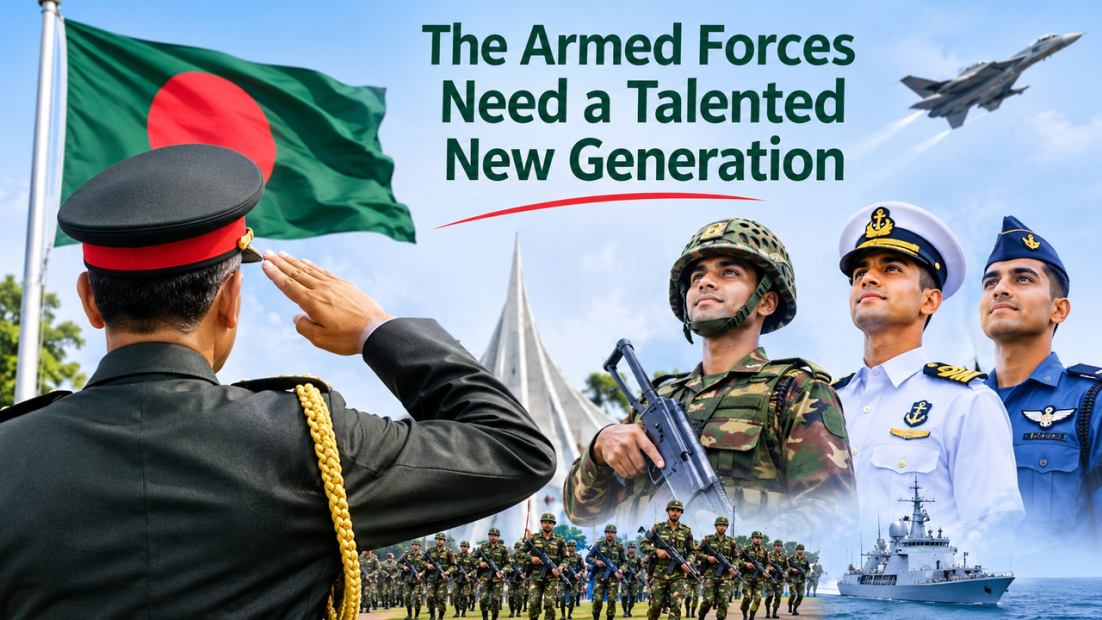
The Army, Navy and Air Force offer equally respected career opportunities for young people with different talents, skills and professional interests. Their responsibilities are not limited to conventional defence. They also play important roles in disaster response, humanitarian assistance, international peacekeeping and national development when required.
I therefore urge talented and qualified young men and women in Bangladesh to seriously consider building their careers in the Armed Forces. However, they must understand that military life demands discipline, physical and mental strength, honesty, loyalty to the Constitution and an unwavering commitment to Bangladesh.
They must be prepared to place duty above personal comfort and national interests above personal gain. We do not simply need more people wearing uniforms; we need more capable people in uniform—individuals who are educated, honest, courageous, compassionate, technologically aware and able to lead by example through their work.
The country must attract and develop such talented young people through quality professional training, equal opportunities, merit-based leadership and institutional excellence.
I remain deeply grateful to my parents, BMA term commanders, platoon commanders, instructors, senior commanders, colleagues and coursemates who contributed to my journey. I am also grateful to the Bangladesh Army and the Armed Forces of Bangladesh for providing me with countless opportunities to learn, serve and develop myself.
On the anniversary of my commissioning, my message to the younger generation is simple: Choose a life that gives you purpose, builds your character and allows you to make a meaningful contribution to the country.
If you have the ability, courage and commitment, consider wearing the military uniform with pride. Military service is a special honour, a lifelong responsibility and a source of pride whose value cannot be measured in money or material benefits.
In conclusion, the greatest contribution of military training is not merely producing officers who can lead soldiers. It is about developing individuals who understand the true meaning of discipline, honesty, courage, responsibility and service. These qualities are essential not only for the Armed Forces but also for society as a whole.
Writer: Adjunct Professor at the Institute of Professional Language, Bangladesh Maritime University, and a former infantry officer of the Bangladesh Army.
Email: shahadatb@gmail.com