Tk 1.5 Crore Embankment in Barguna Collapses Within Six Weeks
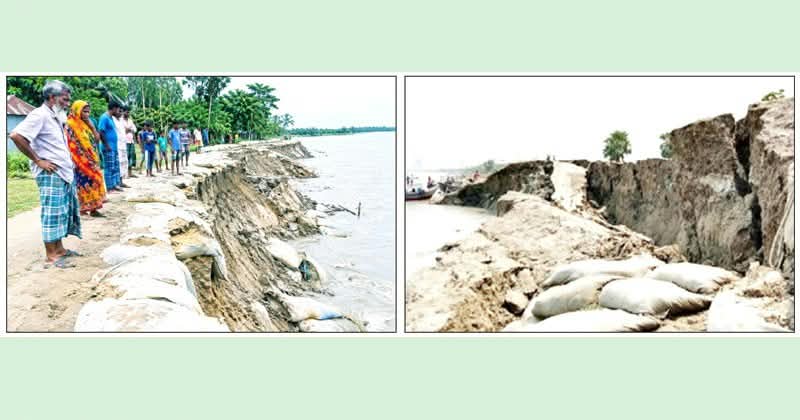
An embankment and sand-filled geotextile bags built at a cost of nearly Tk 1.5 crore along the Payra River in Barguna have begun collapsing less than six weeks after completion, leaving residents of at least 15 villages in Taltali upazila at imminent risk of flooding. Large cracks have appeared along the flood control structure while sections of soil and geotextile bags are rapidly slipping into the riverbed. Meanwhile, residents across several river-ringed villages in Naltuna union of Barguna Sadar upazila continue to live in constant fear because the river has not permanently rebuilt an embankment swallowed decades ago.
Coastal communities in Barguna frequently endure sleepless nights whenever news of a Bay of Bengal depression or cyclone emerges, haunted by memories of catastrophic storm surges like Cyclone Sidr. That long-standing dread is now becoming a harsh reality in the Tetulbaria-Nalbuniya area of Nishanbaria union under Taltali upazila. Implemented by four contracting firms under the Bangladesh Water Development Board (BWDB) across five packages worth Tk 1 crore 47 lakh 74 thousand, the project aimed to repair 590 meters of embankment and dump protective geotextile bags by September, yet its structural durability has failed almost immediately.
Field observations reveal that roughly 300 meters of the newly repaired embankment and its geotextile bags are already caving into the Payra River. In comparison, severe cracks span another 200 meters of the structure. In several spots, outer soil layers have washed away, exposing the embankment’s vulnerable inner core and raising alarm that upcoming high tides or storm surges could trigger a catastrophic breach. If the defense gives way, homesteads, Aman paddy fields, agricultural lands, fish enclosures, safe drinking water sources, and local transport networks across Tetulbaria, Baro Ankujan, Nalbuniya, and Agapara could be completely inundated.
Local inhabitants allege that the rapid deterioration stems directly from substandard construction materials and poorly filled geotextile bags. Expressing frustration over the project’s execution, resident Rafiqul Islam stated, ‘We had objections about the quality of work from the very start of the embankment’s construction. We saw soil being cut from the riverbank to build the embankment. Now, within a short time, cracks have appeared in the embankment, and geotextile bags are going into the river. If tidal water rises, it will be hard to save our homes.’
Echoing this anxiety, nearby resident Amena Begum highlighted the severe threat to family survival and local agriculture if the weakened barrier fails. She remarked, ‘Our family homestead and cropland are close to the river. If the embankment breaks, not only our houses, but paddy fields and fish enclosures will also go underwater. We want a permanent embankment. We do not want to live in fear every year.’ Her concerns reflect a widespread demand among vulnerable coastal families for lasting infrastructure rather than fragile, short-term patchwork that crumbles before the first major seasonal storm arrives.
Meanwhile, a parallel crisis grips the riverside settlements of Naltuna union in Barguna Sadar upazila, where villagers in Azgarkathi, Majherchar, Jintala, Padma, Ruhitar, Paler Baliatali, and Agapadma panic at every weather warning. Because a major section of their protective embankment vanished into the river decades ago without permanent replacement, normal high tides pose daily threats, and many Azgarkathi families have already lost their homes. Local social worker Salim Shahnewaz noted, ‘We want not just temporary repairs, but a durable embankment built considering the river’s behavior and local realities, along with effective riverbank protection in erosion-prone areas.’
The swift collapse of a Tk 1.5 crore project has sparked serious questions regarding how construction quality was verified before contractor bills were disbursed and how officials will be held accountable for public funds. Responding to these concerns, Barguna BWDB Executive Engineer Md. Abdul Hannan Prodhan explained, ‘When work on that embankment in Taltali was underway, the river was far from the embankment. Later, as erosion began on the riverbed, it became difficult to manage the situation with geotextile bags.’ He added that proposals for CC block protection in Taltali and urgent embankment work in Naltuna await higher approval.
Ultimately, coastal residents emphasize that they do not want post-disaster relief handouts or recurring temporary fixes, but rather reliable preventive defenses built ahead of natural calamities. Immediate emergency repairs to the failing sections in Taltali, paired with thorough technical and financial audits of the recently completed project, have become urgent public demands. Unless authorities ensure strict accountability and construct durable, scientifically planned embankments in both Taltali and Naltuna, spending crores of taka in public money will fail to free Barguna’s river-erosion victims from perennial danger.