The fall of Modi’s Hindutva rule is inevitable
Jamal Uddin Bari
Over the past two decades, a shared fascist political reality has grown in India and Bangladesh. First, India gave full support to the Awami League to build it into a fascist force in Bangladesh, so that it could protect Indian dominating interests. India plotted to prolong a criminal political power that had no ideal or goal. The young generation of Bangladesh resisted this on the streets and gave their fresh blood. They brought down Ms. Sheikh Hasina, who obeyed India, and began a new Bangladesh.
After that, the Indian subcontinent saw an unexpected domino effect of politics against Indian domination. In Sri Lanka, a government that served India fell even before the uprising of 2024 in Bangladesh. After Ms. Hasina fell in Bangladesh, the young generation of Nepal came out on the streets under the leadership of Mr. Balendra Shah. They brought down the government that supported India, and they took power in Nepal through a democratic election. A saying from the Mahabharata now stands in front of India’s Hindutva rulers like a wall they cannot cross: He who will kill you is growing up in Gokul.
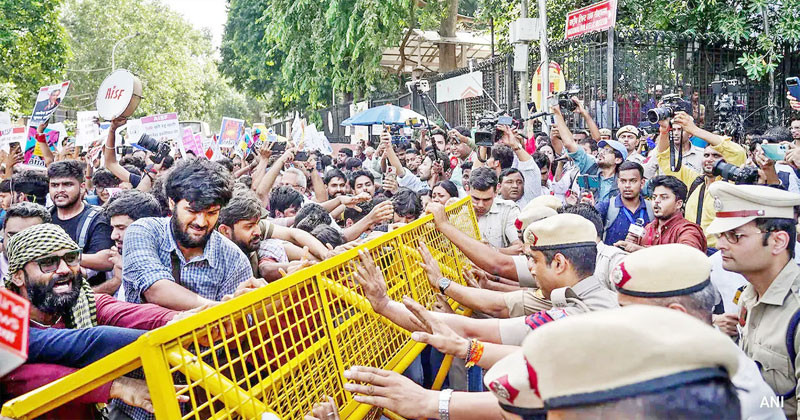
India has used many formulas of force in this subcontinent to protect rulers who obey it. Now in that same India, the protests of the CJP, or the Cockroach Janata Party, against the government have begun to shake the base of the fifteen year BJP rule. What is happening in Delhi reminds us of the situation in the July and August anti discrimination movement of 2024. A few days ago, before the CJP protest rally at Jantar Mantar in Delhi, the police arrested and jailed thousands of workers. These were not only workers of the Cockroach Janata Party, but also of almost all parties that oppose the government.
The CJP protest demands the resignation of the Chief Election Commissioner. Many people who supported it were arrested. They include Ms. Mamata Banerjee, former Chief Minister of West Bengal, Mr. Manik Sarkar, former Chief Minister of Tripura, Mr. Arvind Kejriwal, former Chief Minister of Delhi, and Mr. Pinarayi Vijayan, former Chief Minister of Kerala. The police also detained Mr. Humayun Kabir, the elected legislator of Murshidabad, and Mr. Aamir Khan, a superstar of Bombay cinema. The police released several thousand CJP workers after holding them.
But the movement has started to take a new turn after the arrest of the top CJP leaders. These include Mr. Abhijeet Dipke, Mr. Ashutosh Ranka, the popular YouTuber Mr. Dhruv Rathee, and Ms. Neha Bora, President of the All India Students Association. Mr. Modi seems not to have learned from the fall of Ms. Hasina. In Dhaka, DB chief Mr. Harunur Rashid arrested the main leaders of the anti discrimination movement to stop it. They were Mr. Nahid Islam, Mr. Arif Sohel, Mr. Hasnat Abdullah, Mr. Sajib Bhuiyan, and Mr. Sarjis Alam. He then made them give misleading statements, yet he could not stop the movement.
The political reality of the two countries is the same. The leadership of the movement comes from outside the usual political forces, and the nature of the narrative is almost the same. There is a small difference. Ms. Sheikh Hasina used the word “Razakar” for the protesting students in her speech. The Chief Justice of India’s Supreme Court compared the educated jobless generation to cockroaches in his remark. But both reflect the same attitude of the ruling class toward social and economic inequality.
If we look a little back, in 2019 Mr. Amit Shah, a BJP leader and Home Minister of the Modi government, spoke during an election campaign. He compared Muslims, and especially the so called migrants from Bangladesh, to termites. Many international analysts and human rights groups called his words dangerous at that time. In its second term in Delhi, the Modi government took steps for a full program to turn India into a Hindutva “Akhand Bharat,” or undivided India. It placed a map of the so called Akhand Bharat in India’s new Parliament building. On that map, the whole subcontinent, including Bangladesh, Pakistan, Nepal, and Afghanistan, belongs to India.
Taking over neighboring countries by military force and political tricks, to expand its own size, is part of the history of India after colonial rule. The latest case came in the first week of May 2025 with Operation Sindoor. India planned to seize a large area, including Pakistan controlled Kashmir, if it succeeded. But that attack turned into a boomerang for India. Pakistan’s air force struck back, and India’s air defense and military dominance fell on their face within two days. Mr. Donald Trump has said that Mr. Narendra Modi asked him, and he then got Pakistan to agree to a ceasefire.
Earlier, India suffered a sad defeat in the Indo Pakistan war of 1965. A ceasefire was signed in Tashkent through the mediation of India’s friend, the Soviet Union. India’s Prime Minister at that time, Mr. Lal Bahadur Shastri, signed it and died of a heart attack there. But India’s rulers have hidden every defeat from the people. They also used the media they control and the Mumbai film industry to sell defeats as their military victories.
Now the representatives of the majority of India’s people have also come out with the cockroach crowd. The government answers with mass arrests, internet shutdowns, and metro closures to stop the movement. These steps show that the Modi government has its back to the wall. But the effort to push Indian Muslims and supporters of opposition parties against the wall has been going on from much earlier. Now it is time to strike back.
In Bangladesh, after fifteen years of fascist oppression, the July fighters defeated Ms. Sheikh Hasina’s killer force. They freed the country from Hindutva aggression. The cockroach crowd of India has come out with the same spirit. They want to free India from fascism and bring peace and stability. In mid July 2024, Mr. Abu Sayed stood with his chest out before the raised rifles of the police in front of Begum Rokeya University in Rangpur, and he was martyred. From that spark, the movement spread like a wildfire across Dhaka and the whole country. In Bangladesh, the parties that oppose the government did not take direct lead or show up in it.
In Delhi, the case is a little different. At Jantar Mantar, the protesters demand the resignation of Chief Election Commissioner Mr. Gyanesh Kumar. The main opposition party, the Indian National Congress, and the alliance “INDIA” actively support this demand. That support gives extra strength to the movement of the cockroach crowd. But a political change is not possible through a peaceful movement that takes permission from a police force that serves the party. The other side of the picture also exists. Opposition alliance leader Mr. Rahul Gandhi said that more than 200 BJP legislators are in touch with the opposition and give important information. A report in Anandabazar says that half of the police force now stands with the movement, and they favor continuing it.
The movement now going on in India cannot stop with the resignation of Chief Election Commissioner Mr. Gyanesh Kumar alone. This movement is the voice of ordinary people against the BJP’s grip on political power through fake elections, which breaks the democratic base of India. It is not only about the Election Commissioner. The throne of the Modi government is tied to it. Before the vote, the authorities removed lakhs of Muslims and likely anti BJP voters from the list in the name of the Special Intensive Revision (SIR). This puts the legality and the result of that election in question.
This means the BJP government did not come to power through valid votes. The BJP removed lakhs of valid voters from the list as it pleased, and then took power through the result. That result must be seen as illegal. Along with the ultimatum for Mr. Gyanesh Kumar to resign, the cockroach crowd announced that they would meet the Chief Justice. If they get no response, the protesters also think of a possible program to surround the Supreme Court in Delhi.
This is the same Chief Justice whose careless remark led India’s young generation to move from virtual activism to the street. That is how the Cockroach Janata Party was born. The movement of the cockroach crowd is a trial by fire at the same time for India’s Chief Election Commissioner, the Chief Justice, and the Prime Minister. On one side stands the future of Indian democracy. On the other side stands the seat of power of the BJP government. This time, the people of India have chosen democracy and national unity.
This unity does not mean the India of the Gupta age. It means the India formed through British colonial mediation, and the political and geographic reality of the subcontinent. This is probably the first political movement of this kind in India. The future of democratic India depends on the success of this movement.
BJP led India has created a dangerous pit for the whole subcontinent. It is the most populous Hindu country in the world. Muslim sultans and Mughals ruled it for about 800 years, and the British ruled it for about 200 years. Yet no Hindutva ruler has ever ruled it successfully. The Hindutva political party is not yet a hundred years old, and the BJP has held power for only fifteen years. In this time, India has faced charges of the worst communal rule in the world, torture of minorities, human rights violations, and ethnic cleansing. Hindutva leaders have openly announced the killing of Muslims.
This is an age of technology, education, and trade globalization. Every region of the world has enriched itself with a demographic dividend by taking people from other regions. About 40 to 50 million people from India live as migrants in various countries, including Europe, America, and the Middle East. But in India, a country of a billion people, foreign migrants number no more than a few million. People disagree widely on the number of Indians working illegally in Bangladesh. No exact count exists, so various groups claim it is anywhere from 5,000 to several lakhs. This is not strange in an age of globalization.
Because of the reality of the partition, demographic spread between India and Bangladesh is unavoidable for social, religious, and economic reasons. Europe has now taken in more than 60 million people as migrants. In the United States, more than 50 million people live as migrants. A large part of them are of Indian origin, more than any other single country. About four percent of India’s people have migrated abroad. Yet in a complex geopolitical and historical reality, India cannot tolerate three to four million migrants who speak the same language.
The state of India has fallen into the trap of a plot. The plot puts vote counting first and aims to turn lakhs of Muslims into outsiders without citizenship, voting rights, or human rights. Several years ago, Dr. Gregory Stanton, founder and director of Genocide Watch, pointed to the fear of Hindutva killing of Muslims in India. He described it as the fifth stage of systematic genocide. Recently, he has shown data that the genocide of Muslims in India has reached the seventh of its ten stages.
India once had a large Buddhist community. Under the attacks and pressure of the Brahmin order, the Buddhists could not survive here. In the same way, they want to free India of Muslims and set up Hindutva. In this age of globalization, it may not be possible to wipe out 250 million Muslims even in a decade. After coming to power, the BJP removed the special status of Kashmir. It has also kept imposing laws like the NRC, the CAA, and the SIR by state order. These are in essence only methods to take citizenship from Muslims.
The plan to push these Muslims into neighboring countries, like the Rohingya of Myanmar, is now on its way. The Hindutva plan to push Muslims who have lived in India for thirty or forty years across the border into Bangladesh in the dark of night is now real. China’s population is also a billion, and it has crores of Muslims too. There are charges of discriminatory policy against Uyghur Muslims. But China has never tried to push its own Muslims into neighboring Pakistan or Central Asia.
In Bangladesh, Hindus live with equal rights and safety. Still, Indian media have raised imagined charges many times and tried to start communal riots here. The people of Bangladesh have beaten these attempts successfully. Hindutva rule in India is a very big threat to India’s unity, communal harmony, peaceful coexistence, and regional stability. For this reason, the fall of the BJP government, elected through fake votes, is now certain. The later it comes, the louder the sound of the fall and the greater the damage.