Waterlogging in Capital Remains Unsolved
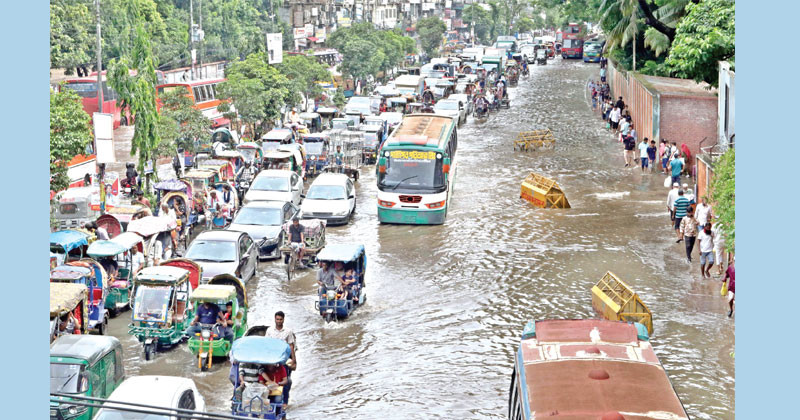
- Traffic system stalls with every rain, long jams form, and stagnant water creates breeding grounds for mosquitoes
The capital comes to a standstill with even light rain. Waterlogged streets cause endless suffering for city residents. Commuting to offices, courts, and schools becomes very hard. Heavy rain floods roads, lanes, and residential areas across the city.
Yesterday’s continuous morning rain caused waterlogging on many roads in the capital. Vehicle movement was disrupted and long traffic jams formed. The rain began at dawn and flooded low lying areas including Old Dhaka, Paltan, Malibagh, Mouchak, Kakrail, New Market, and Motijheel. Traffic came to a near halt as a result.
Office workers, students, businesspeople, and ordinary residents faced severe hardship. Roads in Mugda, Khilgaon, Sabujbagh, Goran, Manik Nagar, Taltola, Arambagh, Gulistan, Culvert Road, and Kakrail were seen submerged in water. In some spots the water rose so high that rickshaw and vehicle wheels nearly disappeared underwater. Normal movement on footpaths was also disrupted.
Many CNG run auto rickshaws and cars broke down in the water and were left stranded on the roads. Rickshaw and van pullers demanded higher fares, but many could not operate on the flooded streets. Because of the rain, the number of vehicles on the road was noticeably lower than usual from the morning onward.
Mr. Liyakat Ali, a resident of Malibagh, said that people suffer because water collects on the roads. He said vehicles cannot move at normal speed, so even short trips take much longer. He added that so much water sits on the roads that walking is also difficult, and traffic jams add even more delay.
Mr. Shahid, a CNG auto rickshaw driver, said he saw waterlogging in almost every part of Dhaka. He said many drivers had to push their vehicles by hand after the engines failed due to water on the roads.
Officials say the suffering from waterlogging does not end when the rain stops. Standing water mixes with garbage and waste and lingers for days, creating good breeding conditions for mosquitoes. Aedes mosquito larvae have been found in clear or relatively clean water in containers, under construction buildings, rooftops, parking areas, drains, and abandoned structures, which worsens the dengue situation in the capital.
On June 13, several areas of the capital including Mohammadpur, Farmgate, Green Road, Karwan Bazar, Gulshan, Badda, Mirpur, and Motijheel went underwater. Roads flooded and vehicle movement was disrupted. From the night of July 12, continuous rain made the situation worse in Green Road, Tejturi Bazar, Panthapath, Bashundhara residential area, Dhanmondi, and Mohammadpur.
On July 13, water rose from knee to waist level in many parts of the capital. On July 9, rain flooded New Market, Dhanmondi 27, Azimpur, Nazira Bazar, Bakshibazar, Sheorapara, Kazipara, Kalshi, Badda, Mirpur, Mogbazar, Shantinagar, Green Road, and Karwan Bazar.
Waterlogging is clearly not limited to a few isolated parts of the capital. Similar conditions occur regularly across the city after every rain. The two city corporations of Dhaka have identified 141 areas as high risk for waterlogging.
Even though these risky spots were already known, water still collected there during the rain. Responsibility for drainage was handed from Dhaka WASA to the two city corporations at the end of 2020. One main goal of this handover was to improve coordination in the city’s water drainage system.
But repeated waterlogging shows that managing the whole drainage system in a coordinated way remains a major challenge, even alongside new infrastructure work. A joint survey by DSCC and the Directorate General of Health Services identified 29 wards in the south city as high risk for Aedes mosquito breeding and dengue.
These areas include Dhanmondi, Kalabagan, Shukrabad, Shahbagh, Paribagh, Banglamotor, Khilgaon, Basabo, Mugda, Lalbagh, Azimpur, Chawkbazar, various parts of Old Dhaka, Jatrabari, Kadamtali, Kamrangirchar, and parts of Demra, Sarulia, Dakshingaon, and Nandipara.
The Dhaka South City Corporation said heavy rain with thunder from 4 AM caused temporary waterlogging on some low lying areas and sloped roads under its jurisdiction. It said cleaning staff and an emergency response team from its waste management department worked actively in the field from dawn to ease the temporary suffering of residents.
The emergency response team and cleaning staff worked on site to clear blockages in drainage lines and keep water removal running without pause. Full effort continued to quickly clear the water and restore normal movement for vehicles and pedestrians. The DSCC administrator, chief executive officer, chief waste management officer, and other related officials inspected the situation in the field from the morning.
Dr. Adil Muhammad Khan, executive director of the Institute for Planning and Development (IPD) and an urban planner, told Inqilab that Dhaka’s waterlogging has reached a point where it can no longer be seen as just a rainy season problem. He said it is a combined problem linked to urban planning, the environment, public health, transport, and the economy.
He said that even after years of spending on drain construction, repair, canal recovery, pumping stations, and other infrastructure, important parts of the city still go underwater within hours of rain, so the effectiveness of these projects needs review. He warned that stagnant water in waste can create Aedes mosquito breeding sites.
He said identifying hotspots alone is not enough. Coordinated mosquito control work must happen quickly, and wherever breeding sites are found, both larvae removal and mosquito control measures must follow. He said authorities must focus on why water collects in these places in the first place.