
Potato Production Satisfactory in the North
Weak Market Management, Storage and Export Shortfalls Plunge Northern Potao Farmers into Crisis
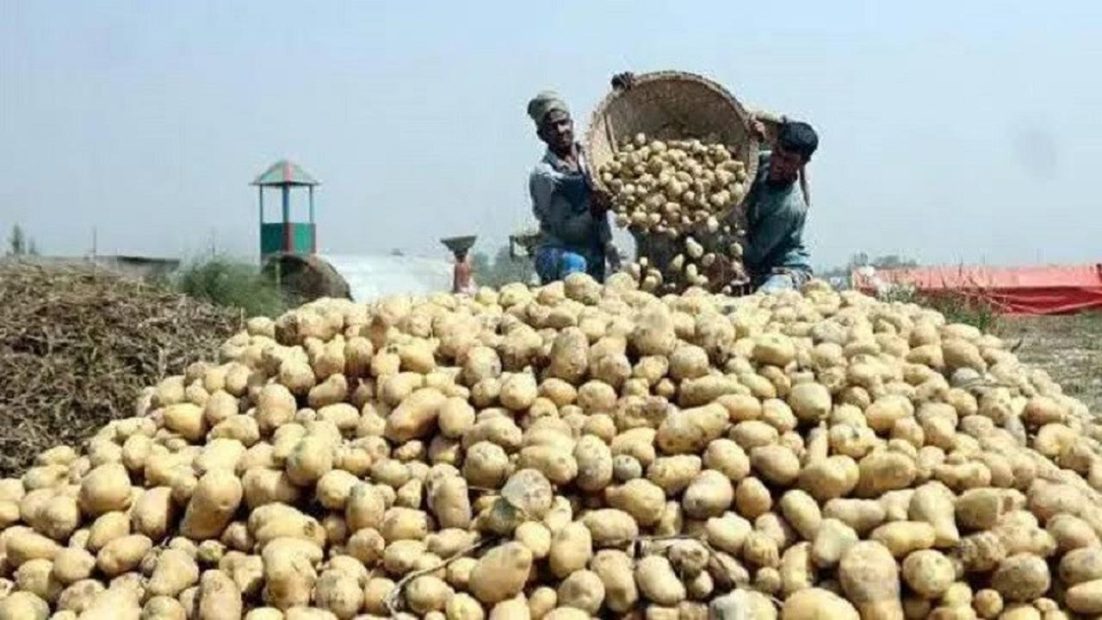
Potato production in Bangladesh has exceeded domestic demand for several years. As a result, farmers are facing a difficult situation, with bumper yields in the fields but falling market prices and limited exports. The crisis facing potato growers remains unresolved.
According to the Department of Agricultural Extension (DAE), nearly 11.573 million tonnes of potatoes were produced in Bangladesh in the 2024-25 fiscal year, against annual demand of around 8-9.5 million tonnes. The Department of Agricultural Marketing estimates annual demand at around 8.9 million tonnes. As a result, an estimated 2-2.6 million tonnes remained in surplus last season.
According to recent figures from the Bangladesh Cold Storage Association, around 11.2 million tonnes of potatoes were produced in 2026, leaving a surplus of approximately 2.2 million tonnes. Although production has declined, the surplus problem remains.
Northern Region Produces the Bulk of Potatoes
Rajshahi and Rangpur divisions are the country’s main potato-producing regions. In the 2024-25 fiscal year, the two divisions together produced approximately 8,798,188 tonnes, accounting for around 76 percent of national production. For the 2025-26 season, a combined production target of around 8.4 million tonnes was set.
Rangpur produced 5,178,549 tonnes this season, compared with 5,559,739 tonnes in the previous season. Despite the decline, it remains one of the country’s largest potato-producing regions.
Rajshahi also produces a significant amount. In the 2024-25 season, Rajshahi district alone produced 1,030,517 tonnes against annual local demand of only 113,145 tonnes, leaving a large surplus for supply to other parts of the country.
Based on population and the national demand estimate of 8.9 million tonnes, Rajshahi and Rangpur together have an estimated annual demand of around 2.05 million tonnes, against production of approximately 8.4 million tonnes.
Production Costs and Farmers’ Losses
Production costs vary by region and variety. According to field-level estimates, producing potatoes on one bigha in many northern areas costs Tk 70,000-80,000. Of this, Tk 25,000-30,000 is spent on seed, Tk 15,000-18,000 on fertiliser and pesticides, Tk 12,000-15,000 on labour, and Tk 13,000-17,000 on irrigation and other expenses.
However, costs differ by location. The Department of Agricultural Extension estimated production costs in Joypurhat at around Tk 41,000 per bigha during the 2025-26 season, while farmers in parts of Rajshahi reported costs of Tk 50,000-60,000.
A good yield can produce around 75-85 maunds of potatoes per bigha. But if potatoes are sold at Tk 15-20 per kilogramme, the total sale value may stand at around Tk 70,000, potentially leaving farmers with losses of up to Tk 10,000.
Export Potential Remains Largely Untapped
Bangladesh has considerable scope to expand its potato export market. The country exported 62,135 tonnes of potatoes in the 2024-25 fiscal year, a significant increase compared with previous years.
Potential markets include Malaysia, Singapore, Saudi Arabia, Nepal, the United Arab Emirates, Qatar, Bahrain, Kuwait, Sri Lanka, Oman, Canada and the Maldives.
However, exports remain very low compared with production. Key obstacles include a shortage of export-quality varieties and disease-free potatoes, inadequate packaging, phytosanitary certification, traceability, laboratory facilities and weak supply links with international markets.
Government agricultural analyses have also identified potato quality, excessive moisture and weak international market connectivity as major export barriers.
Bangladeshi potatoes were previously banned by Russia after the detection of brown rot disease, although the ban was lifted in 2022. The incident highlighted the importance of disease-free production, traceability and stronger phytosanitary management from cultivation to export.
The northern region has an advantage as major potato-producing districts include Rajshahi, Bogura, Joypurhat, Naogaon, Natore, Rangpur, Dinajpur, Thakurgaon and Nilphamari. However, storage and export infrastructure has not expanded in line with production. The Agricultural Information Service has highlighted the need for export-oriented packing stations, cooling zones and modern cold-chain facilities.
Storage Capacity Remains Inadequate
According to 2023 data from the Department of Agricultural Marketing, 365 operational cold storages in 40 districts had a combined capacity of around 3.013 million tonnes.
The Bangladesh Cold Storage Association reported that 351 cold storages stored around 3.4 million tonnes of potatoes in 2026. Although the number of facilities has declined, total capacity differs because of new and expanded facilities.
Recent 2026 data from the Department of Agricultural Marketing show 126 cold storages in Rajshahi and Rangpur divisions, of which 120 are operational. Rajshahi has 40, Bogura 52, Joypurhat 22, Naogaon 10, Natore three, Pabna two, Sirajganj one and Chapainawabganj one.
Rajshahi district’s 38 operational cold storages have a combined capacity of 433,250 tonnes. Rangpur has 115 cold storages with a total capacity of approximately 1,129,035 tonnes. Against this season’s 5,178,549 tonnes of production, Rangpur’s storage capacity covers only around 22 percent.
Lack of Coordination at the Core of the Crisis
The current crisis in the potato sector stems mainly from production exceeding demand, inadequate and unevenly distributed cold-storage facilities, limited export markets, shortcomings in export-quality and phytosanitary management, and low farm-gate prices compared with production costs.
Experts and agricultural stakeholders have called for production-based regional planning, expansion of export-oriented varieties, quality seed supply, modern small- and medium-sized cold storages, export-packing centres and better laboratory facilities.
An integrated potato export processing section covering the Rajshahi-Bogura-Joypurhat-Rangpur-Dinajpur belt could bring production, storage, sorting, packaging and exports under one supply chain. Contract farming could also be expanded to target markets in Nepal, Bhutan, northeastern India, the Middle East and Southeast Asia.
The main problem in Bangladesh’s potato sector is not a shortage of production but a lack of coordination among production, storage, markets and exports. With a surplus of more than two million tonnes, the key challenge is to utilise the surplus through value addition, processing and exports.
The northern region can play a major role in this regard, as Rajshahi and Rangpur account for around three-quarters of national potato production. However, potato growers, cold-storage owners, traders and export-sector stakeholders in Rangpur believe that without improvements in storage, cold chains, export standards, packaging and international market connectivity, bumper production will continue to cause losses rather than profits for farmers.