Why is India eager to Bring PM Tariq in Delhi Now?
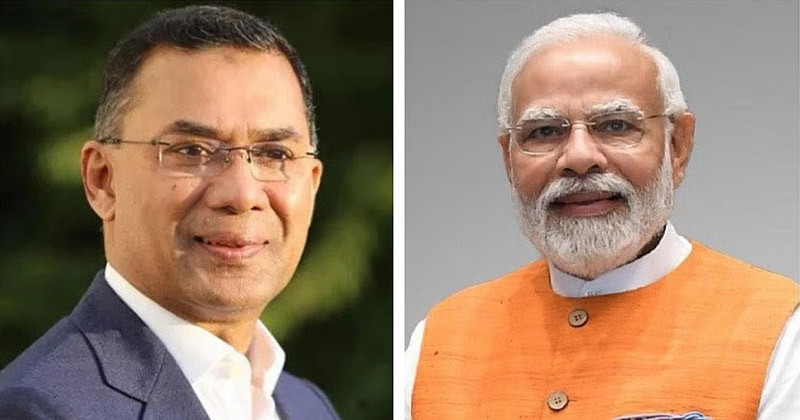
India’s invitation to the PM Tariq Rahman to visit New Delhi comes at a politically sensitive moment in Bangladesh-India relations, particularly because ousted Prime Minister Sheikh Hasina remains in India.
As the current chair of BIMSTEC, the PM has been invited to attend the outreach session of the BRICS Summit in New Delhi in September. Indian Foreign Ministry spokesperson Randhir Jaiswal said the invitation follows the customary practice of inviting heads of regional organisations. A separate bilateral invitation extended to the PM in February also remains valid.
On paper, the BRICS invitation is routine. But in diplomacy, timing, location, personalities and political circumstances matter. New Delhi is not only India’s capital but also the place where Ms. Hasina is staying, making any visit by Bangladesh’s current prime minister politically sensitive. Former Indian High Commissioner to Bangladesh Reena Ganguly recently said Ms. Hasina did not flee to India but was taken there by Bangladesh’s armed forces for security reasons. She also highlighted India’s long-standing relationship with the Awami League and Ms. Hasina. Such remarks reinforce the perception in Dhaka that New Delhi has not completely closed the Hasina chapter.
This raises a crucial question: under what political circumstances should Bangladesh’s current prime minister visit the capital of a country that continues to attach importance to the ousted former PM?
The precise nature of India’s invitation also matters. Unless the full invitation letter is made public, no definitive conclusion can be drawn about how the PM was addressed. If the invitation is solely in the PM’s capacity as BIMSTEC chair, the visit would clearly be multilateral. If a bilateral component is added, however, its political implications become considerably more significant.
Dhaka should therefore distinguish between the BRICS outreach invitation and any bilateral engagement. The former gives the PM an important opportunity to represent Bangladesh and BIMSTEC internationally. The latter requires a separate assessment of political, diplomatic and security considerations. The issue should not be framed as a conspiracy without evidence. The real question is risk management. Maintaining constructive relations with India remains in Bangladesh’s interest, particularly in trade, border management and security cooperation. But cooperation should not come at the expense of Bangladesh’s diplomatic position or national dignity.
The BRICS invitation is therefore an opportunity, but whether it should be combined with a bilateral visit to India is a separate question. Dhaka should decide only after carefully assessing the invitation, its purpose and the wider political context. Diplomacy’s first lesson is simple: friendship can be built, but the keys to the state must never be handed to someone else.