We’re formulating Teesta Master Plan to strengthen agriculture, climate resilience: PM
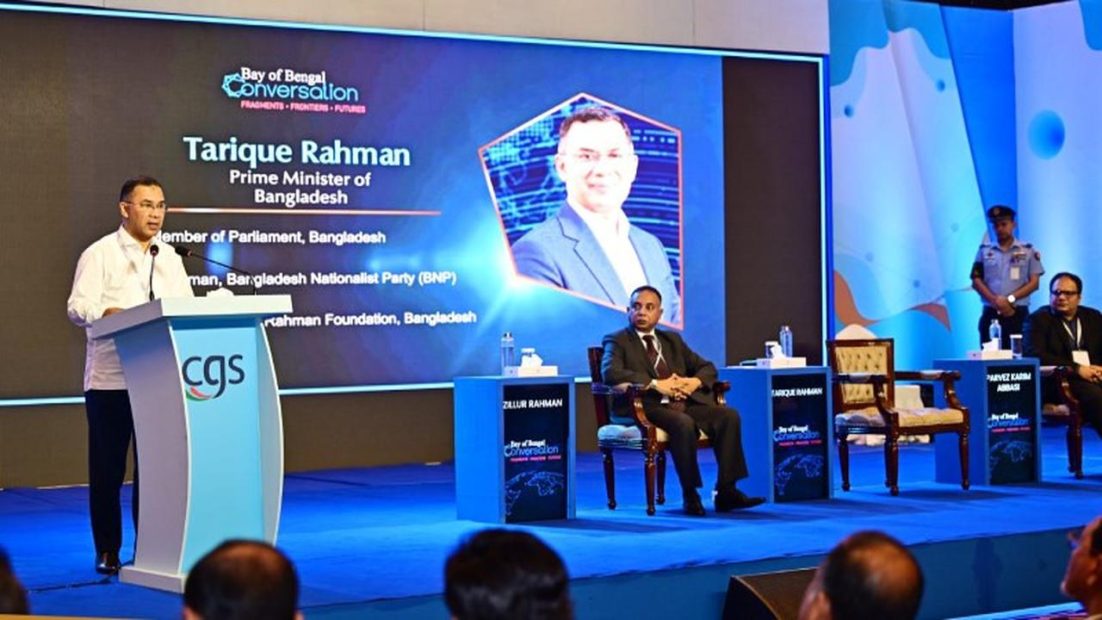
Prime Minister Tarique Rahman has said water security is equally important. The government plans to excavate 20,000 kilometres of canals and waterways over the next five years. It is also advancing the Padma Barrage Project for water conservation and management. In addition, the government is formulating a Teesta Master Plan. These steps will support agriculture and strengthen climate resilience.
He made the remarks at the Bay of Bengal Conversation 2026 on Saturday.
The prime minister thanked the Centre for Governance Studies for organising the event.
“Bangladesh has a new elected government with a strong mandate from the people. We have a five-year action plan to fulfil that mandate. Our priorities are protecting national interests, maintaining policy continuity, ensuring economic stability and carrying out institutional reforms. We are now moving directly from commitments to implementation,” he said.
“We are making Bangladesh an attractive destination for investment while developing it as a strong production and investment hub. We want to create extensive employment opportunities in production, services, exports and other sectors. Policy certainty is essential for investors, and continuity in our long-term policies will provide that certainty.”
He said social protection programmes had been designed to prioritise the most disadvantaged people.
“Through the Family Card, financial assistance will be provided to mothers in each family, starting with the poorest and most marginalised groups. The Farmer Card will connect farmers with government incentives, agricultural services and markets. The Health Card will ensure access to healthcare for all. Ultimately, the Universal Card will enable citizens to access coordinated government services under one umbrella,” he said.
The prime minister said healthcare must reach every household.
“We are working to recruit 100,000 healthcare workers, around 80 percent of whom will be women. They will provide primary healthcare, health advice and necessary referral services at the grassroots level. We are also giving special attention to maternal and child health,” he said.
He said the education system should prepare students for real life, not only for certificates.
“We are working to ensure a joyful learning environment. Culture, sports, values and ethics will play an important role in developing our children’s character. They will also have opportunities to learn a third language. Alongside general education, technical and vocational education will be expanded. Our government will provide free uniforms, schoolbags, midday meals and stipends from Class One. We are also expanding free education for girls up to the undergraduate level,” he said.
Referring to the country’s large youth population, Tarique Rahman said skills and suitable employment were essential to turn the demographic advantage into progress.
“We are increasing language skills and employment opportunities while embracing technological transformation and artificial intelligence. We are supporting innovation, entrepreneurship and start-ups. We want our young people to compete on the global stage and turn brain drain into brain circulation,” he said.
He described agriculture as the backbone of the economy.
“We are making technology, irrigation, agricultural finance and market access for farm products more accessible. We are supporting fisheries, livestock and rural entrepreneurs. Alongside food security, we need to develop agro-processing and agricultural export industries. I believe a strong rural economy can build a strong Bangladesh,” he said.
The prime minister said the government had planned to excavate 20,000 kilometres of canals and waterways over the next five years.
“We are advancing the Padma Barrage Project for water conservation and management. We are also formulating a Teesta Master Plan. These measures will support agriculture and strengthen climate resilience,” he said.
The government has set specific targets for environmental protection, he said.
“We will plant 250 million trees over the next five years. We are expanding the use of solar power. Bangladesh is taking a leading role in waste recycling and environmentally friendly green factories. Of the world’s top 100 LEED-certified factories, 53 are now in Bangladesh,” he said.
He said clean and environment-friendly cities could help reduce waste, strengthen climate resilience and further boost the economy.
The prime minister said strong state institutions were essential for development.
“We are strengthening institutional transparency and accountability. Human rights, democratic values and freedom of expression must be protected. The rule of law must apply equally to every citizen. We will build an institutional culture in which state institutions truly serve the people of Bangladesh,” he said.
He said Bangladesh was also carrying a major global responsibility by hosting nearly 1.2 million Rohingya refugees.
“Our main goal is to ensure their swift, voluntary, safe, dignified and sustainable repatriation to Myanmar. This requires continued political support and international funding. It is also essential to address the root causes of the crisis. A crisis that originated in Myanmar must also end in Myanmar,” he said.
Referring to the Bay of Bengal, the prime minister said Bangladesh’s geographic and strategic location offered significant opportunities.
“Our seaports, waterways and coastal economy can connect us with the rest of the world. There is enormous potential in shipping, fisheries, tourism, energy and regional supply chains. We must turn our shared geographic position into shared prosperity. This requires deeper bilateral and multilateral engagement,” he said.
He said Bangladesh could expand mutual cooperation in trade, energy, education, technology, climate and maritime affairs.
“We can open new markets and create more opportunities for our young people. We can build stronger partnerships based on equality, fairness and justice. Geography has brought us together, and we firmly believe that closer people-to-people ties will take us much further,” he said.
“Bangladesh believes in dialogue, partnership and mutual respect. We will protect our national interests and sovereignty while continuing to work positively with all our regional and global partners. Peace and harmony are the foundations of shared prosperity and development,” he said.
The prime minister expressed hope that the Bay of Bengal region would become an area where all countries could develop together, benefit equally and expand meaningful cooperation among their people.
“Bangladesh is fully prepared to play its due role in this regard. Thank you all very much. Have a good day. Allah Hafiz,” he said.