
Repeated killings, daylight shootings and body recoveries have sparked fear among locals; drug trade and easy access to illegal firearms are behind most killings
Killings Persist in Khulna Despite Home Ministry Ultimatum, Ongoing Crackdown
Despite a one-month ultimatum issued by the Home Ministry to police officials in the Khulna region and ongoing law enforcement operations, killings have continued.
A series of brutal killings in recent times has spread fear and concern across Khulna district and the metropolitan area. Several sensational killings in the past few days have further complicated the situation. Repeated killings, daylight shootings and the recovery of bodies have left local residents deeply alarmed.
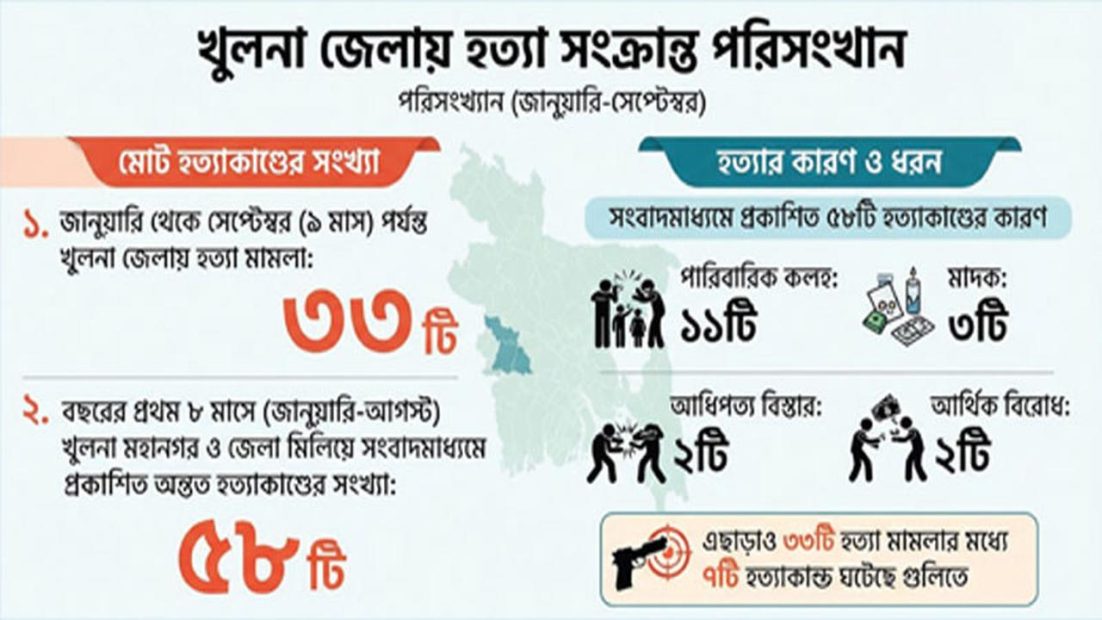
According to police data, 33 murder cases were filed in Khulna district from January to September this year. In addition, media reports recorded at least 58 killings across Khulna city and district during the first eight months of the year. These included 11 cases linked to family disputes, three to drugs, three to theft and robbery, two to establishing dominance and two to financial disputes. Of the 33 murder cases, seven involved shootings.
Recent incidents include killings and attempted killings, stabbing and hacking, shootings, recovery of bullet-ridden bodies, beatings to death, recovery of bodies from hotels and homes, allegations of extortion, recovery of illegal firearms and cocktails, drug seizures including yaba, arrests of wanted and accused persons, and special operations and checkpoints.
According to sources, several brutal crimes have occurred in different parts of Khulna in recent days.
On the evening of October 5, Akhtar Dhali, 64, was shot dead in front of his home in Durjani Mahal village of Rupsa upazila. Just 51 days earlier, on August 15, his son Joy Dhali had been murdered by having his throat slit. Akhtar had filed a general diary with the police the day before his death, fearing for his life. Police suspect the latest killing may have resulted from previous enmity or the murder case involving his son.
On October 4, Nasimul Karim, 55, a leader of the banned Purba Banglar Communist Party, was shot dead by two assailants riding a motorcycle at a tea stall in Formayeshkhana area of Dighalia upazila. Police initially suspected that the killing was linked to a dispute over establishing dominance.
In mid-September, students had given police a 24-hour ultimatum to arrest those responsible for beating North Western University student Azmul Hossain to death in Khulna. Police later arrested the accused, but new crimes and killings have continued.
Several bodies have been recovered and incidents involving gunfights have been reported in different areas of Khulna Metropolitan Police, including Labanchara, Sadar and Daulatpur, leaving city residents deeply concerned about their safety.
The number of murder cases and other crimes has shown a worrying upward trend over the past year. Civil society members and residents of Khulna have expressed deep concern over the situation.
Khulna Citizens Society has called for Khulna to be declared a high-risk area and demanded special operations to arrest criminals and recover illegal firearms. The police administration said additional personnel have been deployed in different areas and operations to arrest those involved are continuing.
According to local residents and concerned citizens, the deterioration in law and order is linked to political conflicts, internal disputes among extremist groups and the growing activities of drug syndicates and juvenile gangs.
Although police and the Rapid Action Battalion (RAB) have intensified operations to arrest suspects, no lasting improvement has been seen. Juvenile gangs and local criminal groups have become particularly active in areas such as Labanchara and Ashibigha in Khulna city, reportedly over disputes related to establishing dominance.
Killings involving hacking and shootings are taking place in broad daylight, sometimes over minor incidents or previous enmity. Internal conflicts among banned extremist groups and attempts to eliminate political rivals have also resurfaced in Dighalia and various upazilas and border areas of Khulna.
Even when targets have personal bodyguards or security arrangements, criminals have reportedly entered public places such as tea stalls and carried out targeted killings.
An investigation found that the drug trade and easy access to illegal firearms are behind most of the killings. Criminal groups are able to commit crimes and escape easily because of their access to sophisticated firearms.
Information has also emerged about the involvement of teenagers and young men in conflicts ranging from neighbourhood disputes to clashes between criminal groups. Recent reports on Khulna’s crime situation have identified the activities of several criminal groups accused of involvement in drugs, extortion, land grabbing, robbery and establishing dominance.
Some of these groups reportedly include teenagers and young people in their 20s. Small disputes in neighbourhoods often develop into group-based conflicts, with drug and firearm use subsequently increasing as groups seek to maintain their dominance.
Khulna Metropolitan Police and district law enforcement agencies said operations against drugs, terrorism, illegal firearms and criminals are continuing. Checkpoints have been set up on major roads and entry points, while regular searches and operations are being conducted to arrest accused persons in various cases.
Operations have also been intensified in Labanchara, Harintana, Sonadanga, Khalishpur, Daulatpur and other areas of the city to bring the law and order situation under control.










