Solar Power Brings New Hope to the Western Zone, Including Barishal
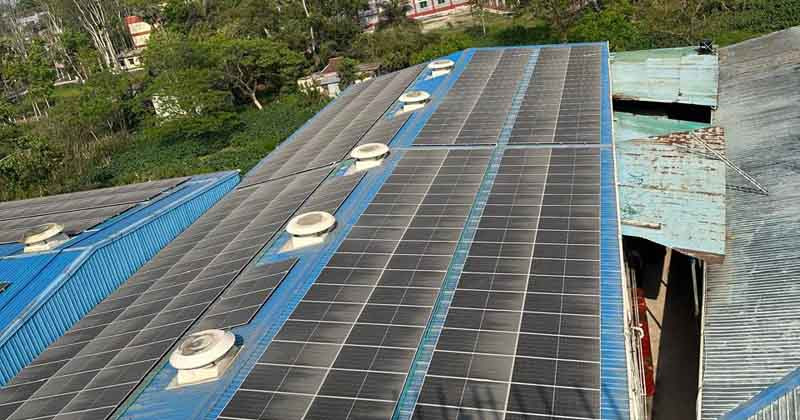
Energy experts hope that multifaceted initiatives undertaken under Prime Minister Tarique Rahman’s directives to produce renewable energy through public and private endeavors, particularly across Barishal and the western region, will yield positive results in mitigating the ongoing power crisis. Solar energy has already demonstrated transformative socio-economic impacts on agriculture, industry, and commerce. The Power Division is executing intensive measures to integrate at least 3,000 MW of solar power into the national grid by next year. Authorities at WZPDCL confirm that the government aims to procure at least 10 percent of the western zone’s peak demand from renewable sources within the current fiscal year.
The government is prioritizing the renewable energy transition across all administrative tiers. Broad-spectrum measures in public and private sectors have already added 25 MW of peak-hour solar power to the grid from 555 institutions in the western zone. A notification issued on September 1 outlined that the government will purchase power from private rooftop solar systems at BDT 10.50 per kilowatt. This mechanism enables consumers to offset electricity bills by selling solar power back to distribution entities. PM Tarique Rahman emphasized, ‘We must focus on reducing dependence on imported fossil fuels and accelerate the adoption of clean, sustainable renewable energy across the country.’
Bangladesh currently maintains an installed capacity of nearly 29,000 MW against a peak summer demand exceeding 18,000 MW, though renewable energy accounts for a limited share. If economic expansion continues, power demand is projected to grow annually by 6 percent, reaching up to 30,000 MW by 2030. However, heavy reliance on imported fossil fuels exerts severe economic, environmental, and energy security pressures. Experts stress that global market volatility and supply chain vulnerabilities make the energy sector increasingly precarious. Consequently, the government targets securing 20 percent of total generation from renewables by 2030, and at least 35 percent by 2035, aligning with its sustainable economic agenda.
To bypass high population density and land constraints, the government is prioritizing rooftop solar expansion. Sector targets include 5,500 MW from rooftop installations, 4,500 MW from ground-mounted systems, and around 500 MW from wind, waste-to-energy, floating solar, and agrivoltaics. Growing interest in expanded Net Metering allows private investors to sell surplus power at the benchmark BDT 10.50 rate. Concurrently, a low-interest loan scheme at 5 percent under the Green Financing initiative has been launched to finance solar-powered agricultural pumps and farm equipment. These efforts aim to insulate the domestic economy from global energy shocks while curbing industrial and agricultural disruptions caused by power deficits.
In Barishal, notable industrial efforts include Opsonin Group’s ‘Padma Blowing’ enterprise, which generates nearly 6.5 MW from its rooftop and supplies surplus electricity to the national grid during off-peak hours. Meanwhile, evaluation is underway for 1,011 enterprise applications seeking enlistment as service providers to add 3,000 MW of regional rooftop solar capacity by February. WZPDCL is constructing rooftop solar structures on its installations while implementing a 1.748 MW peak solar project across divisional and district administration roofs. Additionally, negotiations are advancing to set up 18 MW peak solar systems on available land and rooftops of various public institutions.
Further regional expansion includes ongoing processes to establish 23.35 MW solar capacity across five key organizations. Contracts were recently signed to erect 1.78 MW of rooftop solar at Khulna Shipyard and 1.39 MW at Petromax Limited, while feasibility assessments for a 15 MW solar facility on WZPDCL land have concluded. Power Division officials highlighted, ‘Our concerted push towards solar adoption in the western region will establish a sustainable energy model that directly benefits both consumers and national industries.’ With systemic incentives, net metering support, and public-private cooperation, Bangladesh is moving decisively toward a green, self-reliant energy future.