
Dumki Swamped by Unchecked Waste Dumping as Public Health Risks Mount
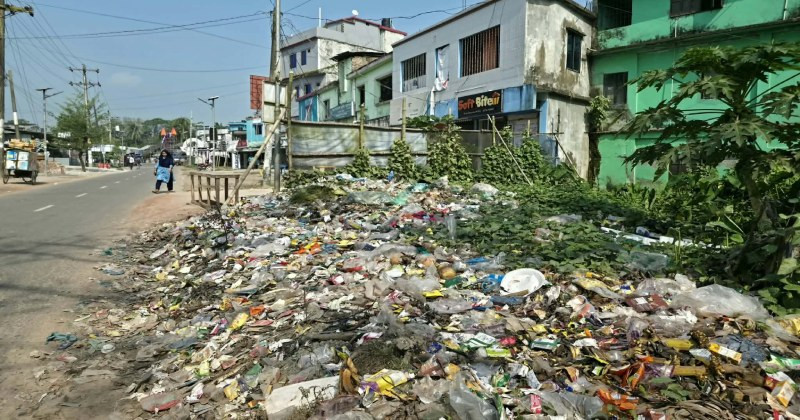
Indiscriminate dumping of garbage is turning Dumki Upazila Sadar in Patuakhali into a vast waste dump. In the absence of a planned waste management system or designated dumping sites, household, market, and business waste is being discarded haphazardly. Huge piles of refuse have cropped up along major roads, market alleys, densely populated residential neighborhoods, and vital canals. Public life has become unbearable due to the pervasive stench of rotting waste. Environmental pollution is worsening rapidly, and health risks are rising, fueling anger among residents and business owners over the lack of effective initiatives.
A visit to various areas reveals garbage scattered across crowded marketplaces, key roads, and residential areas. Stacks of domestic food scraps, perishable goods, single-use polythene, plastics, and discarded commercial items are visible everywhere. One of the worst-affected spots is the eastern edge of the New Market area near the Dumki-Bauphal Highway at the Western Gate of Patuakhali Science and Technology University. Similar scenes prevail near the Old Thana bridge in Pirtola Bazar, the approach road to Dumki Police Station, and near the Srijoni Biddyaniketon bridge, where foul odors severely disrupt life for commuters and students.
The catastrophic impact of waste mismanagement has heavily hit the Pirtola Canal, flowing through the heart of the Upazila Sadar. Vast amounts of market waste from Pirtola Bazar and nearby areas are indiscriminately dumped into it, stretching from the Lutheran Healthcare Hospital area to Angaria. Residents allege that the canal, already narrowed due to previous illegal encroachment and land filling, is now further devastated under the pressure of garbage. They fear that if this continuous dumping goes unchecked, the existence of this vital waterway will eventually be completely wiped out.
Residents highlight that the absence of basic infrastructure leaves them with no choice but to throw waste in open spaces. Teacher Jasim Uddin stated that despite daily household waste generation, there is no designated disposal spot, forcing people to throw trash everywhere, especially into the canal. Pirtola Bazar trader Shaheen Mridha noted that seeing one person dump waste in residential alleys leads others to follow, turning whole areas into stench-filled dumps. University student Siyam added that people act out of sheer helplessness because there are no dustbins available.
The accumulation of rotting waste has raised serious public health concerns across the Upazila Sadar. Open garbage heaps create ideal breeding grounds for disease vectors like mosquitoes and flies, while rainwater washes waste into local drains and water bodies, drastically increasing water pollution and the risk of waterborne illnesses. Highlighting these hazards, Upazila Health and Family Planning Officer Dr. Mir Shahidul Hasan stated that even their medical waste dumping station built by the administration is not being properly utilized, creating further pollution. He stressed that it is critical to prioritize waste management to protect public health.
Residents are urgently demanding the immediate implementation of a planned waste management system tailored to the area’s growing population and commercial activity. Key demands include installing dustbins at critical locations, establishing regular collection and disposal routines, setting up a designated waste processing center, and enforcing strict surveillance to stop indiscriminate dumping. Additionally, citizens want routine monitoring of market and residential waste alongside public awareness campaigns. Conscious citizens emphasize that immediate, coordinated action is essential to restore environmental balance, safeguard public health, and transform Dumki Sadar into a clean and habitable settlement.
Responding to the growing public outcry, local authorities acknowledged the issue while citing resource constraints as a major hurdle. Dumki Upazila Executive Officer Abdullah Khairul Islam Chowdhury stated that the administration occasionally cleans up waste from various places, but setting up a permanent waste dumping station is quite costly. He noted that no long-term initiatives had been taken in the past to address the waste removal problem permanently. However, he assured the public that the upazila administration will consider the matter with serious priority in the future.










