Overhauling the Education System Is Imperative
HSC Results Disaster: Who Is to Be Held Accountable?
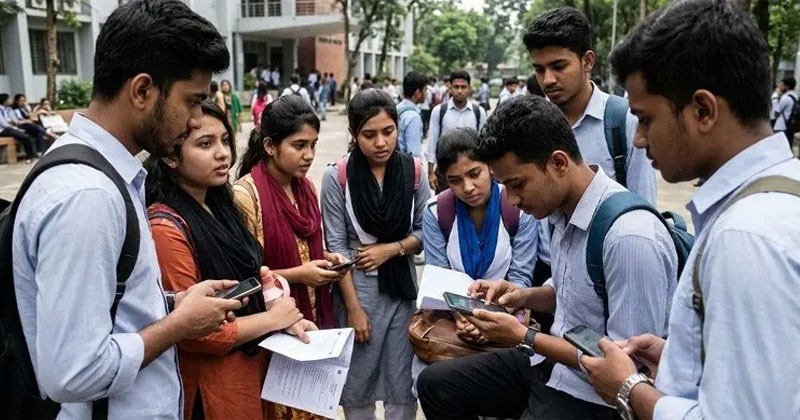
The HSC, Alim and equivalent exams have ended in a result disaster this year. The average pass rate in the 11 education boards is 52.12 percent. Almost half of the examinees could not pass. We have not seen such a disaster in recent times.
This result is not only the result of one exam. It demands a serious review of classrooms, teaching, evaluation, the accountability of institutions and our whole idea of education. According to the summary of the published result, the pass rate fell from 58.83 percent last year to 52.12 percent this year. The number of students with GPA 5 also fell from 69,097 to 40,084.
The most worrying part of the result is that not a single student passed from 293 institutions. On the other hand, only 139 institutions had a hundred percent pass rate. Between these two opposite pictures stand the 1,270,583 examinees who registered this year.
Of them, 1,240,798 took part in the exam and 646,685 passed. So 594,113 students failed. We cannot dismiss the failure of 594,113 students as only a personal failure. It includes gaps in student preparation, limits of teachers, weakness of institutions, problems in the syllabus and possible errors in evaluation. We must find who is responsible at every level and also build a way to fix it.
We want a hundred percent pass rate, but we want a hundred percent learning even more. The pass rate has fallen, but we cannot judge the quality of the education system by this one number alone. The question is why so many students could not pass. Did they not study, or was there a gap in teaching them? Was the question paper harder than before, or was the evaluation stricter this time?
Student preparation, the standard of teaching in institutions and the marking of answer scripts all need review. It is easy to label students as unfit when the result is bad. But it is far more important to find how much of the failure comes from the education system.
One important point in this result is that a huge number of students failed in English and in Information and Communication Technology. According to the published statistics, 243,528 students failed in English and 138,493 failed in ICT. If we add the failures in the two subjects, the total is 382,021.
The same student may have failed in both subjects, so we should not take this number as the number of separate students. But the statistics make it clear that there is a big learning gap in these two subjects. So many students failing in English points to a problem we have had for a long time. English is taught from school life, but many students still struggle at the higher secondary level.
They find it hard to read and understand a paragraph, to write their own views, or to use basic grammar. In many cases, learning English means memorising some rules for the exam and answering by recognising the type of question. Of the four basic skills of language learning, which are listening, speaking, reading and writing, the first two are often ignored in classroom practice. So when a question comes that is slightly different from the textbook, students are in trouble.
The same questions arise in ICT. Having technology in the syllabus does not make a student skilled in technology. If there is no chance to teach the basic ideas of computers, the internet, software and information technology by hand, the subject becomes a matter of memorising. Many institutions do not have the needed equipment, steady electricity, internet or trained teachers.
In some places, practical classes only mean marking attendance. How effective can technology education be without real experience?
Another question comes up. Why do so many students fail in HSC after passing SSC? Does an SSC certificate not prove that a student is fit for higher secondary studies? In reality, SSC and HSC are exams of two different levels. Passing SSC does not mean the student has gained equal skill in all subjects of the next level.
Often a student gets into college after passing somehow, even with weakness at school level. At college, the student faces a wider syllabus, deeper content and analytical questions, and the weakness becomes clear.
There is also a question of continuity in the education system here. In which subject was a student weak in SSC, and which skill did the student fail to gain? After admission to college, how much arrangement is there to fill that gap? In reality, most institutions have no effective system to find each student’s learning gap and give separate help.
So a student who was weak in English at school has to move ahead with the same weakness in college. The higher secondary syllabus then does not become a chance to learn something new. It becomes a new pressure on top of the old gap.
Another worrying part of this result is the number of institutions with zero pass. Not a single student passed from 293 institutions. Last year the number was 202. In one year, the number of zero pass institutions has gone up by 91. On the other hand, the number of institutions with a hundred percent pass rate fell from 345 in 2025 to 139 this year.
These numbers show not only the failure of students but also raise questions about the ability and accountability of the institutions. We cannot accept it as a normal educational failure when not a single student passes from an institution. But it is not a solution to punish all institutions in the same way.
In some places there is a shortage of teachers. In some places there are no subject teachers. In some places classes do not happen regularly, and in others student attendance is very low. In some institutions the number of students is small, so the failure of a few students makes the pass rate zero.
So every zero pass institution needs a separate inquiry and review. We must publish how many examinees there were, how many failed in which subject, how many teachers there are, how many days classes were held and whether practical lessons took place.
For institutions that keep doing badly, the education boards and the Directorate of Secondary and Higher Education must supervise together. If needed, they must send expert teams to review teaching, teacher attendance, the classroom environment and student preparation. In weak institutions, the authorities can place skilled teachers, arrange extra classes and subject training, and start counselling centres for students.
The accountability of the head of each institution must be ensured. But the situation will not improve if we only punish teachers without giving them the help they need. The aim should not be to shut an institution down. It should be to turn it into an effective institution.
Questions have also been raised about the marking of answer scripts. When the pass rate falls in any exam, many people naturally doubt the way scripts were marked. But we cannot conclude that the evaluation was wrong just because the pass rate fell. We also cannot assume that the evaluation was a hundred percent correct. Marking answer scripts is a responsible and sensitive job.
A small mistake by an examiner, or inconsistency in marking an answer, can change a student’s result. A few changes are urgent here. Examiners must get subject training so that the same answer does not get very different marks across boards or examiners. Every question needs clear mark distribution and marking guidelines.
For creative and analytical questions, examiners must know clearly how many marks each element earns. We can also start a system to review scripts close to a mark boundary, to check sample scripts through more than one examiner and to test the consistency of examiners. We also need to make the scrutiny of answer scripts more effective for students.
Scrutiny usually checks whether marks were added correctly, whether any answer was left out of marking and whether marks were recorded properly. It is not the same as marking the scripts again in every case. So we must make the application process for scrutiny easier. If any error in marking is found, there must also be a clear way to correct it.
This year, students can apply for scrutiny for seven days starting today. The education minister has said that failed students will get a chance to sit exams again, only in the failed subjects, within one to two months. If this plan works, it will reduce uncertainty in the lives of many students.
But this chance should not be a decision taken only to publish results quickly. Students must get enough time to prepare, the needed guidance and quality learning support. The standard of question papers and evaluation must also be kept.
The biggest change must come in our idea of education. Raising the pass rate cannot be the only goal of education. If we do not test the real knowledge and skills of students in the name of a hundred percent pass, the number of certificates will grow but the quality of education will not. It is also not acceptable to let a huge number of students fail in the name of strict evaluation and then feel the job is done.
The aim of education is to teach students, to build their ability and to prepare them for later life. An exam is only a way to check that achievement. For this, we must build an effective link in the syllabus from SSC to HSC. After admission to college, we can test the basic skills of students and start a bridge course for the weak ones.
In English and information technology, we must replace memorising with regular practice, practical work, group projects and continuous assessment. Teacher training must not be a one time formality. It must be part of regular professional development. We must find students at risk early, based on attendance, participation in class and exam results.
The result of this year’s HSC is not just sad news. It is a warning to rebuild the education system.