Gas extraction at Inani may open a new door for energy
Shamsul Haque Sharek, from Cox’s Bazar
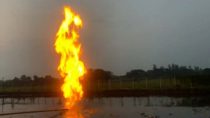
Gas has kept erupting from underground at Inani in Ukhiya, Cox’s Bazar. It has brought new talk about oil and gas potential on the Cox’s Bazar coast. Based on expert opinion, local people are greatly excited. They hope a new door of energy potential may open in this region. The gas eruption at Inani has stayed unchanged for a week.
There are early signs of condensate, an oil like liquid, along with the gas. Water is also coming with the gas now. This has raised new hope for the search for energy resources. But more tests and geological study are needed to confirm whether this is a new gas field or a commercially recoverable resource. Meanwhile, Bangladesh Petroleum Exploration and Production Company (BAPEX) is working on a 15 day plan to watch the Inani gas eruption.
Mr. Mohammad Nasiruddin, manager (geology) of BAPEX, said they revisited the site yesterday. He said the flame temperature was found to be between about 800 and 1,000 degrees Fahrenheit. He said the flame height is the same as before. Judging by the color and nature of the flame, they first guess it is formation gas. He said the true type of gas cannot be confirmed without lab analysis and other tests.
He said a committee of Petrobangla and BAPEX has been formed on the gas eruption. He said a meeting discussed what to do next. The committee is weighing how to bring the gas fire under control and how to extract the gas or use another safe method. It is also weighing how to reduce fear and safety risks for local people. Petrobangla will decide, and BAPEX will carry it out later.
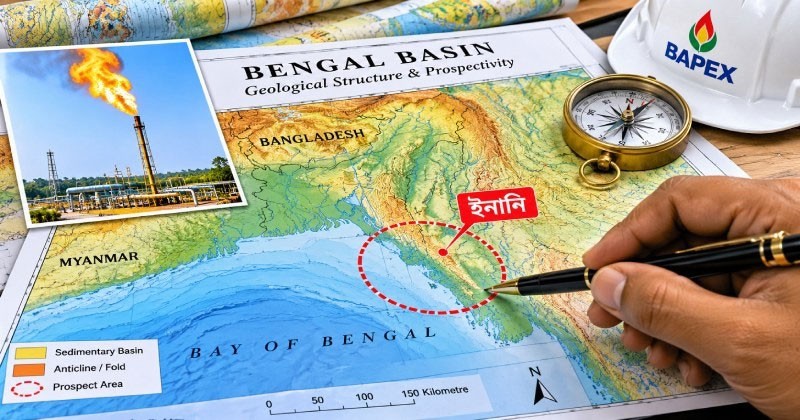
Oil and gas potential on the Cox’s Bazar coast: Cox’s Bazar is not only a tourism region but also important for energy potential. Experts say the hilly areas around Inani in Ukhiya and the Bay of Bengal coastal area have folded geological structures. Geologists say such structures can create good conditions for oil and gas to collect underground. For this reason, searches by international oil companies in the seventies and eighties gave weight to the potential of large oil and gas in the Bay of Bengal and nearby coastal basins.
In 1969, the international oil company Shell Oil drilled a well in the Cox’s Bazar area. The well found no oil or gas that could be extracted commercially. In 1977, the American company Union Oil found gas for the first time in the country in the Kutubdia island area. But building a seabed pipeline, an offshore platform, and gas processing and supply systems needed huge investment. Because of these limits, commercial production could never begin there.
Later, in 1996, Sangu, the first commercially produced offshore gas field of Bangladesh, was found in the Bay of Bengal. The field lies about 80 to 90 kilometers from the Inani coast. Commercial gas production from Sangu began in June 1998. Production went on for a long time, but gas pressure and output fell over time. The field stopped production permanently in October 2013.
The earlier finds of gas at Kutubdia and Sangu give reason to treat the energy potential of the Cox’s Bazar coast and the Bay of Bengal region more seriously.
Interest in condensate: The recent gas eruption at Inani has given the matter a new dimension, because early signs show a oil like liquid, or condensate, along with the gas. Condensate is a light liquid hydrocarbon found underground with natural gas. It stays liquid under certain temperature and pressure.
Still, more detailed geological and technical study, including sample tests, is needed to confirm the true makeup of the gas, the type of hydrocarbon, the condensate and possible reserves. Experts say it is not possible to say yet whether Inani is only an isolated gas eruption or whether a large underground gas reservoir lies behind it. This needs scientific tests, analysis of geological data and search with modern technology. The Inani eruption has again brought forward the potential for oil and gas search on the Cox’s Bazar coast. But turning the potential into reality needs planned, long term exploration. The test results and later decisions of Petrobangla and BAPEX will decide whether the eruption opens a new door in Bangladesh’s energy sector.