Unrest in the Garment Industry Must Be Resolved Immediately
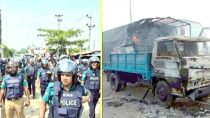
The ready made garment industry, one of the main drivers of the Bangladesh economy, is passing through a hard time. On one side are the global slowdown, fewer orders in the international market, the gas crisis, higher production costs and uncertain power supply. On the other side, worker unrest, protests, road blockades and factory vandalism push the industry into deeper crisis. In recent days, workers protested and clashed with police in Mirpur, Ashulia, Uttara, Gazipur and other industrial areas. Roads were blocked in some places, police vehicles were set on fire in others, and factories were vandalized elsewhere.
According to BGMEA, a large number of workers did not turn up at factories in Dhaka, Gazipur, Mymensingh, Savar and Ashulia because of unrest. At least 529 garment factories had to stay shut for the time being. We cannot deny the real reasons behind workers’ unrest. With runaway inflation and higher house rent, food, medical and transport costs, a garment worker cannot run a family on the present wage. So the workers’ demand for a fair wage is not unreasonable.
But along with the reality of the demand, we must also keep the industry’s capacity in mind. The effects of the Russia and Ukraine war, the conflict in the Middle East, instability in the international oil market and regional geopolitical tension have put new pressure on fuel supply and import costs. There are also raw material import costs and the lack of enough orders from international buyers. Many small and large factories already struggle to survive. If a large wage rise comes suddenly without thinking of the industry’s overall capacity, many firms may find it hard to keep producing.
We need a solution that lets workers run their families and keeps owners’ factories running. If factories close, there will be no talk of wage rises, because workers will lose their jobs. The satisfying news is that the government has moved to solve the wage problem. The day before yesterday, it formed a six member wage board to set a new minimum wage. BKMEA welcomed the decision. Its president, Mr. Mohammad Hatem, said, “We also understand the pressure our worker brothers and sisters face as living costs rise.”
He said, “At the same time, the challenges are real, with the global slowdown, the energy crisis, rising production costs and falling export orders. So ensuring workers’ fair dues and keeping factories running are equally important to us.” BGMEA president Mr. Mahmud Hasan Khan asked worker groups to act responsibly. He said factories open in the morning and have to shut again after an hour. He said it has become impossible to run production this way. We must find out why protests, vandalism and road blockades continue even after the wage board was formed.
The statement of Home Minister Mr. Salahuddin Ahmed deserves special weight here. After meeting BGMEA and BKMEA leaders yesterday, he alleged that some people who were ministers, state ministers and MPs under the previous government, along with some owners, are involved in creating unrest in the garment sector. He said some people use worker group banners to create disorder with political backing. He also alleged that unrest is being created from across the border to carry out a political agenda. The home minister said he has audio, video and other evidence for these claims.
The government is also collecting a list of owners who shut factories on purpose and information on people and groups involved in violence. These allegations must be investigated fairly, and those responsible must face strict legal action. Yesterday, Ms. Najma Akhter, president of Sammilito Garment Sramik Federation, said the vandalism and unrest in various places in the name of workers is not a real workers’ movement. She called it part of political activity. She said that after the wage board was formed, workers should help the government and the new wage should be announced quickly.
Dr. Shafiqur Rahman, Jamaat e Islami chief and leader of the opposition, has also voiced concern over the garment crisis. He said the government must quickly take lasting steps to ensure uninterrupted power, cut production costs and solve the industry’s problems. He rightly reminded us that if industry survives, not only owners but the country survives. We must give equal weight to workers’ interests as well. Setting police vehicles on fire, vandalizing factories or blocking people’s movement in the name of a workers’ movement is not acceptable in any way.
Owners who shut factories on purpose and put workers in danger must also be held to account. The path of talks is open to win workers’ fair demands. Choosing violence when a chance for solution exists can help no one. The same fair investigation and needed action must apply to those accused of spreading so called political or ideological influence. The government, worker groups and owners must stay alert so that no group can use workers’ real problems for its own political gain.
While the garment industry faces many internal and international challenges, Vietnam moves ahead in trade under the same global reality, and we do not learn from it. A report in the English daily The Daily Star yesterday said Vietnam’s total goods trade reached about 1.01 trillion dollars in the first 10 months of this year. That is 32.3 percent more than the same period last year. The country’s export earnings rose to about 499 billion dollars.
Vietnam’s progress rests on market diversification, use of technology in production, high value addition, stronger local firms and a long term plan to expand export markets. The country wants to raise the share of local firms in exports to 28 to 30 percent by 2030. It also aims to raise exports of high tech goods. Cutting dependence on a single market and entering new markets are part of its strategy. Why can Bangladesh not move ahead with the same kind of far sighted planning?
We cannot stay competitive in the international market by only keeping wages low or relying on low production cost. We must take effective steps to raise productivity, modernize technology, ensure fuel supply, improve ports and transport, diversify products and search for new markets. We must also keep the pressure on the foreign currency market in mind. Because of the Middle East conflict, expatriate income is not rising at the expected pace. According to Bangladesh Bank, remittance in October was 2.87 billion dollars.
That is 12.1 percent more than the same time last year, yet it stays below 3 billion dollars for the fifth month in a row. Meanwhile, import costs rose 12 percent to 12.20 billion dollars in July and August. In the same period, the import cost of refined petroleum products almost doubled. So more dollars are needed to import essentials like oil, gas, fertilizer and food. If remittance and export earnings do not grow as hoped, pressure on foreign currency reserves and the exchange rate may rise further.
In this reality, long lasting unrest in the garment industry will pose a big risk to the economy. So all sides must sit at the table of talks at once. The wage board must be allowed to work independently. It must set a realistic wage structure that considers workers’ living costs, factory finances and the industry’s future. The government must take effective steps for uninterrupted fuel supply, easy financial support, export market expansion and reopening of closed factories.
At the same time, whoever is involved in violence, provocation or deliberate harm to the industry must face the law through a fair investigation. Workers must also understand that a factory is their place of work, and they cannot secure their future by destroying it. Owners must remember that industry cannot run without workers. The government’s duty is not only to control law and order but also to protect the interests of both workers and owners and build a lasting environment for industry. If the garment unrest is not ended at once, its effects will not stay in one industry. Export earnings, jobs, the foreign currency market and the whole economy will suffer.