Garment Sector Besieged by Four-Pronged Crisis, Including Workers’ Wage Protests; Daily Losses Hit Tk 500 Crore
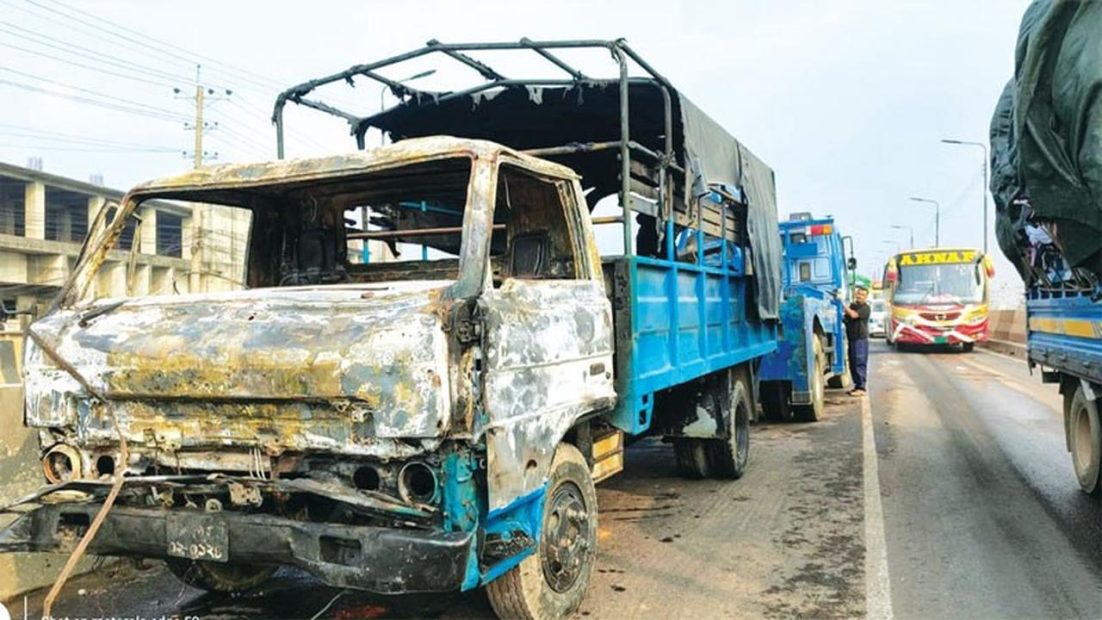
The garment sector is facing growing turmoil amid labour unrest. A group of people and activists linked to the banned political party Awami League are allegedly using the protests to create instability and disorder in the country.
The unrest is disrupting not only garment production and exports but also the sector’s backward linkage industries and supporting services. When garment factories suspend production or highways remain blocked for hours, the losses extend from yarn and fabric suppliers to transport workers and local restaurant businesses.
Thousands of small and medium-sized industries worth thousands of crores of taka, including manufacturers of buttons, zippers, hangers, cartons and labels, depend directly on garment industry orders. When factories remain closed, the entire accessories supply chain comes to a standstill.
Industry insiders estimate that labour unrest causes daily losses of around $45 million, or more than Tk 500 crore. However, the actual economic damage is several times higher. Although the government-appointed wage board has started its work, the country’s leading business organisation, the Federation of Bangladesh Chambers of Commerce and Industry (FBCCI), has questioned the justification for the ongoing protests. The organisation claims that the movement is not entirely spontaneous among workers.
Meanwhile, losses in the garment sector have already exceeded Tk 1,500 crore. Economists fear that prolonged unrest could lead to the cancellation of new orders and create further risks for exports. They warn that labour unrest, attacks on factories, vandalism and road blockades are weakening Bangladesh’s position in global competition.
Repeated disruptions are also damaging the country’s image in international markets and increasing the risk of losing the confidence of foreign buyers. This could directly affect new orders, export earnings, employment and investment.
While leading garment-exporting countries and Bangladesh’s competitors are expanding their market positions, Bangladesh is gradually falling behind. China is offering price discounts to retain its share of the global market. Meanwhile, Vietnam, India, Cambodia and Pakistan are strengthening their positions by increasing exports and focusing on higher-value garments.
Bangladesh, by contrast, has managed to maintain much of its previous position through only modest growth.
Vietnam, one of Bangladesh’s major competitors, increased its exports to the United States by 42 per cent in the first eight months of this year alone. As a result, it has overtaken China and Mexico to become a major US trading partner with the largest goods trade surplus.
Daily losses exceed Tk 500 crore
The country’s leading export-earning sector, ready-made garments (RMG), is facing growing pressure as protests over wage increases continue on the streets and in industrial areas. The FBCCI sees no reasonable grounds for continued labour unrest after the government-appointed wage board began working to determine a new pay structure. The organisation’s administrator has said that the nature of the protests and the violence involved do not reflect the normal expression of workers’ demands.
Garment factory owners say production at more than 500 factories was suspended during several days of continuous protests, resulting in losses exceeding Tk 1,500 crore. Analysts fear that if the unrest does not end soon, Bangladesh could lose new orders and see a decline in exports. Economists point out that a crisis in the garment industry affects not only factory owners but also the livelihoods of around 4 million workers. They have urged the authorities to finalise the new wage structure quickly to resolve the unrest.
Mohammad Hatim, president of the Bangladesh Knitwear Manufacturers and Exporters Association (BKMEA), said factory closures and production disruptions caused by labour unrest were resulting in daily losses of around $45 million, or more than Tk 500 crore, in the garment sector.
He said production had been suspended at several factories due to wage-related protests, attacks and vandalism in industrial areas, including Ashulia, Gazipur, Savar and Narayanganj. As a result, timely shipments are being disrupted, raising concerns about Bangladesh’s international reputation and the confidence of foreign buyers.
He added that international buyers were demanding price discounts on the grounds that they might not receive products on time. They were also becoming cautious about placing new orders, creating a double crisis for the garment sector. Mr. Hatim expressed concern that the protests might continue despite the wage board finalising the new pay structure this month and workers receiving their revised wages.
He said workers might again take to the streets, claiming that the announced wages did not meet their expectations. If such situations continue to emerge every few months, Bangladesh’s garment industry could eventually be forced to shut down. Foreign buyers have already expressed concern over the wage protests, and discussions about shifting orders to other countries are under way.
Mr. Hatim said, “Workers must remember one thing: If workers survive, the industry survives; if the industry does not survive, workers will not survive either.” He said production losses caused by protests might eventually be recovered, but questioned who would take responsibility for the damage to the country’s international image.
Competitors gain ground as Bangladesh faces instability
According to industry sources, countries that previously ranked below Bangladesh in garment exports are gradually moving ahead. Meanwhile, labour protests, alleged conspiracies by neighbouring India, political instability surrounding the possible return of former autocratic leader Sheikh Hasina from India in December, and political activities under the banner of labour movements are creating further pressure on the country’s exports and economy.
Industry insiders say Bangladesh’s major competitors are strengthening their positions among international buyers while domestic instability is increasing the risk of losing market share. If the current situation continues, the consequences will extend beyond immediate production losses. Bangladesh could gradually lose its position in the global market to competing countries.
More concerningly, the impact of the unrest is already reaching the decisions of international buyers. Foreign buyers are asking about production schedules and delivery timelines. Some are considering reducing orders for the next two months. Industry sources have also reported that some orders from Bangladesh may be shifted to India, Pakistan and other competing countries.
Industry insiders say a single day of production disruption in the export-oriented garment sector means much more than the loss of that day’s output. It affects raw material supplies, workers’ wages, electricity and gas bills, bank loan interest, shipping arrangements and buyers’ delivery deadlines.
When production falls behind schedule, work on subsequent orders is also disrupted. Factories may have to send goods by air at additional costs to meet delivery deadlines. Otherwise, they risk price discounts or order cancellations. Once a buyer shifts production to another country, bringing those orders back to Bangladesh is not easy.
Bangladesh is not the only country competing in the global garment market. India, Pakistan, Vietnam, Cambodia and Indonesia are also competing to attract international buyers. These countries are particularly competitive in production costs, supply capacity and timely delivery. Repeated factory closures, road blockades and violent incidents in Bangladesh send negative signals to foreign buyers.
Buyers consider more than just product prices. They also assess whether goods will be delivered on time, whether factories can maintain uninterrupted production and whether labour unrest could disrupt the supply chain.
Bangladesh’s share of the global market under pressure
According to available data, the global ready-made garment market expanded by 4.46 per cent in 2025. However, Bangladesh failed to fully capitalise on the growth. An analysis of the figures shows that the global garment market was worth $545.23 billion in 2021. China held 31.71 per cent of global garment exports at the time. Bangladesh ranked second with a market share of 6.57 per cent, followed by Vietnam with 5.62 per cent. India accounted for 2.96 per cent, Cambodia 1.43 per cent and Pakistan 1.55 per cent.
Five years later, in 2025, the global garment market had grown to $574.46 billion. However, China’s market share fell to 27.35 per cent, while Bangladesh’s share declined to 6.76 per cent according to the reported figures. In contrast, Vietnam’s share increased to 6.53 per cent, bringing it close to Bangladesh. India’s share rose to 3 per cent, Cambodia’s to 2.1 per cent and Pakistan’s to 1.73 per cent.
Analysts say China has adopted a price-discount strategy to retain its market position. Meanwhile, garment prices increased by 10.53 per cent in Vietnam, 5.47 per cent in India, 16.88 per cent in Cambodia and 6.83 per cent in Pakistan. Bangladesh’s export growth was only 0.89 per cent, significantly lower than that of its major competitors.
Industry insiders say international demand is increasingly shifting away from simply buying larger quantities at lower prices towards higher-value and value-added products. They warn that Bangladesh could find it increasingly difficult to maintain its global market position unless it makes rapid progress in product diversification, technology-based manufacturing, design development and the production of higher-value garments.
Weak competitiveness and strategic shortcomings
Fazlul Hoque, former president of the Bangladesh Knitwear Manufacturers and Exporters Association (BKMEA), expressed concern over Bangladesh’s declining share of the international garment market. He said that although the overall global garment market had weakened somewhat, Bangladesh was losing market share at a much faster rate than its competitors. The situation had become even clearer in the figures for subsequent months.
He identified domestic policy and strategic weaknesses, alongside the slowdown in international markets, as major reasons behind the decline. He added that the ongoing labour unrest was making the situation more complicated. Mahiyuddin Rubel, a former director of the Bangladesh Garment Manufacturers and Exporters Association (BGMEA), said Bangladesh had failed to achieve the expected progress in the global market and was largely holding on to its previous position.
He said a significant portion of the market share gained by different countries in recent years had come from businesses shifting away from China. Garment industry entrepreneurs say geopolitical tensions and tariffs have prompted US buyers to move away from China and look for alternative sourcing destinations.
South and Southeast Asian countries, including Bangladesh, are benefiting from China’s declining market position. However, Bangladesh has failed to capture as much of this shifting business as other countries. Mr. Rubel identified the country’s lack of competitiveness compared with rival nations as a major reason.
He said competing countries had made greater progress than Bangladesh in effective marketing, infrastructure development, strategic planning and institutional capacity, all of which are essential for attracting international buyers and expanding trade.
Urgent reforms needed to protect market share
Fazlul Hoque has called for urgent policy and strategic measures to protect Bangladesh’s position in the global garment market and overcome the domestic crisis. He also stressed the need for immediate steps to resolve the ongoing labour unrest. He said Bangladesh must adopt an aggressive marketing strategy within a short time to remain competitive in international markets.
Product diversification is also essential, as the country remains heavily dependent on a limited range of conventional garments. Emphasising the need to expand production capacity in man-made fibre-based garments, Mr. Hoque said Bangladesh must improve its skills and capabilities in this segment. He warned that these measures must be implemented quickly because once Bangladesh loses its share of the international market, recovering it will not be easy.