Nikah Registrars Seek Prime Minister’s Intervention to Protect Professional Status and Rights
The Bangladesh Muslim Nikah Registrar and Nikah Registrar Welfare Unity Council has called for Prime Minister Tarique Rahman’s intervention to protect the professional status, rights and existing jurisdictions of Nikah registrars across the country.
The organisation demanded that at least two qualified and experienced representatives of Nikah registrars from across the country be included in the committee responsible for drafting and amending the Muslim Marriage and Divorce Registration Rules.
It also called for religious education from madrasa institutions, knowledge of Islamic Shariah and Muslim family law, and practical skills in marriage and divorce registration to be made essential qualifications for appointment as a Nikah registrar. The organisation demanded the withdrawal of any proposal that would allow appointments based solely on general academic degrees.
The leaders also demanded that the existing jurisdictions and rights of serving Nikah registrars be maintained. They opposed any move to divide existing jurisdictions or appoint multiple registrars in place of one.
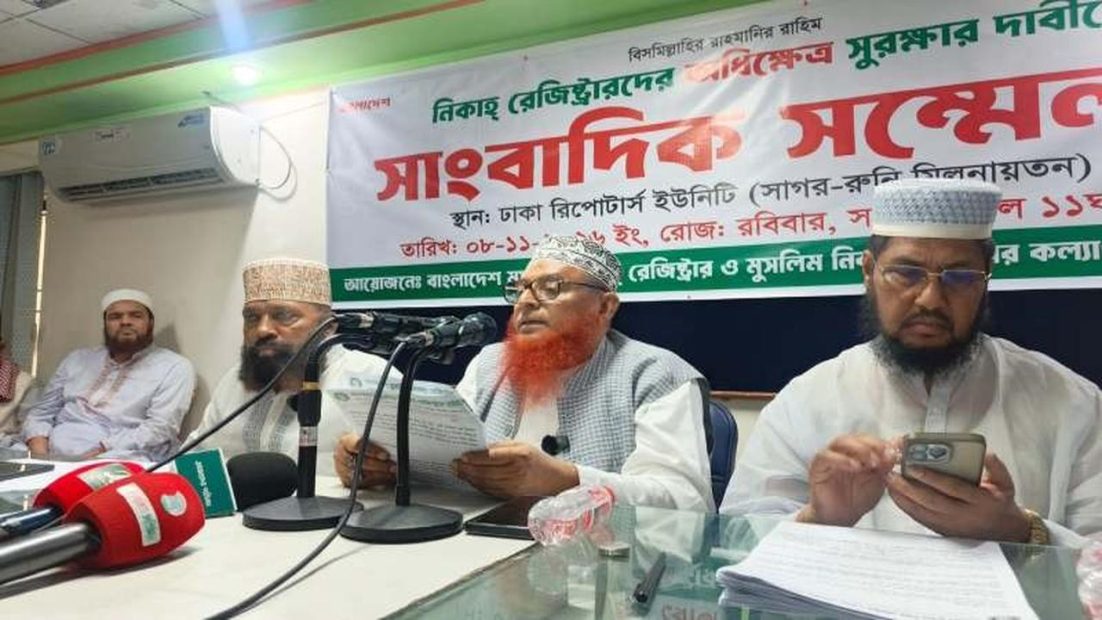
The demands were raised at a press conference organised by the Bangladesh Muslim Nikah Registrar and Nikah Registrar Welfare Unity Council at the Sagar-Runi Auditorium of the Dhaka Reporters Unity in Segunbagicha, Dhaka, on Sunday (November 8).
Maulana Shah Md Nesarul Haque, president of the Muslim Nikah Registrar Association, read out the written statement. Among those present were Maulana Kazi Md Nazrul Islam Talukdar, president of the Muslim Nikah Registrar Welfare Association; Maulana Kazi Md Selim Reza, secretary general of the Muslim Nikah Registrar Association; Kazi Iqbal Hossain, Kazi Ashraf Uddin Bhuiyan, Kazi Nurul Amin, Mofizul Islam, Azizul Haque, Sumon Mashiur Rahman, Kazi Md Zakir Hossain, Shihab Uddin Yahia, Masud, Kazi Maulana Mobarak Hossain Farazi and Abdur Razzak.
In their statement, the leaders expressed deep concern over the Law, Justice and Parliamentary Affairs Ministry’s decision to formulate new Muslim Marriage and Divorce Registration Rules. They said the proposed draft of the 2026 rules included plans to reorganise the long-established jurisdictions of Nikah registrars. The draft proposed dividing their jurisdictions into three sections in city corporation and union parishad areas. It also proposed changes to the existing system of appointing one Nikah registrar for each ward in municipal areas.
The draft also included a proposal to allow people with general educational backgrounds to be appointed as Nikah registrars. The leaders claimed that even during the previous authoritarian government, no one had dared to take such decisions, which they consider contrary to Shariah.
They warned that these changes could negatively affect the professional stability of Nikah registrars, the established administrative structure and the orderly management of marriage and divorce registration. According to the association, the existing jurisdiction system was not introduced through any sudden or arbitrary decision. Rather, it was established through extensive discussions, reviews and practical experience.
During the 2001–2006 tenure of the government led by former Prime Minister Begum Khaleda Zia, an initiative was taken to reorganise the jurisdictions of Nikah registrars under the supervision of the then Law Minister and renowned lawyer Barrister Moudud Ahmed.
Several meetings and discussions were held under the law minister’s chairmanship, involving senior leaders of Kazi associations and prominent Islamic scholars. Based on those discussions, a policy decision was made to appoint one Nikah registrar for each ward in city corporations and one for each union. Rules were subsequently formulated accordingly.
The association said changing a system established through years of consultation and practical experience without properly discussing the matter with the professionals concerned was unacceptable. The leaders also raised concerns over the proposed educational and religious qualifications for appointment as Nikah registrars.
They said marriage and divorce were not merely administrative or official procedures but important matters governed by Islamic Shariah. A Nikah registrar must have clear knowledge and practical skills in various aspects of Islamic family law, including the conditions of marriage, dower (mahr), offer and acceptance (ijab and qabul), guardianship, divorce, khula and delegated divorce (talaq-e-tafwid).
The association clarified that it was not opposed to general education. However, it believes that madrasa-based religious education, knowledge of Islamic Shariah and Muslim family law, and relevant expertise in marriage and divorce registration should be considered essential qualifications alongside general academic education.
The leaders warned that appointing people solely on the basis of BA or MA degrees without ensuring adequate knowledge and training in Shariah could create complications and lead to religious and legal errors in marriage and divorce registration.
They said the responsibilities required a combination of religious knowledge, legal expertise, professional experience and ethical standards. The association further expressed concern that reopening a long-settled issue could create dissatisfaction and professional uncertainty among Nikah registrars across the country. It also warned that such proposals could create an unnecessary gap between the country’s Islamic scholars and the government.
The leaders urged the government to formulate the rules by considering the opinions of all concerned parties, practical experience and public interest rather than acting on the influence or one-sided recommendations of any vested interest group.
Appealing to Prime Minister Tarique Rahman on behalf of Nikah registrars across the country, they sought his intervention to retain the existing jurisdiction system established through consultations during Begum Khaleda Zia’s government.
They also urged him to instruct the concerned ministry not to finalise any rules affecting the professional future and responsibilities of Nikah registrars without ensuring their representation.
Demand for higher registration fees
The association also demanded an increase in marriage and divorce registration fees, saying the fees had not been revised despite increases in salaries, allowances and other benefits for officials and employees across different sectors in line with rising living costs.
Its proposed revisions include:
• Marriage registration fee: Tk 20 instead of Tk 14 per Tk 1,000, up to Tk 500,000.
• For every additional Tk 100,000, the fee should increase to Tk 300 instead of Tk 100.
• Divorce registration fee: Tk 2,000 instead of Tk 1,000.
• Certified copy of marriage registration: Tk 200 instead of Tk 50.
• Commission fee: Tk 500.
Protest programme announced
At the press conference, the association announced a programme to press for its demands and protect the existing jurisdictions of Nikah registrars. A human chain will be formed in front of the National Press Club on Monday (November 9). The association will also submit memorandums to the Prime Minister and the Law Minister.