Traffic Gridlock Inflicting Irreparable Damage
Harun-Or-Rashid
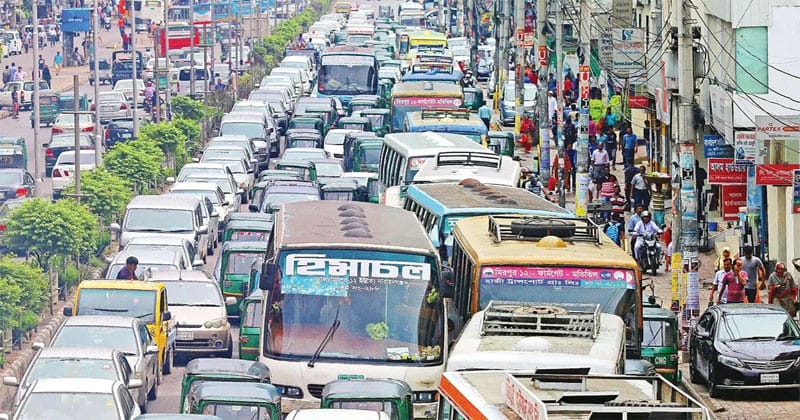
Dhaka’s traffic congestion has become an unavoidable reality, driven by unplanned infrastructure, disorganised road expansion and an exponential rise in vehicles far beyond road capacity. Bangladesh consequently loses hundreds of crores of taka, reducing government revenue and increasing public expenditure. A journey that should take five to 10 minutes can take 30 to 40 minutes. Civil society has described the loss of 30 productive minutes per journey as intolerable.
While average urban vehicle speeds in Singapore, Canada and England are about 40 km/h, Dhaka barely allows 10 to 15 km in an hour. Dhaka, described as Asia’s second most populated city after Tokyo, loses three to four working hours daily because of roadblocks, while Tokyo is almost free of traffic. Such losses contribute to budget deficits and currency depreciation, reflected in sharp price increases over the past decade. Congestion also damages the capital’s visual appeal.
Dhaka’s wholesale markets lack modern technology and maintenance systems. Nearly half of agricultural produce arriving from outside the city deteriorates during transportation because of chronic delays, aggravated by extortion and illegal toll collection. Ordinary families suffer, spending time and resources on employment, education and daily necessities. Tasks requiring two to three hours can consume eight to 10 hours, costing citizens thousands of dollars in lost productivity. Annual losses could finance a nationwide metro and underground system.
Bangladesh’s weaknesses become clearer through international comparisons. China, 65 times larger than Bangladesh, became a major economic force in 50 years, while Bangladesh’s 56-year journey has produced far less. Bangladesh remains absorbed in politics while China prioritises engineering and production. Malaysia, of similar age, has a much higher purchasing-power-adjusted GDP per capita, reflecting technological advancement and political stability rather than internal political disputes.
Malaysia offers low-skilled opportunities, while millions of Bangladeshis seek menial work abroad, especially in the Middle East. Their determination could have built domestic prosperity, but low earnings, corruption and limited opportunities force migration. The fundamental crisis is Dhaka’s uncontrolled concentration of people and vehicles. Decentralising urban services to regional and rural hubs, a strategy used by Western capitals such as London, could ease pressure.
London’s mayor created more than 400 independent “village towns” connected to the city centre by modern rail networks. With political resolve and strategic administrative decentralisation, Bangladesh could avoid one lakh crore taka in annual losses and achieve sustained growth and economic stability by prioritising technological urban engineering over endless political confrontation, and sustained economic stability and long-awaited national wealth.