Rohingyas demand safe, dignified repatriation
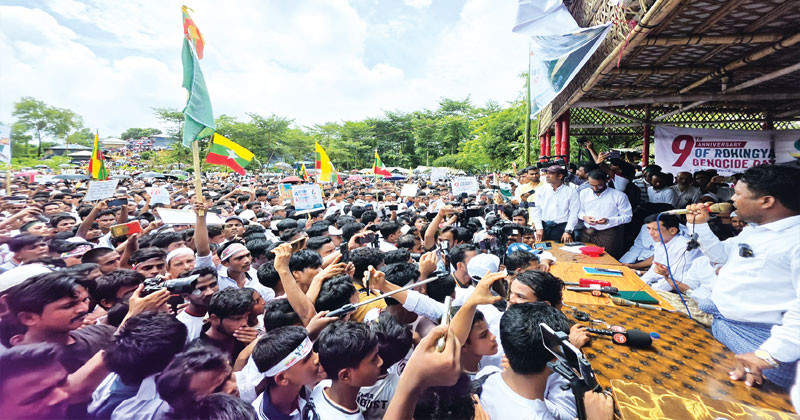
Rohingyas held Genocide Day programmes at the Rohingya camps in Ukhiya-Teknaf of Cox’s Bazar. Marking nine years of the crisis and entering its 10th year, a rally was held at the football field of Kutupalong Rohingya Camp-4 in Ukhiya yesterday. Thousands of Rohingya women, men, children and youths joined the rally. The venue echoed with slogans including “Hta ekkan, firt chai Arakan” (We have suffered enough, we want to return to Arakan) and various other calls for returning to their homeland. From the rally, the Rohingyas demanded safe, voluntary, sustainable and dignified repatriation, along with recognition of their citizenship in Myanmar, security, fundamental rights and guarantees of returning to their ancestral homes. They also demanded internationally acceptable justice for the killings, persecution, arson and human rights violations committed against them in 2017.
The programme was organised yesterday morning under the banner of the United Council of Rohingya (UCR) to commemorate the 2017 Rohingya Genocide Day. From early morning, women, men and children from different blocks of the camps marched to the rally venue carrying banners, festoons and placards. Many held placards bearing demands such as “No more refugee life, we want to return to our homeland” and “We want safe and dignified repatriation.”
Frustration as return route remains closed after nine years
On August 25, 2017, hundreds of thousands of Rohingyas began fleeing to Bangladesh to save their lives amid widespread repression, killings, arson and persecution by Myanmar security forces in Rakhine State. More than seven lakh Rohingyas took shelter in Bangladesh within a few weeks. Nine years have passed since then, but sustainable repatriation to their homeland has yet to become possible. At present, a large number of Rohingya refugees are living in 33 camps in Ukhiya and Teknaf. Over the past nine years, several rounds of discussions on repatriation have been held involving the international community, the Bangladesh government and humanitarian organisations, but none has been implemented in practice. As a result, uncertainty over their refugee lives continues to grow. The Rohingyas complain that prolonged life in the camps is causing the new generation to lose practical ties with their homeland. At the same time, they are facing various difficulties related to food assistance, education, healthcare, employment and security.
Rohingyas demand citizenship and rights to ancestral homes
At the rally, the Rohingyas demanded that Myanmar repeal its 1982 Citizenship Law and recognise them as citizens. They said that if they are merely sent back as refugees, they will remain at risk of persecution and displacement as in the past. They said that before returning to Myanmar, citizenship recognition, security guarantees, the right to return to their ancestral homes, freedom of movement and basic civil rights must be ensured. They said they are ready to return to their homeland in Rakhine State once these conditions are met. Recently, Myanmar authorities said around 309,000 Rohingyas currently staying in Bangladesh had been recognised as former residents of Rakhine. However, Myanmar also said repatriation would not begin until the security situation in Rakhine State improves. As a result, although discussions over the possibility of repatriation are continuing, uncertainty over when it will actually begin remains.
New concerns as crisis enters 10th year
The Rohingyas’ nine-year refugee life is not only marked by uncertainty over repatriation; they also face various crises every day in the camps. Limited food assistance, lack of employment opportunities, shortages in education and healthcare, risks of drug abuse and human trafficking, crime, fires and landslides have made their lives even more vulnerable. On the other hand, the prolonged sheltering of a large number of Rohingyas has also created economic, social and environmental pressure on the local population of Cox’s Bazar. There are concerns that continued shortages in international assistance could put further pressure on essential services such as food, healthcare, education, water and sanitation in the coming days. They also claimed that another 250,000 Rohingyas had recently arrived in Bangladesh after facing persecution by the Arakan Army.
The United Nations and partner organisations have sought US$710.5 million in assistance in 2026 to meet the urgent needs of Rohingya refugees and host communities. However, a shortage of international funding remains a major challenge. Meanwhile, a high-level roundtable discussion was held in Cox’s Bazar marking nine years of Rohingya displacement, with participation from the Bangladesh government, diplomatic missions, donor agencies, the United Nations, national and international humanitarian organisations, local NGOs, academics, media representatives and Rohingya representatives.
The Office of the Refugee Relief and Repatriation Commissioner (RRRC), the Bangladesh government and the Norwegian Refugee Council (NRC) jointly organised the two-day “The Rohingya Exodus” programme on August 24 and 25. As part of the programme, a roundtable discussion titled “The Rohingya Exodus: Challenges and the Future of This Protracted Crisis” was held.
Rohingyas see repatriation as the only solution
The environment for repatriation remains unfavourable due to the ongoing conflict and insecurity in Rakhine State. Nevertheless, the Rohingyas say they do not want to remain refugees in Bangladesh indefinitely. Returning to their homeland is their only expectation. From the Genocide Day rally, they called on the international community and Myanmar not merely to hold discussions on repatriation but to take effective measures for a safe and sustainable solution. They demanded that a pathway be opened for their return to their ancestral homes by ensuring citizenship recognition, security and fundamental rights. After nine years of taking shelter in Bangladesh, the Rohingyas once again voiced the same plea yesterday: No more refugee life; we want to return to our homeland, Arakan.