Padma, Mahananda River Erosion Worsens as Floodwaters Rise
Md. Haider Ali, Godagari (Rajshahi)
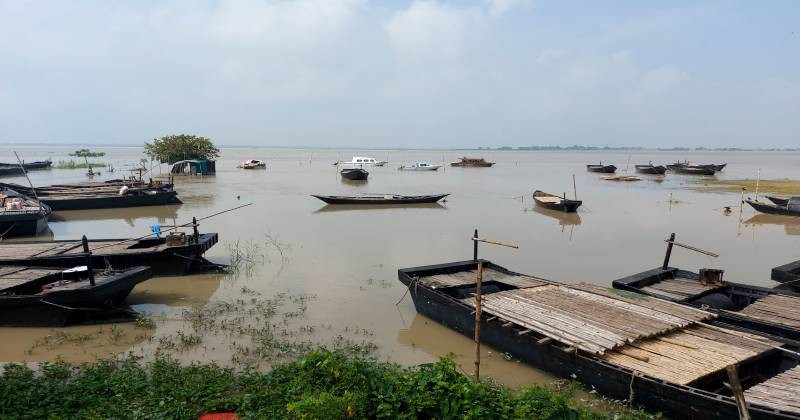
River erosion has intensified along the Padma and Mahananda rivers in Godagari of Rajshahi and Chapainawabganj Sadar as upstream floodwaters continue to rise following the opening of the Farakka Barrage gates. In Godagari Municipality’s Ward 4, around one kilometre of land at Yahia Mia Kup in Kuthipara Mahalla has been eroded by the Padma, sending more than 100 bighas of land into the river. Several roads in Char Ashariadah Union have also gone underwater.
Areas where geo-bags were placed to prevent erosion are now at serious risk. Floodwater is flowing over the geo-bags, and locals fear they could soon be washed away by the strong current. Residents said more than 200 bighas of land, including the road connecting the Diyar area with Manikchak, have already been lost to erosion. Paddy, jute, maize, banana, bitter gourd, pointed gourd, water spinach and dhaincha crops were also destroyed. Farmers were unable to harvest most of their crops, causing significant losses.
Meanwhile, five children drowned while bathing in the river at Dachar-Chakla village in Debinagar, Chapainawabganj Sadar, on Friday afternoon (August 28). The deceased were Ms. Sumaiya (11) and Ms. Suraiya (9) daughters of Mr. Nizauddin of Char Chakla village, Ms. Sumaiya (11) and Ms. Areeba (8) daughters of Masud Ali, a Cyprus expatriate from the same area, and Ms. Sharifa (11) daughter of Shariful Islam. Sadar Model Police Station Officer-in-Charge Ekramul Hasan confirmed the deaths, citing local residents.
Md. Babul Akhtar, a resident of the area, said extensive erosion by the Mahananda River in front of Alia Madrasa at Patu Market in Debinagar Union has washed away hundreds of bighas of farmland, bamboo groves and mango orchards. The road from Char Debinagar to Najipur has also been submerged, putting hundreds of people at risk while travelling through the area. The region has faced similar losses in previous years. Last year, rising Padma water submerged 1,559 hectares of crops, including Maskalai, transplanted Aush rice and other vegetables, across parts of Chapainawabganj Sadar and Shibganj upazilas. Around 5,315 farmers were affected, with damage reported to Maskalai, Aush rice, summer onions, Chinese sugarcane and other crops.
Locals have long blamed the Farakka Barrage for worsening the region’s water crisis and flooding. India commissioned the barrage on the Ganges on a trial basis in 1975. Located in Murshidabad, West Bengal, the barrage has 119 gates. Around 18 kilometres downstream, the Ganges enters Bangladesh and becomes the Padma near Chapainawabganj.
Bangladesh and India signed the Ganges Water Sharing Treaty in 1996. Locals and stakeholders, however, claim Bangladesh does not receive its expected share of water under the agreement. They also point to sharp fluctuations in river flow between the dry and rainy seasons. The 30-year water-sharing agreement is nearing its end, while concerns remain over equitable water access. Locals say the recurring rise in Padma water during the monsoon causes widespread flooding and river erosion across the region. This year, river erosion has already begun in several areas, raising fears of further damage to farmland, roads and settlements if the water level continues to rise.