
How Positive is Joining The Trilateral Mecca Defense Alliance?
Dr. Md. Abu Hassan
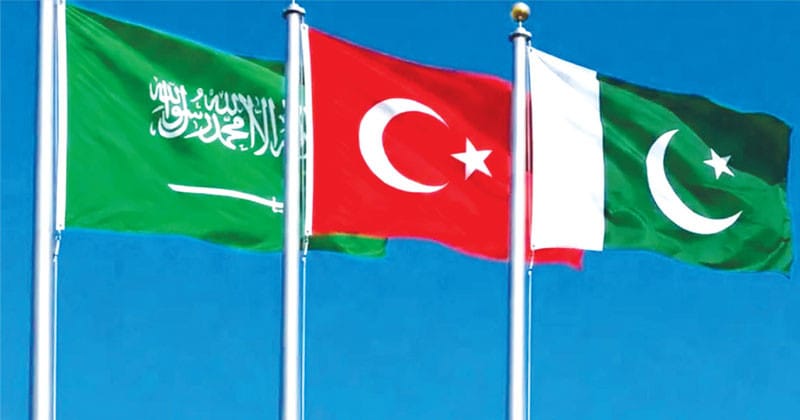
Following discussions for a combined military agreement that Saudi Arabia, Turkey, and Pakistan signed in Mecca on August 7, recent diplomatic disclosures have placed Bangladesh’s foreign policy decisions into sharp view. Turkish Foreign Minister Mr. Hakan Fidan has drawn technical parallels between this pact and NATO’s Article 5, stating that an armed attack on any one member will be considered an attack on all three. The proposal depends on a recently formed ministerial committee and institutional secretariat, although a fully integrated military command and automated response system have not yet been established. This security architecture combines Saudi Arabia’s significant financial and diplomatic power, Turkey’s defense manufacturing skills and NATO expertise, and Pakistan’s military and nuclear force.
Late in August, statements from high-ranking government officials made Bangladesh’s formal participation in the project publicly known. State Minister for Foreign Affairs Mr. Humayun Kabir declared on August 24 that Dhaka has officially expressed interest in the proposal and has a good opinion of it. During an August 27 national parliament session, Foreign Minister Mr. Khalilur Rahman clarified this position, stating that although direct membership has not yet been discussed, Bangladesh would welcome membership if requested by the member states. He went on to say that an extensive agreement may serve as a self-defense plan for the Muslim community worldwide, describing it as an internal matter that does not allow for external considerations.
This diplomatic shift takes place in the middle of urgent internal issues, particularly a severe oil and gas crisis and ongoing hostility with New Delhi. The prosecution and extradition of former Prime Minister Ms. Sheikh Hasina for crimes related to the 2024 mass uprising has put a great deal of tension on relations between Dhaka and New Delhi. Ms. Hasina was sentenced to death for crimes against humanity by Bangladesh’s International Crimes Tribunal in November 2025, putting her extradition and a critical evaluation of judicial autonomy, accountability, and trust. Bangladesh’s regional considerations have been made more difficult by a United Nations Human Rights Office report on the violence that occurred in July and August of 2024.
Analysts stress that Bangladesh’s participation in the Mecca agreement cannot be seen as simply a reaction to the extradition controversy involving Ms. Sheikh Hasina. Rather, in Bangladesh’s strategic environment, several kinds of geopolitical changes are creating multiple pressures and other routes. While the Mecca agreement has the potential to serve as a diplomatic hedging technique, foreign policy experts warn that effective hedging requires multiplying partners rather than just moving the center of gravity from one single reliance to a new group of numerous dependents. Foreign policy diversity must essentially avoid a collection of weaknesses.
Bangladesh has a critical dual reality regarding energy security, which complicates these larger strategic changes. Dhaka has had to balance its reliance on Indian energy supply during recent shortages with an effort to broaden its sources of purchase across foreign markets. As an example of this multi-source strategy, on August 19, Qatar officially promised to assist Bangladesh in meeting its urgent energy demands. Meanwhile, ongoing agreements include strategic interaction with China and Gulf countries. True energy resilience, according to experts, depends more on developing local storage resources, strong infrastructure, and varied supply chains than it does on shifting from one foreign source to another.
Bangladesh’s idea of national security also expanded to include economic considerations in addition to traditional military weapons like warships and border guards. Important commodities, including food supplies, secure supply chains, foreign exchange reserves, imported fuel, and gas to run industrial operations, are widely acknowledged as critical elements of national security. According to state leaders, receiving foreign aid does not automatically threaten national sovereignty; rather, the real institutional risk is the inability to make decisions on one’s own without outside assistance. Therefore, to guarantee that foreign partnerships provide true national value, they must be checked by strong domestic state institutions.
Particularly in the Gulf area, financial connections are still firmly rooted in traditional migration and labor routes. Data from Bangladesh Bank shows that for the financial year 2025, Saudi Arabia sent over $4.26 billion in remittances, or 14.06 percent of all remittances, while the Gulf countries as a whole contributed around 45 percent of all inflows. Practical diversity is also common in defense procurement outside of labor markets. According to media sources, Bangladesh is planning to begin official discussions in August 2026 to purchase Chinese J-10CE fighter planes and attack helicopters. This shows how security diversification is actively moving from diplomatic statements into actual military capabilities.
Given their shared 4,100-kilometer border, considerable trade, cross-border rivers, and regional electrical grids, Bangladesh is geographically unable to avoid India. Though authorities emphasize that Dhaka’s national policies cannot blindly match with Indian preferences without losing strategic negotiating power, sound bilateral relations with New Delhi remain an essential need. Normal interdependence runs the potential of becoming unequal influence when alternatives are reduced. As a result, managing relations with India requires preserving strong diplomatic power and making sure that bilateral collaboration advances shared goals rather than enforcing unilateral restrictions.
Ultimately, foreign policy analysts argue that Bangladesh’s biggest risk would be to believe that any strong international alliance or outside superpower could replace the capabilities of its own state. Building sustained autonomy requires avoiding reliance on any one group, even while ties with India, China, Saudi Arabia, Turkey, and Pakistan offer crucial economic and security cooperation. To ensure that diplomatic changes actively promote domestic technology, industrial manufacturing, and institutional strength rather than locking the country in new cycles of external reliance, Bangladesh must develop a practical politics of capability and alternative resilience.
Author: Associate Professor,
Shaheed Buddhijibi Government College, Rajshahi
Email: hhafij@yahoo.com