LNG crisis eases as new cargo arrives at terminal
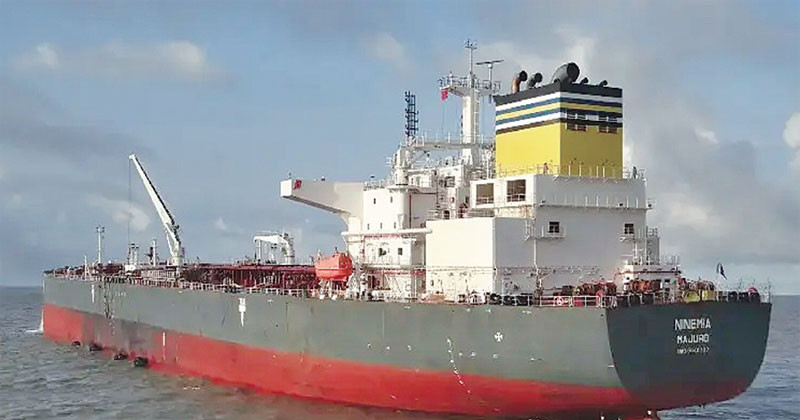
- Crude Oil Ship Traveling from the Middle East via Africa
Rafiqul Islam Selim
Another new ship carrying liquefied natural gas (LNG) has docked at the floating LNG terminal in Moheshkhali. The Greek-flagged tanker named Maran Gas Olympias anchored at the terminal yesterday, Thursday, at 3:30 PM. Mohammad Nasir Uddin, Deputy General Manager (LNG) of Rupantarito Prakritik Gas Company Limited (RPGCL) — the entity responsible for LNG imports on behalf of Petrobangla — told Inqilab that gas from this cargo will be supplied to Summit Power’s terminal, and all preparations have been made for this. He said that terminal is currently supplying 450 million cubic feet of gas, and with the new cargo added, supply can be increased by 100 million cubic feet, meaning gas supply could increase starting today, Friday.
The Maran Gas Olympias, 295 meters long and 46 meters wide, has a capacity of 95,194 metric tons. This is the third ship to bring LNG this month; two other ships arrived earlier on September 2 and 4. A decision was already made to import 10 cargoes this month, of which eight have had their schedules announced. According to the schedule, another cargo will dock at Moheshkhali next Monday, and gas from that cargo will be supplied to the US company Excelerate’s terminal. That terminal is currently supplying 200 million cubic feet of gas, although its capacity is 550 million cubic feet; supply from this terminal has been reduced as LNG stock runs low. Officials say three more LNG cargoes are scheduled to arrive by September 23. If these cargoes arrive on time, the two terminals combined will be able to supply a maximum of 1,100 million cubic feet of gas; until then, supply will remain limited to between 700 and 750 million cubic feet.
However, if the new cargo arrives Monday, gas supply could increase further. According to the schedule, another cargo will arrive from Aramco on September 18, from Total on September 23, and from Gunvor on September 28. Those concerned are hopeful that the entire month’s demand (10 cargoes) of LNG will arrive this month, and say that once these cargoes arrive, uncertainty over LNG will be fully resolved. Meanwhile, to meet the country’s urgent gas demand, the Cabinet Committee on Economic Affairs has approved a proposal to import 18 more LNG cargoes through direct purchase from TotalEnergies. According to the proposal, Bangladesh will import two cargoes of LNG per month from next October through June 2027, meaning a total of 18 LNG cargoes are planned to be brought into the country within the specified period.
Crude Oil Ship Traveling via Africa
Avoiding the Strait of Hormuz and surrounding waters, which have become risky due to the war in the Middle East, a ship named “MT Ninemia” carrying more than 100,000 tons of crude oil is arriving in Bangladesh tomorrow, Saturday, after traveling via Africa. It has been learned that the Marshall Islands-flagged MT Ninemia — 249.95 meters long, 44.4 meters wide, with a draft of 14.6 meters — is carrying 104,026 tons of crude oil. MT Ninemia began its journey after loading crude oil from Yanbu port on July 23. The ship, built in 2024, is traveling at a speed of 11 nautical miles. It has already reached close to Bangladesh’s maritime boundary. As usual, preparations for lightering the crude oil into smaller tankers have been completed for when MT Ninemia arrives at the outer anchorage.
This ship had earlier brought the first crude oil shipment to Bangladesh after the outbreak of war between Israel, the United States, and Iran, which had allowed the country’s sole state oil refinery, Eastern Refinery, to restart its closed unit after crude oil stocks ran out. The state-owned Bangladesh Shipping Corporation (BSC) transports 100% of Bangladesh Petroleum Corporation’s (BPC) crude oil. In the interest of the country’s energy security, BSC agreed to the proposal from the ship’s owners or local agent to travel via Africa to reach Chattogram port. Under normal circumstances, the ship would travel from Saudi Arabia’s Yanbu port through the Red Sea and the Bab-el-Mandeb Strait, covering 4,200 nautical miles to reach Chattogram port’s outer anchorage in 13-15 days. But on the new route, via the Suez Canal, the Strait of Gibraltar, and South Africa’s Cape of Good Hope, the distance has increased by nearly 9,000 nautical miles, taking about 52 days. On this longer route, costs are rising by several million dollars for the ship’s own fuel — low sulfur fuel, marine gas oil — Suez Canal transit fees, charter costs, and so on. While some costs, including fees, are fixed, the full accounting will be finalized through negotiation between both parties.
An official of Eastern Refinery PLC said that Eastern Refinery (ERL), under BPC, is currently refining about 4,400 metric tons of crude oil daily, for which ERL receives a refining fee from BPC. Diesel makes up the largest share of the refined output, with LPG, furnace oil, kerosene, and MS octane also produced as by-products. ERL’s tanks hold crude oil stock of about 160,000 tons. Eastern Refinery’s production had stopped in mid-April because crude oil could not arrive on schedule due to the Iran war; it resumed on May 8 after crude oil arrived via the MT Ninemia. The government did manage the wartime energy crisis by importing large quantities of refined diesel from alternative countries outside the Middle East, but BPC is now bringing crude oil via the alternative, costlier route to keep Eastern Refinery operational. Eastern Refinery refines 1.5 million tons of crude oil annually, meeting about 20% of the country’s annual demand of 7.2 million tons. To meet domestic demand, 92% of fuel oil must be imported, with the remaining 8% coming from local sources and processed condensate.