

Pass Property Transfer Bill in Accordance with Shariah Law
Islamic leaders and prominent Islamic scholars in Bangladesh have strongly demanded that the Transfer of Property (Amendment) Bill 2026 be aligned with Shariah principles after thorough consultation with expert religious authorities. At a press conference held at the party’s central office in Purana Paltan, Islamic Movement Bangladesh called for the immediate cancellation of the controversial legislation. Announcing protest programs across divisional cities following Friday prayers, the leaders expressed deep dissatisfaction with the current legislative direction. They highlighted that introducing property-related amendments without consulting religious scholars risks violating fundamental Islamic principles governing wealth distribution.
Religious figures expressed deep outrage over the passage of the bill, claiming that the government went back on its explicit commitments regarding religious legislation. Expressing regret, Islamic Movement Bangladesh Senior Vice President Muftī Muhammad Syed Fayzul Karim stated, ‘The current government repeatedly pledged not to enact any laws contrary to the Quran and Sunnah, yet passed Shariah-opposed legislation within six months.’ Present at the event were Secretary General Maulana Gazi Ataur Rahman, Presidium Member Professor Mahbubur Rahman, and other central figures who jointly reiterated the urgent demand for the law’s immediate repeal.
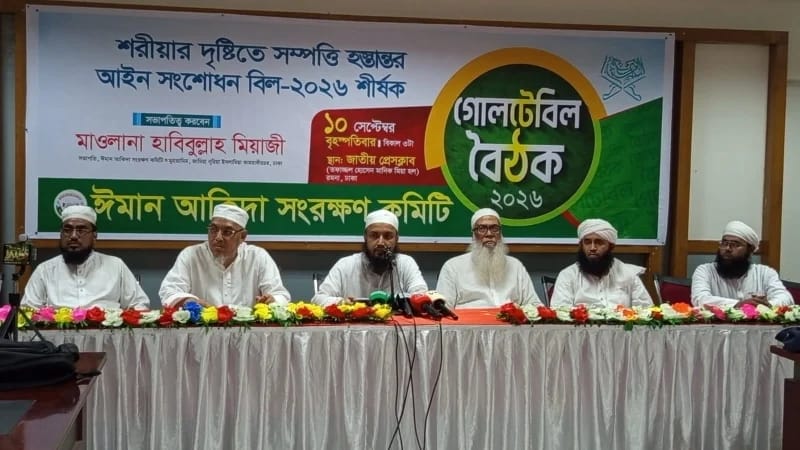
Meanwhile, leaders of the Iman-Aqida Sangrakshan Committee and prominent scholars voiced deep concern over the bill during a roundtable discussion at the National Press Club. Chaired by Maulana Habibullah Miyaji and moderated by Mufti Salah Uddin and Mufti Imranul Bari Siraji, the meeting brought together prominent scholars including Maulana Abdur Hamid Peer Saheb Madhupur and Dr. Ahmad Abdul Kader. The speakers emphasized that even if the intent behind the legislation is good, any clause conflicting with Quranic and Sunnah principles remains a highly sensitive matter in Muslim-majority Bangladesh. Consequently, they urged the PM to consult expert scholars before finalizing the law.
Adding to the widespread criticism, Bangladesh Khelafat Andolan leaders asserted during a Majlis-e-Amela meeting in Purana Paltan that Allah has prescribed clear laws regarding parental maintenance and inheritance rights in sacred texts, chaired by Joint Secretary General Maulana Md. Hossain Akand and attended by Secretary General Mufti Fakhrul Islam, the leaders argued that enacting laws against divine guidance under the guise of protecting parents is unacceptable. They emphasized that in a Muslim-majority society, people distribute property following Islamic jurisprudence, and the government should not attempt to alter these established religious practices through statutory amendments.
To address parental security effectively without compromising religious tenets, the leaders suggested implementing strict state enforcement mechanisms rather than altering property rights. They advised that the government should establish an administrative framework compelling children to care for their parents until death while keeping inheritance frameworks intact. Issuing a stern warning, the Majlis-e-Amela leaders remarked that those who opposed Allah’s law in the past could not remain in power, nor will anyone in the future. They called upon policymakers to respect divine law and consult legal and religious experts to ensure stability and public harmony.