Government Rejected Our Offer of Cooperation: Dr Shafiqul Rahman
Bogura Bureau and Tangail District Correspondent
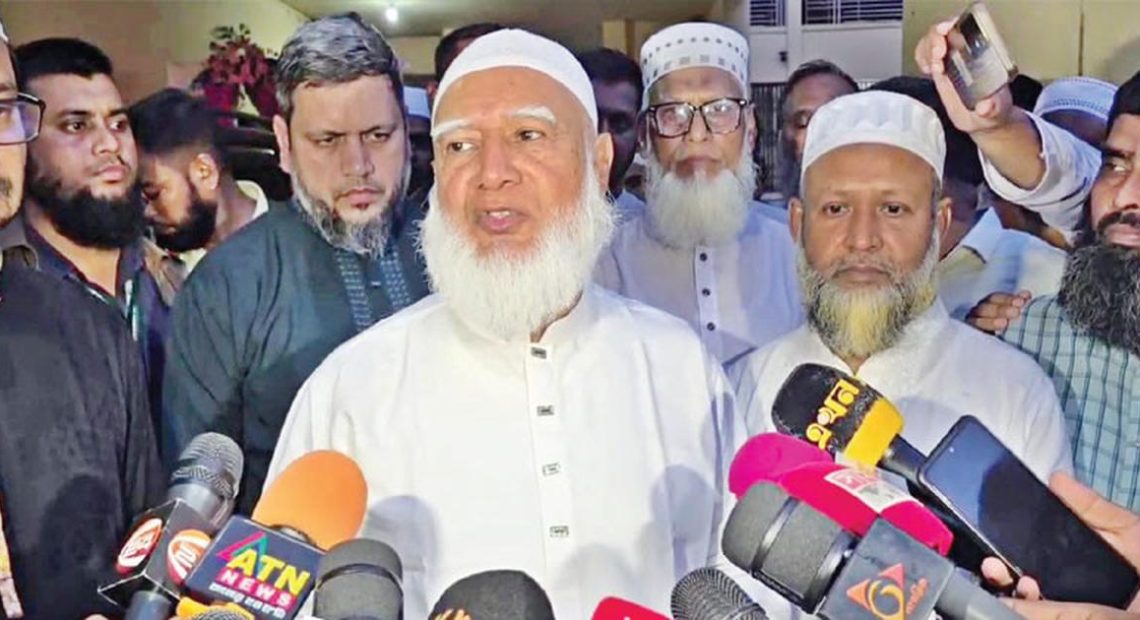
Parliamentary opposition leader and Bangladesh Jamaat-e-Islami Ameer Dr Shafiqul Rahman has said that when they raise the issue of the oil, gas and electricity crisis, the government threatens that the autocratic rule will return. Yet, the people are suffering. He said the opposition had wanted to assist the government in resolving the crisis through a team of technical experts, but the government did not accept the proposal.
“After repeatedly raising the issue in parliament without being able to do anything, we took to the streets,” he said.
He said that after the 2024 revolution, the people wanted fundamental reforms in the country. To achieve those reforms, they voted in favour of “Yes” in the referendum and made it victorious. But as soon as the government came to power, it broke that promise and did not implement the referendum verdict.
The opposition leader said, “Wherever we see inconsistency, we will speak out. But I never thought I would have to speak for Bogura. Bogura has always been neglected and deprived. I want Bogura to receive what it is entitled to.”
Dr Shafiqul Rahman made the remarks while exchanging views with local journalists at the Bogura Circuit House auditorium yesterday morning, Saturday.
He said Bangladesh has passed 55 years since independence. “For a nation, this is by no means a short period. If we look at Malaysia, its age of independence is not much greater than ours. Yet Malaysia has secured a place for itself in the world. If we look at Japan, just two years after World War II, it was able to make a transition to become the world’s largest electronics and mechanical industry. But where is Bangladesh?”
He said that during the Pakistan period, Pakistanis exploited the country and conducted business here. After independence, those properties came under the ownership of the state of Bangladesh. Adamjee Jute Mill was once described as the world’s largest jute industry, but today there is no trace of Adamjee’s former identity. Everything was looted after independence. An industrial park has now been established there, but Adamjee’s former glory is gone. “I am not taking the side of Pakistani business magnates. I am giving examples of our mentality and reality,” he said. He said that although some industrial facilities have been established in the country, they are not enough. The main strength of industry is electricity, which comes from three sources—oil, gas and solar power.
The country is currently facing a severe crisis due to electricity and gas shortages, he said. Industry has been seriously affected. Recently, leaders of the Bangladesh Garment Manufacturers and Exporters Association (BGMEA) met with the President and said that their production had fallen below 50 percent because they were not receiving electricity according to demand.
As a result, they would be unable to repay bank loans, become loan defaulters and lay off workers, he said. If they fail to deliver orders to buyers on time, the buyers are moving to other countries. “If this is the condition of our largest export sector, the situation of the others can be understood from this,” he said. The opposition leader said they had wanted to assist the government in resolving the crisis by forming a team of technical experts on behalf of the opposition in parliament. The team would work with the government’s experts to develop ways to resolve the crisis. “We love the country, which is why we made this offer. In the history of Bangladesh’s parliament, the opposition has never made such an offer to the ruling party,” he said. He said that when an oil crisis emerged earlier, they went from one filling station to another, spoke to people and raised the issue in parliament, but the government denied the crisis. They also denied the electricity crisis and made “absurd” and “irresponsible” statements. “The concerned minister said in a statement in parliament that electricity could not be supplied properly because of its length,” he said.
When they realised they could not accomplish anything inside parliament, they took to the streets with this demand along with five other demands. The movement has now entered its second phase, with a long march underway. He said many things were being said about the long march. Some questioned why they were conducting the march with so many vehicles amid an oil crisis.
“Even if we had not organised the long march, these vehicles would not have remained idle; they would have continued to move. Rather, through the long march, we are carrying out a movement to realise the people’s demands,” he said. He said they wanted to make people aware of their rights through the movement. “One day, the people’s demands will be fulfilled in this way. The movement will continue until the demands are met.”
Dr Shafiqul Rahman said the responsibility of the opposition is to guard and protect the rights of the people and work as a vanguard. “An autocratic regime can never be established by the opposition. A ruler can be a good ruler or an autocrat. We were under autocratic rule for 15 and a half years. We lost many of our leaders, while many who disappeared have still not returned. Their relatives do not know whether their loved ones are alive or dead,” he said.
The Jamaat ameer said that after the 2024 revolution, the people wanted fundamental reforms in the country. They supported the reforms and urged the people to vote “Yes” in the referendum. The people responded to their call, with 68.2 percent of the votes cast in favour of “Yes.” “But as soon as the government came to power, it broke its promise. They will not implement the referendum verdict,” he said.
Regarding Bogura’s development, the Jamaat ameer said, “Wherever we see inconsistency, we will speak out. But I never thought I would have to speak for Bogura. Bogura has always been neglected and deprived. I want Bogura to receive what it is entitled to.”
Jamaat’s Bogura metropolitan ameer Professor Abidur Rahman Sohel, central leaders of the party and journalists working for various print and electronic media were present at the exchange of views.
After the programme, the Jamaat ameer attended a Rukon conference of the Bogura district and metropolitan Jamaat at Hotel Momo Inn Convention Centre. In the afternoon, he exchanged greetings with students and teachers of Jamil Madrasa, the largest Qawmi madrasa in the northern region.
Meanwhile, speaking to journalists after an organisational visit to Tangail yesterday afternoon, Dr Shafiqul Rahman said, “Our country is not doing well. If the government wants, the opposition will cooperate at any time for the sake of the nation. The country belongs not only to the government; the opposition is not free from responsibility either. Both the government and the opposition have responsibilities toward the country. Everyone must unite to build the country.”
He further said a major crisis had recently emerged in the fuel and power sectors. He had submitted a notice under Rule 68 in parliament on the issue. The matter was discussed in parliament on the 7th, with statements from both the government and opposition.
He said there are skilled technical teams at home and abroad capable of addressing the fuel crisis. Although a proposal was made to involve these experts with the government in the national interest, no response has yet been received from the government.
However, the concerned state minister has said that a team would be formed to present a proposal, he added.