

Every Citizen Must Have Access to Quality Healthcare: Dr Zubaida Rahman
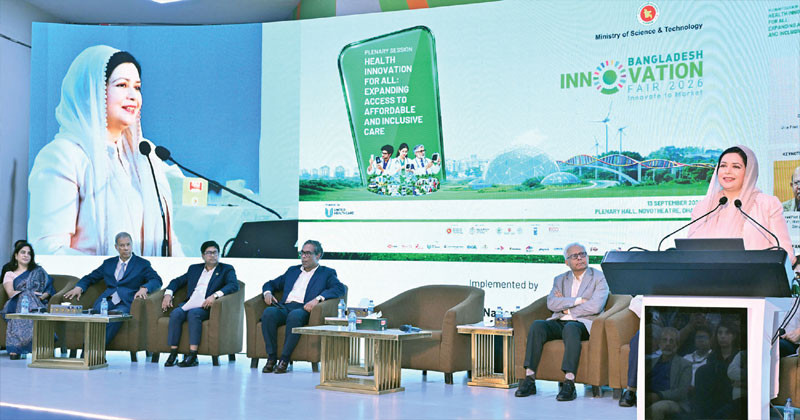
Dr Zubaida Rahman, wife of Prime Minister Tarique Rahman and Vice President of the Ziaur Rahman Foundation, has said that quality healthcare must be made accessible to every citizen of Bangladesh. Healthcare is not a privilege; it is a fundamental human right.
She made the remarks as the chief guest at a plenary discussion titled “Health Innovation for All: Expanding Access to Affordable and Inclusive Care” at the Bangladesh Innovation Fair 2026, held at the Novo Theatre’s plenary hall in the capital on Sunday. The Ministry of Science and Technology organised the fair.
Dr Zubaida Rahman said many people seek treatment at specialised hospitals only after their health conditions become complicated. As necessary healthcare services are not available close to their homes, patients have to travel long distances to receive treatment.
She said modern advanced healthcare has become very expensive. However, this is not a problem faced only by Bangladesh. Many developed countries are also facing similar challenges. “We often say prevention is better than cure. This is true, but it is essential to diagnose diseases and their risks before they become severe.”
Dr Zubaida Rahman said healthcare services must reach even remote villages so that everyone in the country can receive healthcare and it becomes accessible to every citizen. She said dengue patients should not have to travel long distances to receive treatment. Parents of children suffering from measles should have access to healthcare close to their homes. Every screening programme should be linked with confirmed diagnosis, counselling, treatment, medicines, follow-up and referral services.
Dr Zubaida said this approach to healthcare is based on a clear principle: quality healthcare should not be a privilege dependent on income, location or social status. It should be accessible to every citizen in every part of Bangladesh. She said the approach includes strengthening primary healthcare, bringing healthcare services closer to people’s homes, expanding preventive programmes, increasing the number of healthcare workers and gradually raising public investment in the health sector to 5 percent of GDP.
She further said the plan to recruit 100,000 healthcare workers creates an opportunity to build the human foundation of this transformation, with women able to play an important role. These healthcare workers can support communities through screening, maternal and child healthcare, health education, management of chronic diseases and referrals.
Dr Zubaida said the referral system needs to be strengthened to ensure the smooth transfer of patients from community and primary healthcare facilities to district and specialised hospitals. She said Bangladesh needs a nationally coordinated system covering voluntary blood donation, safe blood collection, screening for infectious diseases, separation of blood components, storage, transportation and complete traceability from blood donors to patients.
She further said innovation would play an important role in these initiatives. However, innovation does not always mean inventing an expensive device or launching a new app.
State Minister for Health and Family Welfare Dr M A Muhit attended the event as a special guest. The Prime Minister’s Special Assistant for Health Affairs, Dr S M Ziauddin Haider, moderated the programme. Professor A K Azad Khan presented the keynote paper.
The panel discussion was joined by Department of Drug Administration (DGDA) Director General Alamgir Hossain; Bangladesh Association of Pharmaceutical Industries (BAPI) Senior Vice President M Mosaddek Hossain; TMSS Deputy Executive Director Dr Matiur Rahman; DGDA Director Dr Md Akhtar Hossain; United Healthcare Services Limited Director of Medical Services Dr Azharul Islam Khan; and SKGREN Limited Founder and Chief Executive Officer Dr Sadaf Saj Siddiqui.