Bangladesh seeks minimum military strength for minimum deterrence
Mobaidur Rahman
Last Tuesday, September 15, in this column in Inqilab, I promised to discuss the new direction taken in Bangladesh’s defense and foreign policy and in its weapons procurement. I also said I would compare the military strength of India, Pakistan, Myanmar and Bangladesh, and explain what Bangladesh plans to do to build up its armed forces. Today I am keeping that promise.
Bangladesh’s defense system and military strength rarely come up for discussion at home or abroad. This is because there is little to discuss. For a country of 180 million people, what we have is very small compared to what is needed. Because of this, the outside world does not take us seriously from a military point of view.
To understand this, let us briefly look at the military strength of Bangladesh, India, Pakistan and Myanmar. Countries rarely give official details of their full military strength, so we rely on figures from two of the most widely cited military publications in the world. One is Global Fire Power. The other is the Military Balance report from the International Institute for Strategic Studies in London. A third source is SIPRI, the Stockholm International Peace Research Institute, based in the Swedish capital. This article draws on data from these three organizations.
First, India. India’s army has 1,431,000 active personnel and 1,000,000 in reserve. The air force has 289,000 personnel and the navy has 149,000. India has 3,913 tanks, 476 fighter jets, and 594 attack helicopters.
India also has 2 aircraft carriers, 13 destroyers, 18 frigates and 18 submarines. Its main fighter jets include the Russian Su-30, 36 French Rafale jets, 45 French Mirage 2000 jets, and 60 MiG-29 jets. Older aircraft such as the domestically built Tejas, the Jaguar and the MiG-21 are not counted here since they are outdated.
It should be noted that India has the world’s fourth largest military, behind only the United States, China and Russia. It is also a nuclear power, a fact that hardly needs mentioning.
Myanmar’s military has 228,000 active personnel and 19,000 in reserve. It has 1,040 tanks, 70 fighter jets and 20 attack helicopters. Its navy has 3 frigates and 2 submarines.
Pakistan’s active military has 660,000 personnel, of which 560,000 are in the army. It has 550,000 reserve troops. The air force has 70,000 personnel and the navy has 30,000. Pakistan has 2,677 tanks and 331 fighter jets.
Pakistan can reportedly raise this number to 420 fighter jets quickly by reactivating reserve aircraft. Its navy has no aircraft carrier and no destroyer, but it has 9 frigates and 8 submarines. Pakistan is also a nuclear power, which again hardly needs mentioning.
Bangladesh’s military has 215,000 active personnel and no reserve force. It has 320 tanks and 41 fighter jets, including 8 MiG-29 jets, all of which are reported to be grounded. The remaining fighter jets are older Chinese F-6 and F-7 models. The navy has 2 submarines and 7 frigates.
Comparing the military strength of these four South Asian countries shows that Bangladesh is militarily weaker even than Myanmar. Still, it is true that the members of Bangladesh’s armed forces are skilled, disciplined and brave. If Bangladesh ever had to face Myanmar with its comparatively weaker military, I believe our courage and skill could allow us to respond effectively. However, none of us want any military confrontation.
Two
Discussion of Bangladesh’s military strength grew after the July uprising, during the interim government led by Dr. Yunus. Around this time, India and Pakistan fought a brief war. Some time before that, Bangladeshi and Indian media were full of reports that India had bought the advanced French made Rafale fighter jet.
News reports called the Rafale a fifth generation fighter jet, but I later checked and found it is actually a four and a half generation aircraft. True fifth generation fighter jets include the American F-22 and F-35, the Russian Su-57, the Chinese J-20 and J-35, and the Turkish KAAN. In fact, neither Pakistan nor India possesses any fifth generation fighter jet.
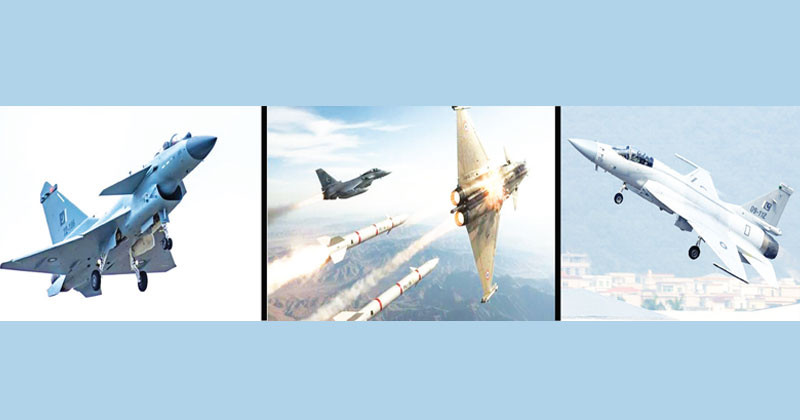
During the brief India Pakistan war, Pakistan used its Chinese built four and a half generation J-10C fighter jet to shoot down two of India’s four and a half generation Rafale jets. Separately, using the jointly built Chinese Pakistani fourth generation JF-17 Thunder, Pakistan shot down an Indian fourth generation Russian built MiG-29.
After this, the post revolution Yunus government in Bangladesh began a project to modernize the country’s armed forces. The first priority was acquiring China’s J-10C and Pakistan’s JF-17 Thunder fighter jets. The current government’s information adviser has said that talks begun under Dr. Yunus to buy 20, or by some accounts 24, fighter jets have progressed significantly.
An agreement between the two countries could be signed soon. It is even being said that at least 16 J-10C fighter jets could arrive in Bangladesh by 2027. Bangladesh is also continuing talks with Pakistan to buy the fourth generation JF-17 Thunder fighter jet.
These aircraft have the advantage of multirole capability, meaning they can perform several types of missions. They are also affordable. Besides Pakistan and Myanmar, the JF-17 Thunder is also used by Azerbaijan and Nigeria.
The J-10C jets that Bangladesh plans to buy from China are also multirole fighters. They are equipped with the PL-15 missile. This missile can detect an enemy aircraft or missile from 200 miles away and strike it. This is how Pakistan’s J-10C jets shot down India’s Rafale jets.
Beyond fighter jets, Bangladesh is also in talks with China to acquire surface to air and air to surface missiles. Discussions are also underway for radar systems that can detect missiles or fighter jets flying at very low altitude.
Three
The Yunus government did not focus only on strengthening the air force. It also paid attention to building up the army and the navy. According to published reports, the BNP government led by Mr. Tarique Rahman has continued this same military buildup policy started under Dr. Yunus.
Meanwhile, India and pro Awami League voices have been quietly asking why so much money is being spent on weapons. They ask whether Bangladesh could ever actually fight and win a war against India. But this is not really the right question.
The real question is that every country needs a minimum deterrence capability, meaning a basic level of defense that can resist an attack. If India were ever to attack, Bangladesh would need enough military strength to hold out for some time. During that time, diplomacy could end the aggression, or friendly countries could step in to help.
We are not saying that India will attack us. But when news came out under Dr. Yunus that a large modern airport would be built in Lalmonirhat, the Indian media did more than just create a stir. They also issued military threats against Bangladesh.
They claimed that the proposed Lalmonirhat airport was actually meant to be an air base, built with Chinese help. They said the target of this air base would be India’s Siliguri Corridor, commonly known as the Chicken’s Neck.
Four
The proposed Lalmonirhat airport is about 135 kilometers from India’s Siliguri Corridor or Chicken’s Neck. Indian voices have spread the claim that the airport project in Lalmonirhat is really a cover to bring in Chinese forces to threaten the Siliguri Corridor.
It should be noted that the Siliguri Corridor is a narrow strip of land of great strategic importance lying between Bangladesh and India. It is 52 kilometers long, and at its narrowest point only 22 kilometers wide. If this corridor were ever taken by a foreign power, India would be split into two parts.
One part would include West Bengal and the rest of western India. The other part would include the seven northeastern Indian states known as the Seven Sisters. Indian media and BJP leaders in West Bengal have warned Bangladesh that if it looks toward the Chicken’s Neck with bad intentions, Bangladesh should remember it also has two vulnerable points of its own.
They named these as Feni and the Rangpur division. They threatened that India could seize these two areas of Bangladesh in only twenty plus twenty, or forty minutes combined. Given these threats from India, Bangladesh must maintain minimum deterrence capability.
India has built up heavy military strength around its own small and narrow Chicken’s Neck area, and continues to do so. At the same time, it points to Bangladesh’s Rangpur division and Feni as Bangladesh’s own vulnerable Chicken’s Neck points. I hope to discuss the military importance of Lalmonirhat, Feni, the Siliguri Corridor, and the preparations of Bangladesh and China in more detail another time.