Sharp Contrast in the Two Bengals: Bangladesh Sees Best-Ever Durga Puja as Eid Joy Crumbles in West Bengal
With the change of government and a new polarisation in politics, unprecedented diversity and contrast have come to the sphere of religious festivals in Bangladesh and neighbouring India. On one side, under the BNP government, Bangladesh’s minority Sanatan Dharma followers celebrated one of the largest and most joyous Durga Pujas in the country’s history. On the other, in India’s West Bengal, since the Hindutva-driven Bharatiya Janata Party (BJP) formed a government against the backdrop of a change of power, the joy of the religious festivals of the state’s largest minority, the Muslim community, has been turned to dust in the face of severe crisis and oppression.
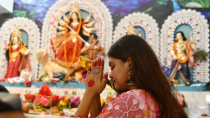
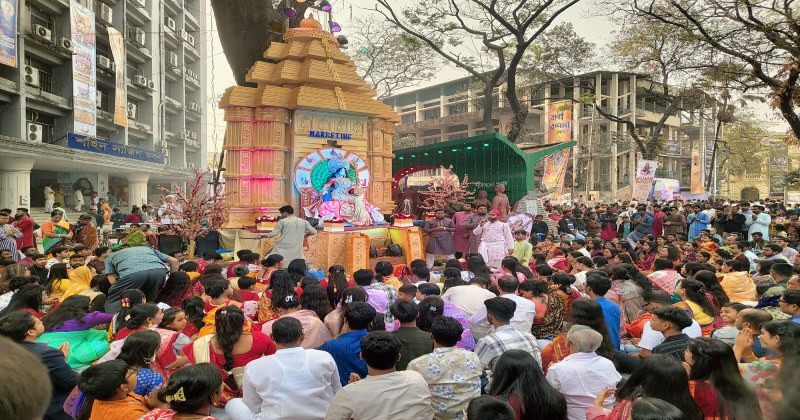
This year’s Sharodiya Durga Puja has created a new history in Bangladesh. The five-day festival ended in a highly orderly and peaceful atmosphere, with idol immersions at Wise Ghat and thousands of water bodies across the country on Bijoya Dashami. The immersion arrangements took on a universal character, with the beat of drums, the sound of gongs and bells, and the prayers of devotees. Devotees bade farewell to Goddess Durga with sorrow and prayers, and, according to their respective faiths, prayed for the welfare of the country and their families.
Local media, social media and ordinary netizens have unanimously described this year’s Durga Puja as “the best and safest ever.” Even Indian tourists visiting Bangladesh have heartily praised this year’s peaceful and trouble-free festival arrangements. Under the overall supervision of Dhaka district Superintendent of Police Shamima Parvin, no major untoward incident or deterioration in law and order occurred anywhere in Bangladesh, not only in Dhaka.
The media have identified seven historic achievements as mainly behind this unprecedented success of Puja in Bangladesh:
1. Record number of puja pandals: According to the Puja Udjapan Parishad, the number of pandals across the country rose from 32,351 to 33,851, about 1,500 more than last year.
2. Highest government budget and grants: The government’s budget for Puja was raised from the earlier Tk 5 crore to a special allocation. New clothes and grants were distributed among needy Sanatan Dharma followers.
3. Record government holidays: Whereas the holiday for Durga Puja used to be one day, this time it was extended to three days in a row. Combined with the weekend, this gave a long break of five consecutive days, creating a new festive mood among people at every level.
4. Highest oversight by government and administration: Continuous vigilance by deputy commissioners (DCs), superintendents of police (SPs) and upazila nirbahi officers (UNOs) at the field level, and their efforts to ensure security, brought a flood of devotees to the pandals. As soon as reports of one or two isolated incidents came in, police took immediate strict action and kept the situation fully under control.
5. Human shield and guard by political parties: Leaders and activists of various political parties and their affiliated organisations, down to the grassroots, came forward to guard temples and give overall support, ensuring a joyful atmosphere free of extortion and provocation.
6. Presence and assurance of top leadership: The universality of the Puja was strengthened by on-the-spot visits to pandals in various divisions. The administration made clear that, in the eyes of the constitution, every citizen has equal rights.
7. Greatest decoration and international praise: The major pandals across the country had dazzling illumination and decoration. Foreign diplomats and Indian visitors were also impressed by the Banani Puja pandal and the management of Dhakeshwari National Temple in the capital. In the media and on social media, many Indian tourists and Sanatan Dharma visitors frankly admitted that the safe, joyful and varied atmosphere in which Puja was celebrated in Bangladesh this year far exceeded their expectations.
Rise of the BJP in West Bengal: Muslims’ Eid joy turned to dust
A picture completely opposite to this harmony and festive spirit in Bangladesh was seen in India’s West Bengal. Since the Hindutva-driven BJP, as a new political party, took the seat of power, ending the long rule of the Trinamool Congress, a major blow has struck the religious freedom of the state’s largest minority, the Muslim community.
The state’s traditional atmosphere of harmony has collapsed as the nature of governance changed after the political shift. The biggest blow has come to the two main Muslim religious festivals, Eid-ul-Fitr and Eid-ul-Azha:
Since the BJP formed the government in the neighbouring state, strict bans and legal restrictions have been imposed on cow slaughter at Qurbani Eid. In the name of cow protection, the rampage of so-called “gau rakshak” groups has reached extreme levels in various districts of the state. Attacks, torture and harassment of ordinary dairy traders and marginal Muslims over the buying, selling and transport of animals have become routine, turning the normal joy of the last Eid-ul-Azha into fear.
The main Eid congregation had been held for more than a century at Kolkata’s historic Red Road, with lakhs of people taking part. But under the influence of Hindutva politics, unprecedented obstacles were created for holding this huge, century-old Eid congregation, citing security and other administrative pretexts. Such government obstruction and strictness over prayers at Red Road created extreme anger and deep sorrow among the state’s Muslims and civil society. Meanwhile, the Shubhendu government celebrated Puja this time by keeping this important Kolkata road closed for four days in a row.
The surprising thing is that, while Bangladesh saw this record-breaking festive picture, the exact opposite was seen in Shubhendu’s West Bengal. Earlier this month, 19 people died in a tragic accident at the Chorbagan festival at Girish Park in Kolkata. They died in a stampede and from suffocation while trying to enter a temple in heavy rain, and the joy of the festival was dimmed. After the political change and the defeat of the Trinamool Congress, this year’s Puja turned sorrowful for Chief Minister Shubhendu Adhikari, a controversial political figure, as well.
On one side, a note of sorrow in Kolkata over disorder, mismanagement and political instability at the festival; on the other, a peaceful Puja at a record number of pandals in Bangladesh without any untoward incident, which has sent a positive message in the international arena as well.
Against this backdrop of political and social change, the picture of the two Bengals is clear. In Bangladesh, through political and administrative goodwill, the minority community’s festival has gained a new dimension and unprecedented security. In West Bengal, because of a Hindutva extremist system of rule, the religious festivals and Eid joy of the Muslim community, which have continued for century upon century, are facing the sad experience of severe suppression and being turned to dust.
Amid this contrast in the security and joy of religious festivals, data from the International Monetary Fund’s latest World Economic Outlook has come to light. The report showed that India has slipped somewhat in per capita gross domestic product (GDP), with Bangladesh moving ahead, as Bangladesh’s per capita GDP stands at 2,886 US dollars.