
Call to Restore Faith in Allah (SWT), Establish Prayer and Introduce State-Run Zakat System in Constitution
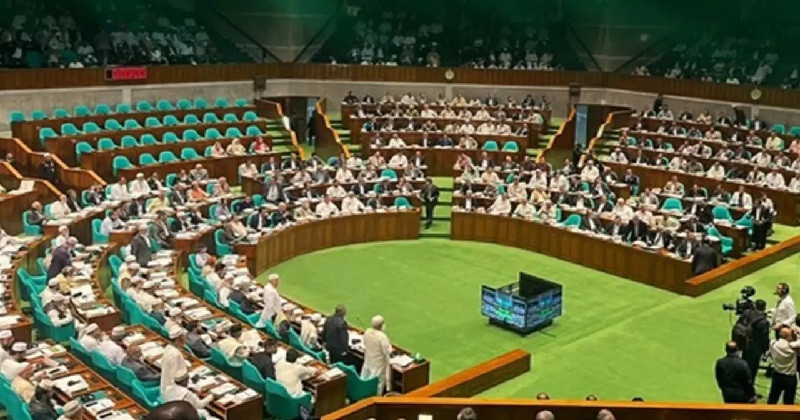
Standing on a point of order during a session of the National Parliament, Rajshahi-1 constituency MP Mujibur Rahman demanded the restoration of full faith and trust in Allah (SWT) in the Constitution, the establishment of prayer, and the introduction of a state-run zakat system.
He also stressed the importance of MPs’ religious practice and character building and urged them to make proper use of prayer breaks in Parliament. Later, the Speaker gave an important ruling on the issue, explaining parliamentary rules and noting that religious practice falls under an individual’s freedom of religion.
During another point of order in the session, when the issue of the tragic death of two members of the armed forces in an accident during a military exercise in Hathazari, Chattogram, was raised, the Speaker reminded the House of the proper procedure for using a point of order.
On Wednesday (September 9), three MPs spoke on separate issues under points of order during the National Parliament session, chaired by Speaker Hafiz Uddin Ahmed. Referring to the constitutional provision on faith and trust in Allah, MP Mujibur Rahman said that the Constitution originally contained a provision on faith and trust in Allah as a fundamental principle, which was later removed.
Mentioning that more than 90 percent of the country’s population is Muslim, he reminded the House about the breaks for Asr and Maghrib prayers. He stressed that when given the responsibility of power, the primary duty is to establish prayer and eliminate hunger, poverty and unemployment from society through the zakat system.
Urging the introduction of prayer and zakat at the state level, he called on the Speaker and the Prime Minister to take initiatives in this regard. He said that establishing prayer and zakat through administrative initiatives would help build citizens’ character and facilitate accountability in the hereafter.
Responding to MP Mujibur Rahman’s remarks, the Speaker said from the chair that religious practice is entirely a matter of personal freedom and belief.
Referring to Islam as a religion of humanity, the Speaker said that the specific rule is that those who practise religion properly will attain paradise, while those who neglect it will go to hell.
The Speaker made it clear that no one can be forced to practise a religion through any parliamentary notice. However, respecting the sentiment expressed in the statement, he expressed hope that everyone would follow the commandments of Allah (SWT).
At one point, MP Rashedul Islam Rashed, elected from Chattogram, stood on a point of order and informed Parliament about the tragic death of two members of the armed forces in tank shelling at the field firing range in Hathazari, Chattogram. He formally informed the Speaker and the House that two soldiers had been killed and an officer seriously injured in a sudden accident during a firing exercise.
However, after the statement, the Speaker reminded the House of the rules governing the use of a point of order. He clarified that a point of order can be used only to correct an error in an ongoing discussion or to prevent disorder. Therefore, he said it was not appropriate to bring news of an unforeseen accident directly under this provision. Meanwhile, Mymensingh MP Fakhruddin Ahmed strongly protested the remarks about prayer.
Speaking on a point of order, he opposed Mujibur Rahman’s comments about whether MPs go to mosques to offer prayers. He said that people regularly perform prayers not only at specific places but also outside mosques. The Speaker, however, immediately intervened to control the situation and directed that the issue should not be turned into a new controversy, allowing the normal proceedings of the session to continue.