Cautious monetary policy for October-December; policy rate kept at 9.50%
Bangladesh Bank is maintaining a cautious monetary policy stance for the October-December quarter, aiming to support economic activity without disrupting efforts to contain inflation. Although inflation has eased somewhat, underlying risks remain significant. The Monetary Policy Committee (MPC) has therefore decided to keep the policy rate unchanged for now and monitor the situation.
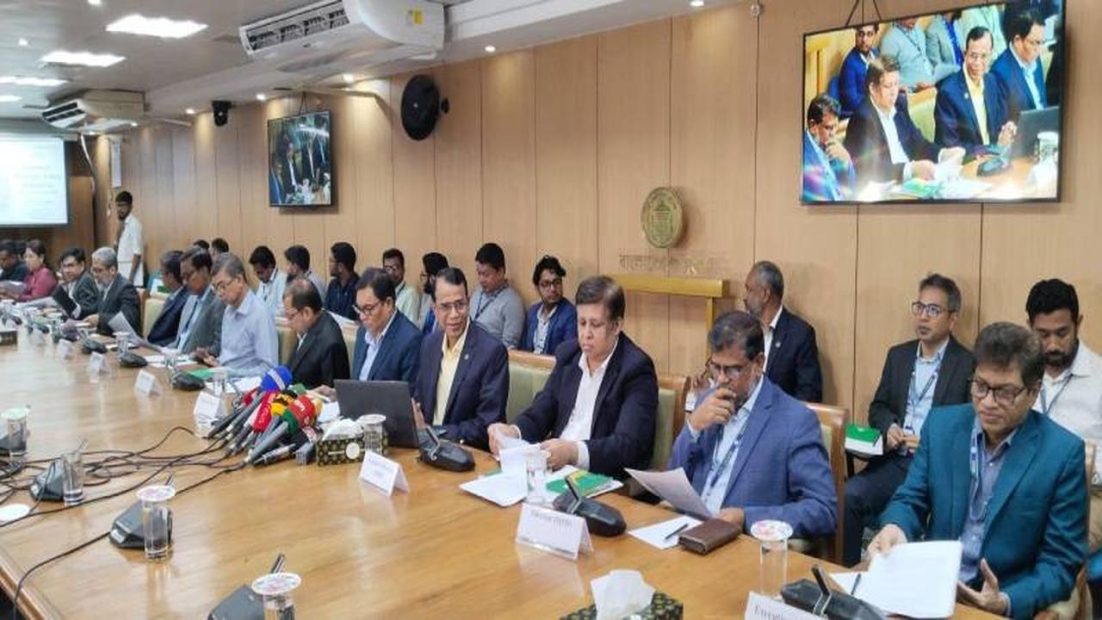
The central bank disclosed the decision at a press conference on Wednesday (September 30) following the announcement of its first quarterly monetary policy.
Bangladesh Bank Deputy Governor Habibur Rahman said the policy rate remains unchanged at 9.50%. The Standing Lending Facility (SLF) rate remains at 11%, while the Standing Deposit Facility (SDF) rate stays at 7.50%.
He said there would be no change in the policy stance during the quarter. Although some macroeconomic indicators are pointing in different directions, inflation had declined somewhat over the past two to three months. However, recent domestic and international developments have created uncertainty over whether the downward trend will continue.
“Against this backdrop, we have kept the policy rates unchanged. The Monetary Policy Committee believes we will observe the situation for another one or two months. After that, we can take a fresh decision regarding the policy rates,” he said.
At its 13th meeting on July 30, the MPC decided to announce monetary policy on a quarterly basis. Accordingly, the first quarterly monetary policy for the October-December period has been issued.
At its 14th meeting on September 23, the MPC decided to keep the policy rate unchanged at 9.50%. The SLF rate was retained at 11% and the SDF rate at 7.50%. This means no further easing was introduced after the 50-basis-point cut in the policy rate in August.
According to the central bank, although overall inflation has declined, the fall cannot yet be considered sufficient evidence of a sustained easing of price pressures. Various supply- and cost-side pressures continue to pose risks. Rising global energy prices, the possibility of disruptions in the Strait of Hormuz, recent upward adjustments to administered fuel prices and the potential impact of a new national pay scale could create additional inflationary pressure.
Overall inflation stood at 9.16% in June and fell to 8.26% in August, the lowest in 10 months. A decline in food inflation to 7.02% was one of the key factors behind the fall in overall inflation. However, non-food inflation remained high at 9.32%, indicating that underlying price pressures remain strong.
Economic activity has also slowed. Real GDP growth for FY2025-26 was estimated at 4.14%, while growth in the third quarter stood at only 2.2%, according to the statement. Industrial production contracted by 0.28% during the same period.
High-frequency indicators, including industrial production, electricity generation, fuel supply and private-sector credit growth, also reflected a slowdown in economic activity during FY2025-26. However, these indicators showed signs of a modest recovery in the first quarter of FY2026-27.
High financing costs, fuel shortages, infrastructure constraints and uncertainty over domestic and external demand could hamper economic growth, according to the central bank.
The central bank noted that supply-side constraints cannot be addressed through monetary policy alone. A Tk60,000 crore incentive package, including Tk20,000 crore for reopening closed factories, along with refinancing schemes for agriculture, CMSMEs and export diversification, could support economic recovery.
The impact of monetary policy has been transmitted somewhat faster through financial markets, but its effect on the real economy remains limited. Following the 50-basis-point reduction in the policy rate to 9.50% in August, interbank interest rates and yields on government securities declined.
Weak private-sector credit demand, strong deposit growth, reduced banks’ willingness to extend new loans and increased investment in government securities contributed to the decline in yields.
Private-sector credit growth stood at just 4.75% in August. Weak investment demand, high borrower risk and weaknesses in the banking sector were identified as some of the key reasons.
Meanwhile, the ratio of non-performing loans (NPLs) in the banking sector reached 32.78% in June 2026. The central bank stressed the need for bank restructuring, stronger governance, capital restoration and improved credit discipline.
The external sector recorded significant improvement in FY2025-26, with a $6.6 billion balance-of-payments surplus. However, in the first two months of FY2026-27, the overall balance of payments moved into deficit, mainly due to a deficit in the financial account.
Remittance inflows increased by 18.90% during the period, providing an important safeguard for the external sector. The relatively stable exchange rate also helped contain imported inflation.
The central bank expects a gradual rather than rapid economic recovery in the coming days. Growth forecasts for Bangladesh also vary among international organisations. The World Bank projects growth of 4.6% in FY2026-27, while the International Monetary Fund (IMF) has revised its previous 4.3% forecast down to 3.5%.
Inflation is expected to gradually decline in FY2026-27, although uncertainty remains over the pace of the decline. Key risks include prolonged conflict in the Middle East, disruptions to supply through the Strait of Hormuz, high international prices of fuel and fertiliser, tight global monetary policy, domestic fuel and infrastructure constraints, fiscal pressures, implementation of the national pay scale and weaknesses in the banking sector.
Against this backdrop, the key policy challenge is to support economic activity while maintaining the downward trend in inflation. The central bank said it would closely monitor global and domestic developments and make data-driven decisions. It will also focus on targeted credit support, structural reforms, strengthening the financial sector and maintaining exchange-rate flexibility in an orderly manner.
Its overall objective is to support sustainable economic recovery while maintaining price stability, external-sector balance and financial-system resilience.