China to Invest in Third LNG Terminal in Maheshkhali
Rafiqul Islam Salim
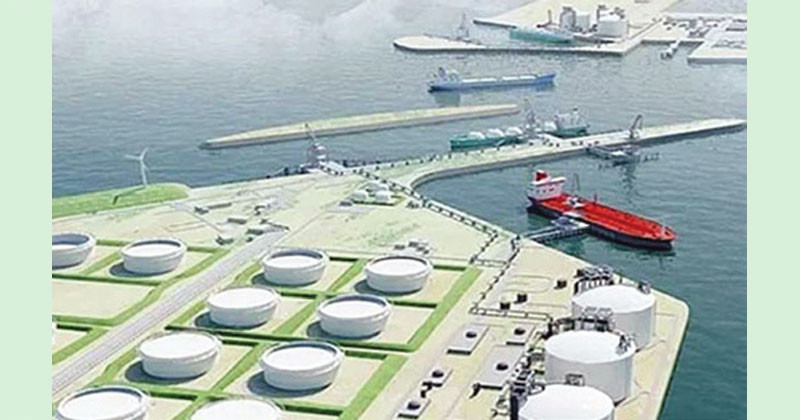
The process of establishing the country’s third floating LNG terminal (SRU) at Maheshkhali Kutubjom in Cox’s Bazar has taken another step forward. The terminal is being established by China’s China National Energy Engineering and Construction Limited (CNEC) on a G2G basis. Once operational, the country’s gas supply will increase by another 600 million cubic feet per day.
Keeping in mind the massive influx of foreign investment in the country and to address the ongoing energy crisis, the government has taken initiatives to increase gas supply within the next two years. To this end, initiatives have been taken to establish a third LNG and drill several new gas wells to increase domestic production. Initiatives have also been taken to examine the feasibility of establishing two more floating LNG terminals on an urgent basis at Payra or Mongla ports, in addition to Kutubjom in Maheshkhali.
All preparations have already been completed for the final approval of China’s CNEE’s proposal to establish an LNG terminal. The proposal will be sent to the Cabinet Committee on Procurement soon, according to sources in the Energy Department. A meeting of the Government-to-Government (G2G) committee was recently held in this regard under the leadership of the Energy Secretary. There, the proposal of the Chinese company was discussed in detail. Earlier, a committee led by Petrobangla Chairman Abdul Mannan evaluated the CNEE proposal and submitted a report to the Energy Department. In all, now the Chinese proposal is being sent to the Cabinet Committee for final approval.
Energy Department officials say that there is no alternative to increasing gas supply to quickly resolve the growing energy crisis in the country and keep the industrial plants running. And for this reason, the proposal of the Chinese company is very positive. Friendly China has come forward in difficult times and they also have the ability to establish terminals quickly through state-of-the-art technology and provide gas supply. Considering these, their proposal has been scrutinized and prepared for final approval at the earliest. It is learned that the government is interested in implementing the Chinese terminal quickly. And for this reason, the G-2-G method has been adopted. According to government officials, implementing projects through the G-2-G method takes less time than international open tenders, decisions can be made faster, and financing and technical cooperation are also easier. Such a system is followed by many countries, especially in strategic sectors like energy.
The Cabinet Committee on Procurement meeting held on July 28, chaired by Finance and Planning Minister Amir Khosru Mahmud Chowdhury, gave in-principle approval to CNEE’s proposal. The committee approved the proposal to build another LNG terminal and Floating Storage and Re-Gasification Unit (FSRU) with Chinese assistance to address the growing gas crisis in the country and ensure energy security. The new terminal and FSRU project will be implemented by CNEE. The initial proposal states that the terminal can be commissioned within 22 months and 500 to 600 million cubic feet of gas will be added to the national grid from there per day.
To overcome the country’s energy crisis, the government announced the establishment of one to two floating LNG terminals within two years. Energy Department sources said that CNEE proposed to establish a terminal in July. Its storage capacity will be 174,000 cubic meters of gas. During normal times, it will be able to regasify 600 million cubic feet per day and supply it to the national grid. CNEE will buy a ship and convert it into an FSRU. This may take 18 to 24 months. However, this agreement will be on a BOO basis, meaning that CNEE will bring the FSRUT to Kutubjom and operate it itself, and after 15 years, they will take the ship away.
The Energy Department held at least four meetings with CNEE in August regarding the third terminal proposal. The evaluation committee, headed by the Petrobangla chairman, discussed various aspects of the proposal with CNEE officials in those meetings. The evaluation committee included members from the Energy Department, BUET teachers, the Law Ministry, and some officials from the bidder.
Currently, there are two floating terminals in Maheshkhali for converting and supplying imported liquefied natural gas (LNG). One terminal is operated by the US company Accelerate Energy and the other by the private company Summit. Accelerate Energy has been supplying gas from the LNG imported by Petrobangla through those two terminals. The combined gas supply capacity of these two is about 1,100 million cubic feet.
However, due to the availability and operational conditions of LNG, the actual supply is not always the same. Moreover, if for some reason a fault occurs at a terminal, the gas supply decreases and the gas crisis becomes acute. The gas crisis has been going on for the past one month as the arrival of LNG cargoes has become uncertain due to the Iran war.
Energy experts say that if the new terminal is built, 600 million cubic feet of gas can be supplied to the national grid daily. This will not only increase gas supply across the country, but also make it uninterrupted. As a result, it is expected that the stability of gas supply to industrial areas, power plants and fertilizer factories will increase. The Chinese terminal will cost at least $450 million to set up. The terminal will take 22 months to become operational. The country currently has a gas demand of 3.8 billion cubic feet. The supply is available from LNG, including 1.1 billion cubic feet, of which 2.6 to 2.7 billion cubic feet. With the third terminal, this supply will increase to 3.3 billion cubic feet.
It is worth noting that the demand for energy in the country is increasing rapidly. As per the election promise, the government is opening the door to massive foreign investment with the aim of creating employment for crores of people. The construction of infrastructure for the Chinese Economic Zone has already started in Anwara, Chittagong. There will be several hundred factories with Chinese investment there. About one and a half billion dollars will be invested in this economic zone. The process of starting industrial factories there is progressing within the next one year. Industrial factories are also being started in the Mirsarai Economic Zone. These foreign-invested industrial factories in the country require sufficient gas and electricity. The implementation of the third terminal will end the gas crisis.Meanwhile, in addition to establishing the LNG terminal, the government has also taken the initiative to drill new gas wells.