
China’s HQ-17AE Added to Strengthen Pakistan’s Air Defence
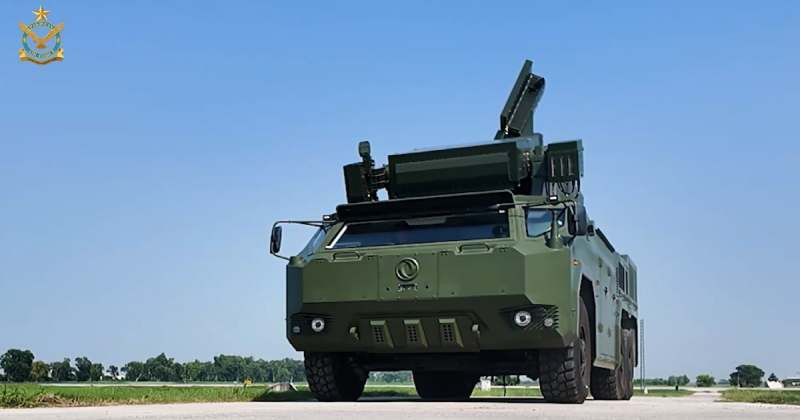
Pakistan’s Air Force unveiled China’s HQ-17AE short-range air defence system on Monday through a promotional video posted on its official X account. According to a Chinese military expert, Pakistan has become another international user of the system. It is expected to help fill gaps in Pakistan’s short-range mobile air defence capabilities and strengthen its ability to deal with low-altitude threats, including drones. Chinese military expert Wang Yunfei told the Global Times that Pakistan had already deployed China’s HQ-9 series of long-range air defence systems, including the HQ-9/P and HQ-9BE variants.
At the same time, Pakistan has also added China’s HQ-16 series of air defence systems to its inventory, ranging from the LY-80 to the extended-range HQ-16FE/HQ-16FE. Together, these systems form the backbone of the regional medium- to long-range air defence network of the Pakistani Army and Air Force, Mr. Wang said.
These systems are key elements of Pakistan’s national strategic air defence network. However, the expert noted that short- to medium-range air defence systems are mainly used to protect specific areas or key points, and Pakistan had significant room for improvement in this area.
If an enemy manages to penetrate the medium- to long-range defensive shield and enter deeper into the country, military concentration areas and armoured formations could face direct threats. As a new user of the HQ-17AE, Pakistan will be able to address gaps in its short-range mobile air defence network and improve its ability to counter low-altitude attacks, such as drone strikes, Wang said.
HQ-17AE First Displayed in 2021
The HQ-17AE was first seen in 2021 at the 13th China International Aviation and Aerospace Exhibition in Zhuhai, Guangdong province, China. It is a multi-purpose air defence missile system developed using China’s own technology.
The system was developed by the Second Academy of the state-owned China Aerospace Science and Industry Corporation (CASC). In a statement to the Global Times in March 2021, CASC said the system was capable of intercepting high-tech targets and destroying multiple attacks at the same time.
All of its major features are integrated into a single vehicle. It uses a wheeled off-road chassis for rapid movement and has been described as a “low-altitude aircraft hunter.” According to its developers, the HQ-17AE uses advanced technologies, including an all-solid-state phased-array radar, a vertical cold-launch missile system, a direct-force fast-turn system and a rotating tail wing.
These technologies allow the system to respond quickly and adapt to complex electromagnetic conditions on the battlefield. The vehicle can also launch missiles while moving and connect with other vehicles to form a network during combat. According to the report, each HQ-17AE vehicle can carry up to eight missiles. It can simultaneously guide four missiles against four targets, making it effective against multiple threats.
Serbia Also Acquired HQ-17AE
Earlier, in June 2024, during a military parade in the Serbian city of Kruševac, then-Serbian Prime Minister Miloš Vučević announced that Serbia would display its newly acquired HQ-17AE short-range air defence system from China. Vučević stressed that the system would provide better protection for Serbia’s airspace and work in excellent coordination with the country’s most powerful air defence weapon, the FK-3.