Cox’s Bazar Airport to Connect Directly with Penang and Other International Destinations
A major initiative has been taken to improve air connectivity as part of efforts to develop Cox’s Bazar, the country’s leading tourist destination, into an international tourism hub. Expansion and modernisation work at Cox’s Bazar International Airport is nearing completion, and the new terminal has already begun trial operations.
AirAsia has confirmed plans to launch direct flights between Cox’s Bazar and Penang, Malaysia. Initiatives are also underway to introduce direct flights to Kathmandu in Nepal, Kunming in China and several destinations in the Middle East.
Civil Aviation and Tourism Minister M Rashiduzzaman Millat said AirAsia had confirmed that it would operate direct flights to Cox’s Bazar. If the proposed route is launched, Cox’s Bazar will be directly connected with Penang. However, the exact launch date and the number of weekly flights have not yet been announced.
Officials said the improved infrastructure at Cox’s Bazar Airport has created new opportunities for international air services. The government aims to reduce dependence on domestic tourists and develop Cox’s Bazar as a gateway to international tourism. Under the supervision of the Civil Aviation Authority of Bangladesh (CAAB), a modern passenger terminal covering about 17,956 square metres has been built at the airport at a cost of around Tk 362.63 crore.
The new terminal has modern passenger facilities, including check-in counters, immigration services, baggage belts, security screening, lifts, escalators and boarding bridges. Domestic passengers are already being served at the new terminal ahead of the launch of international flights.
Air Commodore Abu Sayeed Mehboob Khan, member (Operations and Planning) of CAAB, said domestic passengers would initially be served at the new terminal until international flights begin. Later, domestic and international passenger operations will be managed together.
Once the new terminal becomes fully operational, international passengers will complete their arrival and departure procedures there. Domestic passengers will complete check-in at the new terminal and board their flights through the old terminal.
The terminal expansion is expected to significantly increase the airport’s annual passenger-handling capacity. The capacity, which was previously around 730,000 passengers a year, is expected to rise to about 1.8 million after the expansion. Modern immigration, security and baggage-handling systems, along with boarding bridges, have been installed to provide international-standard services.
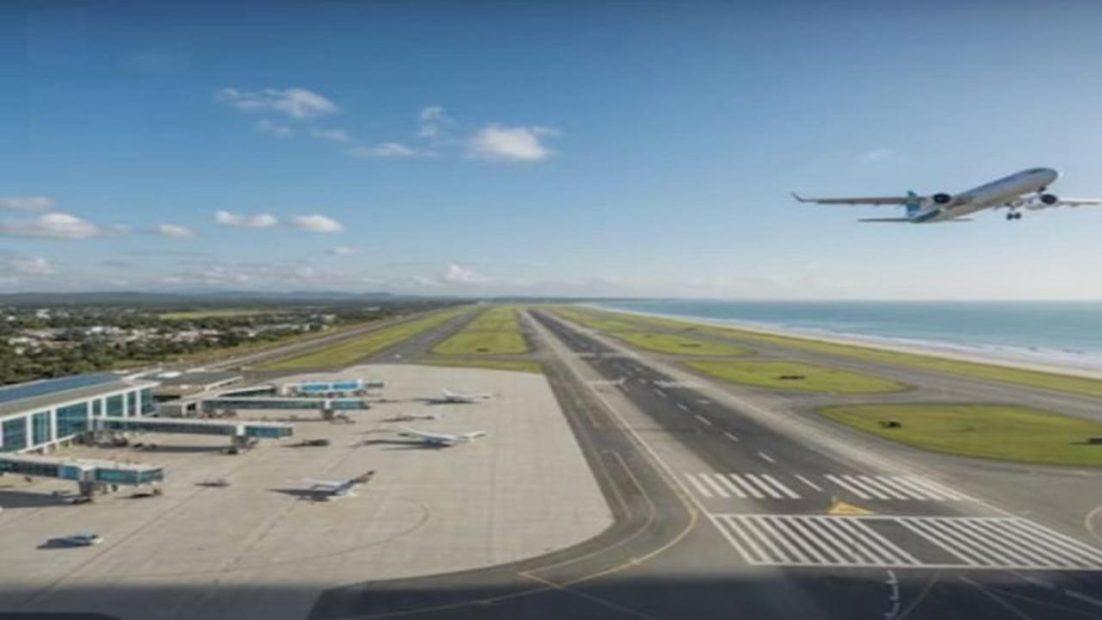
The airport’s runway has also been extended to support international flight operations. About 43 hectares of land was reclaimed from the Bay of Bengal, increasing the runway length from 9,000 feet to 10,700 feet.
A significant section of the extended runway was built over the sea. Aircraft landing there can give the impression of landing directly on the water.
The expanded runway is now considered the longest runway in Bangladesh. It has been upgraded to handle large aircraft used on international routes, including wide-body aircraft. As a result, Cox’s Bazar Airport now has the potential to operate regular international airline services alongside domestic flights.
Minister M Rashiduzzaman Millat said plans were also being considered for direct flights on the Cox’s Bazar-Kathmandu-Cox’s Bazar route. The government is also working to establish direct air connectivity with Kunming in China’s Yunnan province. The Kunming route is expected to help attract tourists from southwestern China and other parts of the country to Cox’s Bazar. The government is also reviewing the possibility of establishing direct air links with several Middle Eastern countries.
If these international routes are launched as planned, Cox’s Bazar could develop beyond a domestic beach tourism destination into an important tourism and aviation hub in South and Southeast Asia. Stakeholders believe direct international air connectivity could increase both foreign tourist arrivals and investment in the tourism sector. More international visitors could create new jobs in hotels, motels, resorts, restaurants, transport, tour operations, entertainment and other tourism services. This could also encourage larger investments in the sector.
Md Rafeuzzaman, former president of the Tour Operators Association of Bangladesh (TOAB), said regular operations by international airlines, reasonable airport fees and overall development of the tourism destination would be important to make Cox’s Bazar commercially viable as a gateway for international air travel.
Experts said that alongside infrastructure development, authorities need to turn international airlines’ interest into regular flights, improve tourist services, ensure security and introduce coordinated tourism packages for foreign visitors. These measures would help the tourism sector make effective use of the airport’s expanded infrastructure.
Cox’s Bazar is home to the world’s longest natural sea beach, as well as hills, forests, islands, a long Marine Drive and wide-ranging opportunities for marine tourism. Until now, many international tourists have had to travel to Cox’s Bazar via Dhaka. Direct international flights could reduce travel time and the difficulties involved in connecting flights.
The initiative to launch the AirAsia Penang-Cox’s Bazar route has already raised new expectations. The potential launch of routes to Kathmandu, Kunming and the Middle East could further expand Cox’s Bazar’s international tourism market.
However, stakeholders say that fully utilising Cox’s Bazar’s potential as an international airport will require more than air connectivity. Tourism infrastructure, environmental protection, law and order, transport, service quality and an investment-friendly environment must also be ensured. They said a coordinated approach would be essential to establish Cox’s Bazar as a sustainable international tourism destination.