Cox’s Bazar City Corporation to be Established Across 169.64 Square Kilometers
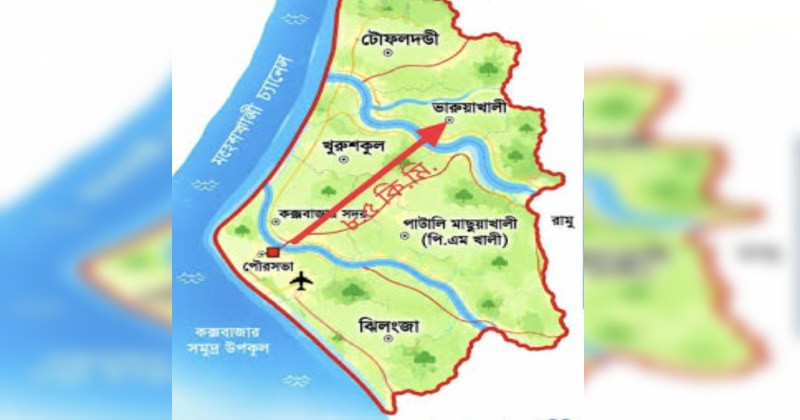
The process to upgrade Cox’s Bazar into a city corporation has officially advanced with a public notice issued by the district administration. Signed by Deputy Commissioner Md. A. Mannan, the proposal aims to elevate the existing municipality by incorporating specific areas from five neighboring unions. Spanning a total estimated area of 169.64 square kilometers, the prospective city corporation will cover the current municipality alongside regions of Jhilongja, Khurushkul, PM Khali, Dakshin Mithachhari, and Khuniapalong. Relevant data sheets estimate the total population of this proposed expanded urban area to be around 1.08 million residents.
The public notice was officially published in accordance with Rule 5, Sub-rule (2) of the Local Government (City Corporation) Establishment Rules, 2010. It follows direct instructions issued by the City Corporation-2 Branch of the Local Government Division. The administration has set a 30-day window from the publication date for any citizen or stakeholder to submit written objections or opinions regarding the proposed boundaries and included areas to the Deputy Commissioner, after which no further feedback will be accepted.
Addressing local citizens, Deputy Commissioner Md. A. Mannan emphasized that the scope of the new city corporation must balance public interest, laws, and ground realities rather than single-area demands. He noted that incorporation brings mandatory responsibilities for roads, infrastructure, and civic services, alongside scheduled fees, holding taxes, and revenue collections. Therefore, the administration must carefully weigh citizens’ financial responsibilities and capabilities alongside the administrative upgrade to ensure sustainable and welfare-oriented outcomes for everyone involved.
For decades, stakeholders have demanded this upgrade for the major tourist hub, noting that the Cox’s Bazar Municipality, established in 1965, has long outgrown its capacity. Critics argue that despite its first-class status, the municipality has struggled with mismanagement and infrastructure deficiencies, failing to meet the demands of locals and tourists. Supporters hope that a city corporation will finally expand crucial services like planned urbanization, modern waste management, robust road connectivity, and reliable water supply, thereby creating new economic and tourism prospects.
However, the initiative has also sparked mixed reactions among local residents and experts who worry about increased financial burdens. Many citizens fear that transitioning into a city corporation will drive up taxes, service fees, and living costs, disproportionately affecting ordinary families. Critics additionally point out that the newly established Cox’s Bazar Development Authority still lacks a clear master plan, raising concerns about jurisdictional overlap, a lack of coordination, and whether resolving existing municipal service failures should take precedence over expansion.
Weighing in on the discussions, Cox’s Bazar-3 Member of Parliament Lutfur Rahman Kajol stressed that boundaries should be finalized through comprehensive public consultation and constructive debate. He noted that while expanding boundaries is tempting, policymakers must carefully evaluate whether increased civic facility expenses will unfairly burden marginalized groups. Pointing out that major cities like Dhaka and Chattogram expanded in phases, he urged officials to ensure that the livelihoods, arable lands, salt pans, and fish enclosures of ordinary workers are fully protected.
Ultimately, experts and local leaders agree that upgrading to a city corporation is much more than a mere administrative title change; it is deeply intertwined with long-term urban planning and economic reality. As the 30-day public feedback window progresses, the government faces the critical task of synthesizing public expectations with practical constraints. A balanced, well-coordinated decision will be essential to ensure that the new city corporation serves as a sustainable foundation for tourism, commerce, and civic life.