Death Sentence to 7 Awami League Leaders for Crimes Against Humanity

A. M. M. Bahauddin>
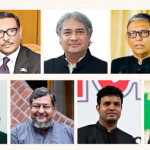
The International Crimes Tribunal-2 has sentenced seven people, including banned Awami League General Secretary Obaidul Quader, Joint General Secretary A.F.M. Bahauddin Nasim and then Information and Broadcasting Minister Mohammad Ali Arafat, to death for their roles in inciting the mass killings during the July-August mass uprising of 2024.
The three-member tribunal announced the death sentences at 12 noon on Tuesday in a packed courtroom. Justice Nazrul Islam Chowdhury delivered the verdict. The other two members of the tribunal were Justice Md. Manzurul Bashid and Justice Noor Mohammad Shahriar Kabir.
This was the second verdict delivered by the reconstituted tribunal, two years after the July mass uprising. Earlier, in mid-November last year, the tribunal handed down its first verdict against former Prime Minister Sheikh Hasina, former Home Minister Asaduzzaman Khan Kamal and former Inspector General of Police Chowdhury Abdullah Al-Mamun. Ms. Hasina and Asaduzzaman Khan Kamal were sentenced to death, while Abdullah Al-Mamun, who became a state witness, was sentenced to five years in prison.
Sheikh Hasina, who was sentenced to death, and the other accused sentenced on Tuesday are currently absconding in India and other countries. The first verdict against Sheikh Hasina during the interim government had removed uncertainty over the trial of the July mass killings. However, there had been some concerns about the future of the tribunal under the elected BNP government. The September 15 verdict has largely eased those concerns.
Those sentenced to death by International Crimes Tribunal-2 had, according to the report, considered themselves above the law and justice during Sheikh Hasina’s 15-year rule. The verdict showed that no one is above the law or justice. Then-Prime Minister Sheikh Hasina had formed the International Crimes Tribunal to try war crimes and crimes against humanity committed during the 1971 Liberation War, mainly to deal with leaders of opposition political parties. Although questions were raised about the purpose, objectives, transparency and impartiality of the tribunal under the Awami League government, Sheikh Hasina used the tribunal to remove senior political leaders, including Jamaat-e-Islami leaders Matiur Rahman Nizami, Ali Ahsan Mohammad Mujahid, Muhammad Kamaruzzaman, Abdul Quader Molla and Mir Quasem Ali, as well as BNP leader Salahuddin Quader Chowdhury, and sought to consolidate what the report describes as her “fascist” rule.
The tribunal’s trial process, witness testimony and the impartiality of its judges had been controversial from the beginning. Despite questions raised at home and abroad about the proceedings, Sheikh Hasina continued the trials and executions of opposition leaders. At one stage, recordings of Skype conversations involving tribunal judges were leaked and published in the media, raising serious questions about the trial process and impartiality. Even then, the trials and execution of death sentences continued.
The report describes that trial process as part of an Indian “hegemonic agenda.” The case of Islamic preacher Allama Delwar Hossain Sayeedi also raised further questions after an important witness, Sukharanjan Bali, was allegedly taken from the tribunal premises and detained in India.
The July mass uprising was a resistance movement against what the report describes as Sheikh Hasina’s 15 years of misrule, repression and discrimination. Alongside the armed forces, leaders and activists of the Awami League, Chhatra League, Jubo League, Swechchhasebak League and other affiliated organisations took up arms against unarmed protesters in an attempt to suppress the student protests.
More than 1,400 people were killed, while around 40,000 people were injured, disabled or lost their eyesight and are now struggling to live in difficult conditions. The report says that the Awami League had established what it describes as a fascist rule by reviving a settled issue from 1971 and sentencing senior leaders to death through a controversial tribunal and trial process. It argues that, through the July mass killings, those responsible ultimately placed themselves in the hands of the same tribunal for trial.
However, the report says the current tribunal is not trying to judge an unclear historical memory or a political narrative. Rather, it is trying to address the “deep wounds” left by the mass killings during a bloody uprising through judicial proceedings.
In the changed political reality, the people of Bangladesh had primarily demanded justice for the July mass killings and implementation of the July Charter. Prime Minister Tarique Rahman is determined to ensure the implementation of the July Charter and justice for the July mass killings.
Seven months after the government took office, the tribunal’s verdict against Obaidul Quader, the second-highest-ranking Awami League leader after Sheikh Hasina to receive such a verdict, has made many people more reassured and hopeful, according to the report.
The people do not want to see the rise of another “fascist” in Bangladesh in the future. Preventing any such possibility permanently is described as the moral and political responsibility of the people’s government and the opposition.
The July-August uprising did not begin suddenly. The report says that widespread corruption, embezzlement and political criminalisation, along with the alleged involvement of business and bureaucratic oligarchs in transferring hundreds of thousands of crores of taka abroad, weakened the country’s economy. It also says that state institutions were systematically destroyed.
Justice for these issues must also be ensured quickly through due process and the courts. However, the International Crimes Tribunal must be kept above any controversy. Everyone involved in the killing of thousands of people must be brought under the law and punished. Criminals who have fled abroad are still allegedly involved in conspiracies against the country. They must be brought back to Bangladesh and brought to justice.