Delhi Police, Accused of Misconduct, Dangerously Teaches Journalists ‘Ethics’
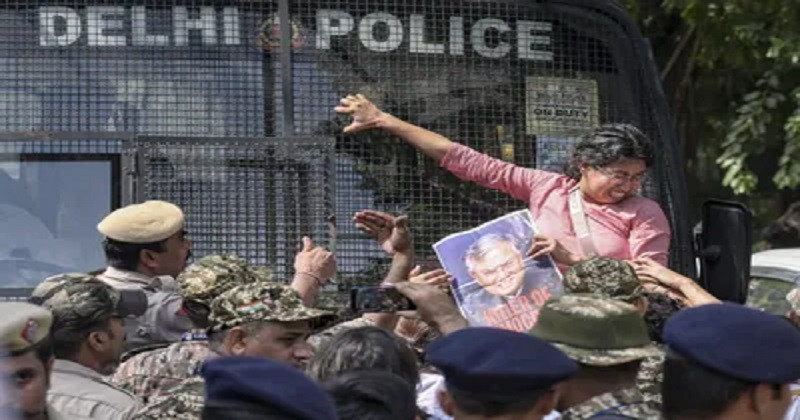
In a democracy, the law enforcement forces must answer to the public through the media. There is no room to twist this fact. Delhi Police is the police force of the country’s capital, but it is only a law enforcement agency. It has no legal or statutory right to issue any code of conduct, governing policy or press guideline for journalists.
Delhi Police posted on X (formerly Twitter) an image of a reporter holding a microphone in front of a police officer’s face, and it gave advice on “journalism ethics”. This post is very problematic in many ways. It is not a simple “safety alert”. Delhi Police issued it after women journalists alleged that police personnel molested and physically assaulted them while they covered a protest at Jantar Mantar.
Police did not investigate the allegations. Instead, they put new rules on the journalists who complained and on their profession, and this is mainly an attempt to hide their own wrongdoing. Police describe the post as “guidelines” and “advice”, but its real aim is to bury the main incident and take control of the situation. The opposite reaction from ordinary people on social media makes it clear that this tactic has already failed badly. People have posted satirical counter “police guidelines” and many have accused the police of protecting their own misdeeds. The serious flaws in this post by Delhi Police on X are listed below.
Delhi Police cannot set up news censorship with one post
In a democratic state, the police must answer to the public through the media. Article 19(1)(a) of the Indian Constitution guarantees freedom of speech and expression, and this includes freedom of the press. There is no legal rule that a journalist must hold PIB accreditation or an institutional card of a recognised media house to cover a public protest, to record photos or videos, or to publish them. Delhi Police works directly under the central government. So this kind of message shows an unfair and unchecked use of power by the Modi administration.
This is like controlling an independent profession, which the Constitution recognises, through police orders. The attempt to cut down press freedom comes at the very time when public protests, arrests and the use of force by the state need the most watching. Pushing journalists away from the scene means closing the path to recording excessive force or illegal detention of peaceful citizens by the police.
This is blaming the victim and hiding facts
The main issue was the allegation that senior officers of Delhi Police molested and attacked women journalists. Police claim that they sent the complaint to the Crime Branch. Even so, they did not ensure protection for the victims, safe keeping of evidence or a fair investigation. Instead, they started to give journalists lessons on ethics. They also used a misleading image made with artificial intelligence (AI) to show the police as “calm and oppressed” and the journalists as “aggressive”. This builds a biased story that covers up their own wrongdoing.
By calling journalists aggressive and teaching them ethics, the police try to move public attention away from the main incident. They try to suggest that the position or the work of the journalists forced the police to act this way. But the way journalists work, or the distance they keep, can never justify sexual harassment, assault or illegal obstruction.
An attempt to weaken the constitutional value of news gathering
The freedom to collect news matters even more than the freedom to publish it. If police push cameras and journalists away during the use of force, the freedom to publish becomes meaningless. The core of press freedom is to protect information and its sources. It is not acceptable to allow news gathering only if journalists dress differently from protesters. If the state decides how it will be watched, the base of fair journalism is destroyed.
Identity card versus permission card: a dangerous confusion
Carrying an identity card can help in a dangerous situation. But if only one “valid” government or institutional card becomes the sole test of who is a journalist, freelancers, freelance documentary makers, trainees and citizen journalists will be left out. The press freedom given by the Constitution is the right of every citizen. It does not belong only to media houses that the government recognises.
Vague and dangerous limits
Phrases like “do not obstruct”, “keep a safe distance” and “clearly identify yourself” have no fixed legal meaning. During a movement or protest, police can use these vague words as an excuse to push journalists away as they find convenient. If police alone decide where journalists can stand, without any clear legal approval, the openness of the state and its answerability to the public will suffer badly.
Police have no code of conduct of their own
This X update from the police makes no promise that they will not seize the devices or phones of journalists. It does not promise that they will not delete footage or force journalists to reveal their sources. It gives no clear outline of how police will protect journalists. It also names no press liaison officer and offers no system for quick settlement of complaints.
Are Mr. Modi and Mr. Amit Shah silent on this?
Delhi Police works directly under the Union Ministry of Home Affairs, and the Police Commissioner answers directly to the central government. So Home Minister Mr. Amit Shah, as the head of this department, is directly responsible. Prime Minister Mr. Narendra Modi should also step in on policy grounds. The first job of Mr. Shah should have been to ensure a fair and quick investigation into the harassment allegations and to take strict action against the guilty. If police keep trying to impose censorship on journalism instead, one must assume that they chose this unprecedented crackdown to hide their failure to stop the street movement of ordinary people.