Dengue Outbreak Spreads Alarmingly
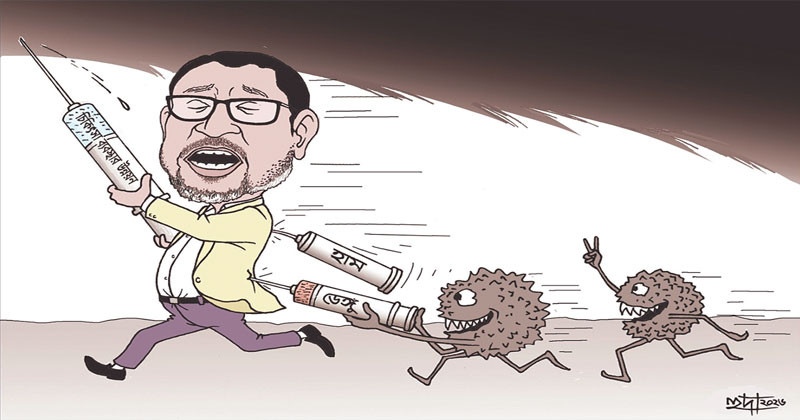
Hasan Sohel
The dengue situation in the country is spreading horror and gets worse day by day. Hospitals have no room for patients. Many people cannot get a bed, so they take treatment on the floor, on verandas and in corridors. In the last 24 hours, 10 more people died of dengue, and 1,996 people were admitted to hospitals. This is the highest number of deaths and admissions in one day this year.
In the whole month of June, 2,907 people were admitted to hospitals with dengue. In the last two days alone, 3,898 patients were admitted. In the first six days of October, a total of 36 people died of dengue in the country. According to government data, 19 people died in the last two days. So experts say October will break all records of dengue deaths and admissions. As infection keeps rising in Dhaka and other areas, the Ministry of Health has ordered hospitals to add more beds. It has told the hospitals in the capital to give extra importance to preparation.
The authorities are considering opening the field hospital set up in the Dhaka Medical College Hospital compound, to make sure dengue patients get treatment. They also plan to move some patients from Dhaka Medical College Hospital to the National Institute of Burn and Plastic Surgery. According to sources, 2,907 people were admitted with dengue in June. Three months later, in September, the number reached 43,774. This means admissions in September were 15.06 times higher than in June.
The highest infection and deaths this year happened in September. In that month, 148 people died and 43,774 were infected. Infection and deaths both rose in September, but proper management and coordination were missing. As a result, dengue is spreading horror in October. In six days of October, 36 deaths are on record. Experts fear the number of patients may rise further, because the Ministry of Health, the two city corporations and the Local Government Division are not giving proper supervision or taking proper steps.
According to the Directorate General of Health Services, 9,206 people were admitted to hospitals with dengue in July. In August the number rose to 20,536. In September it jumped past 43,000. From January to 6 October, a total of 90,356 people have been admitted to hospitals with dengue.
According to the data of the Directorate General of Health Services for the last 24 hours, 10 more people died of dengue and 1,996 were admitted to hospitals. By the government count, this is the highest number of deaths in one day from this Aedes mosquito borne disease this year. The second highest was nine deaths on the day before yesterday. With this, 281 people have died of dengue in the country this year. Of them, 36 lost their lives in the first six days of October.
Yesterday’s bulletin of the Directorate General of Health Services gave the details for the 24 hours from 8 am the day before yesterday. In hospitals in the Dhaka North City Corporation area, 294 people were admitted. In the South City, 187 were admitted. In other hospitals of Dhaka Division outside the two cities, 480 were admitted. Among other divisions, 203 were admitted in Barishal, 242 in Chattogram and 302 in Khulna. Mymensingh had 96, Rajshahi had 199, Rangpur had 75 and Sylhet had 18.
According to the bulletin, 1,964 people left hospitals after dengue treatment in the last 24 hours. This year, 90,356 people have been admitted with dengue, and 84,299 of them have left hospitals. The bulletin says September had the most admissions this year, at 43,774, and 148 deaths. The Directorate General of Health Services has kept data on dengue admissions and deaths since 2000. Among those years, 2023 had the most admissions, at 321,179. The most deaths, 1,705, also happened in that year.
Last year, more than 400 people died of dengue, and the number of confirmed patients was about 102,000. According to the Directorate General of Health Services, more than one thousand people die of dengue every year, and more than 100,000 get infected. This year the numbers will pass that. The article says the Health Minister visits different hospitals for no reason. It says nothing useful is happening, and he cannot manage or coordinate the work of hospitals across the country.
The dengue situation is alarming not only in Dhaka but across the country. The situation is even harder in Khulna and Barishal. Reports say hospitals cannot give enough space to dengue patients, so they treat them in corridors, on verandas and in other empty places. Many patients went from one hospital to another and still found no bed.
On the other side, lack of coordination in the mosquito control work of the two Dhaka city corporations is an old problem. No ward based work is visible. City people are worried about mosquito trouble, but the city corporations act in a careless way. People doubt how well larvicide spraying and fogging work in the two Dhaka cities. City dwellers also have no trust in the Aedes larvae survey of the Dhaka South City Corporation. The Dhaka North City Corporation has identified hotspots, but it lacks the use of medicine there.
Ordinary citizens say dengue is rising, but they see inspections, meetings, seminars and different programmes instead of joint and visible work on the field. The Ministry of Health and related offices publish dengue infection and death data regularly, but they lack a long term and joint plan to stop the spread of the disease.
The Directorate General of Health Services has no joint data on how many beds the government hospitals of the country have in total. It also has no data on how many beds can be used in an epidemic like situation such as dengue. So when hospitals struggle to handle the flood of patients, people ask whether the centre has the ability to manage the situation. A senior official of the hospital branch of the Directorate General of Health Services did not want to be named. He was asked how many dedicated beds the government hospitals in Dhaka have for dengue patients, and he said, “We do not have such data.” He added that special corners have been made for dengue patients in all hospitals, and they treat patients there.
Health and Family Welfare Minister Mr. Sardar Md. Sakhawat Hossain said 300 new beds have been made ready in government hospitals to fight dengue. He said Dhaka Medical College Hospital is also changing the management of different wards to keep extra patients, and a mobile hospital has been arranged there. He said no government hospital can send a dengue patient back. If one hospital has no bed, it must send the patient to another fixed hospital. If those beds also fill up, there is an order to prepare more space. He said an order has also been given to check whether private hospitals admit dengue patients, and action will be taken if any hospital refuses a patient. However, the authorities of Dhaka Medical College Hospital say the proposal is still at an early stage. A meeting on the matter was supposed to be held yesterday.
Those concerned say the authority of Mugda Medical College Hospital has been told to add more beds for dengue treatment. Kurmitola Multidisciplinary Hospital has been asked to treat dengue patients who come from outside the capital.
As the number of dengue patients rises in Dhaka and different districts and towns, fear is spreading among ordinary people. Pressure on hospitals is growing, and so is the risk of death. Even careful doctors cannot escape death. The steps the government has taken to control dengue are not giving effective results. The article says ministers and members of parliament are busy with needless hospital visits and drives, but proper management and coordination are missing.
Experts say there must be a fixed plan and system. It should identify and destroy possible breeding places before the monsoon, keep regular watch in the monsoon, and act quickly in risky areas when infection rises. Spraying insecticide on mosquitoes alone will not solve the problem. If the source of mosquito larvae stays, new mosquitoes can be born again in a short time. So those concerned urge the highest priority on destroying the source.
Mr. Kabirul Bashar, a professor and entomologist at Jahangirnagar University, said dengue rose because “we could not control dengue.” He said, “When an infection starts, if we cannot control it, it will surely grow.” He said the main goal of dengue control should be to stop the production or breeding of mosquitoes instead of killing mosquitoes. When adult mosquitoes die, mosquito numbers fall for a short time. But if breeding places stay untouched, new mosquitoes are born there again. So relying only on killing adult mosquitoes, without identifying and controlling productive breeding places, is not a lasting solution.
He said patients may rise even more in the next two months. He said the country must move away from old ideas. It must adopt joint mosquito management based on breeding places, and it must build strong insect monitoring and effective disease monitoring.