Destruction and Wailing Relatives in Nepal
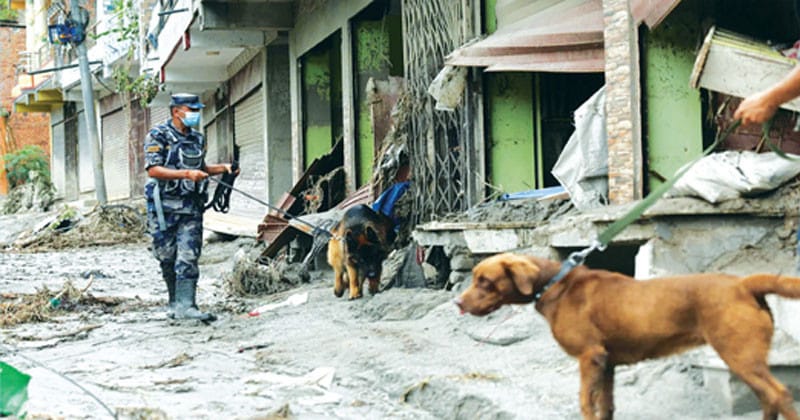
The border region between Tibet and Nepal has been destroyed by a devastating glacier outburst flood, leaving massive destruction in its wake. Many houses, bridges, and power stations were destroyed by an immense flow of rocks, ice, and muck. Following Wednesday’s tragedy, the most recent estimates state that at least 669 people have died in Nepal and 7 in Tibet. About 3,000 people are still missing, including 2,426 in Nepal and 554 in Gyirong County, Tibet. At least 540 foreign people are among the missing, and many of them are Hindu pilgrims from India, giving the humanitarian issue a global scope.
As the weather has improved, rescue activities have started after being delayed at first owing to heavy fog and continuous rain. According to a police officer in Nepal’s hardest-hit Rasuwa area, ‘With the weather turning somewhat favorable, search and rescue operations have been increased using helicopters’. Many found remains are unidentifiable due to decomposition and severe disfigurement, according to rescuers, which pushed officials to expedite the victims’ funerals and burial procedures.
Medical and rescue professionals caution that the critical time for rescuing people is fast disappearing, as the accident occurred about four days ago. In Kathmandu, grieving family members crowd local hospitals, desperately looking for loved ones among rows of pictures that officials had put up on the walls. Authorities in the Chitwan area decided to perform mass funerals for hundreds of unidentified deceased since local morgues are overcrowded with retrieved bodies and cannot handle decomposing remains.
Rescue teams from South Korea, China, and India have arrived in Nepal to accelerate operations as part of the global response to the disaster. Helicopters are increasing the number of rescue operations and the supply of aid in difficult, remote mountain regions. Meanwhile, officials have successfully recovered 187 foreign visitors, but 420 foreign nationals remain missing as search crews investigate the debris-choked valleys and isolated riverbank communities.
Nepal is facing an unparalleled redevelopment task after the widespread destruction. Restoring devastated towns and infrastructure might cost between $4 and $5 billion, according to Nepal’s Finance Minister, who told Reuters that this is only an estimate while evaluations are still being undertaken. Roads, bridges, and the nation’s vital hydropower industry have all sustained significant damage, while satellite footage shows industrial sites destroyed by the massive floodwaters.
According to experts, the disaster is a part of a risky worldwide trend caused by climate change. According to Mr. Jonathan Carrivick, a glacial floods specialist at the University of Leeds, rising temperatures in High Mountain Asia are forcing permafrost and glaciers to melt quickly. Scientists warn that melting ice creates enormous lakes that are kept back by fragile natural glacial barriers that might collapse without notice. In this particular instance, the disastrous outburst flood was caused by rock and glacier failures that momentarily blocked the Lende Khola river.
Sources: CNN, Reuters, Daily Mail.