
‘Eastern Gateway’ Golden Corridor: China-Myanmar-Bangladesh Route Paves Way for a Strong, Self-Reliant Economy
Shafiul Alam
The BNP government, led by Prime Minister Mr. Tarique Rahman, has set a goal to turn Bangladesh into a one trillion dollar economy by 2034. This is double the size of the present economy. To reach this goal, the government gives top priority to wide investment from home and abroad, including foreign direct investment (FDI). It also gives priority to industry, jobs and work for the welfare of the people. With the spirit of “Bangladesh first”, the government does not circle inside the narrow limits of one country or one bloc. In this age of globalisation, it is walking toward new horizons in connectivity, ties and friendship.
The BNP government hopes Bangladesh will be seen as a leading country in South Asia. It hopes so for economic strength, diplomatic weight, and also for geopolitical, strategic security and defence. This will give the future Bangladesh a new identity as a rising regional power. The hope rests on the strong public base of two thirds support that BNP won in the last national election.
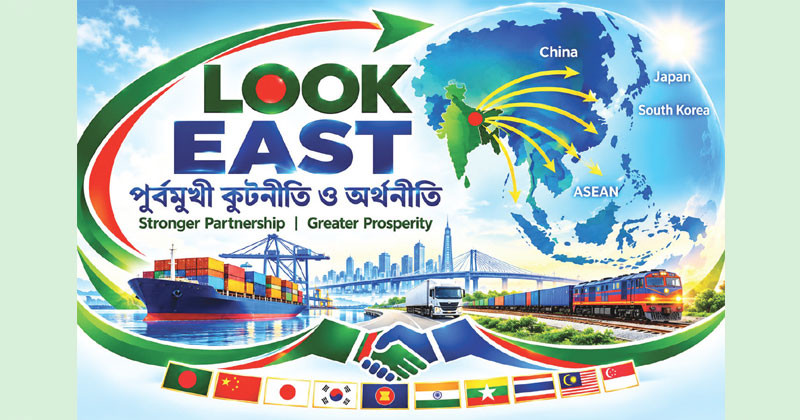
After 16 years of fascist looting, the economy stands in a weak state. Raising it to the trillion dollar level is a hard challenge for the government. To reach the goal of economic rebuilding and strength, the top priority of the government of Mr. Tarique Rahman is a strong, lasting and self reliant economy for Bangladesh. The government is moving ahead with bold plans to build its base. The main pillar of its roadmap for growth and prosperity is the “Look East” policy and strategy. Economists and connectivity experts stress better links and friendship with “Look East” countries. They say a strong and self reliant economy will come only through stronger ties with the east. They say Asia’s east side, next to Bangladesh, holds great chances.
The “Look East” policy had a special place in the foreign policy of the successful statesman, Martyr President Mr. Ziaur Rahman, and former Prime Minister Ms. Khaleda Zia. Mr. Tarique Rahman has begun a march to build a strong and self reliant new Bangladesh by following the path and roadmap of President Mr. Ziaur Rahman and Ms. Khaleda Zia. In the fascist Hasina era, reckless looting and smuggling of money, and deep chaos in the financial sectors, wrecked the economy. The BNP government is working hard to pull the weak economy back from the edge of a cliff.
In this state, the road to turn Bangladesh into a trillion dollar economy has many challenges and obstacles. The government also aims to raise real GDP growth to 8.5 percent in the 2030 31 fiscal year. It plans to create at least 1 crore new jobs under its economic plan. What magic lamp of Aladdin does the government hold to reach these goals? Noted economists, connectivity and development experts, and geopolitical and security experts say these economic goals of the BNP government are not too bold. But they say there is no other way than to raise wide global and regional cooperation. That means the government must open the way for investment, industry, easier trade and jobs. It must also raise partnership in trade.
Professor Mr. Muhammad Sikandar Khan, noted economist and former Vice Chancellor of East Delta University, spoke to Daily Inqilab yesterday. He said Bangladesh must turn its eyes to the east to make its economy strong. He said this will cut too much dependence on India. He said the countries to our east are developed. He said there is no record that Bangladesh’s ties with them have ever turned “bad”, and the ties keep getting better. He said India wants only a one sided and one way relationship. He said India wants to keep Bangladesh dependent on others. He said India does not have good ties with any of its neighbours.
He said the main export market for the country’s goods is the Western world. But he said there is no other way than to raise ties with “Look East” countries to import raw materials, machines and farm goods at low cost. He said countries to the east, including Malaysia, China, Japan, South Korea and Thailand, offer chances to export Bangladeshi goods, services and workers. He said the more the ties grow, the more the country will gain.
On the “Look East” policy, another noted economist, Professor Dr. Moinul Islam, spoke to Inqilab. He said the Bangladesh economy will gain by following the “Look East” strategy. For this, he said, Bangladesh needs connectivity and better ties with the countries of the east. But he said that as long as BJP is in power in India, it will stand against the “Look East” policy. He said Bangladesh will gain for the long term if the corridor happens.
He said if Bangladesh does not join the corridor, China and Myanmar will face no problem, but Bangladesh will lose a great chance. He said this is because a corridor between two countries is moving ahead through Myanmar with Chinese help. He said the Kyaukphyu deep sea port was recently built with Chinese money. He said through it, China has secured easy access to the Bay of Bengal.
In the time of President Mr. Ziaur Rahman and Ms. Khaleda Zia, Bangladesh took policies and strategies based on the idea of a “Look East” economy, geostrategic security, defence and diplomacy. It also gave them real shape. Roads, railways, a deep sea port, container ports, yards, a marine drive and modern tourism and leisure centres in Chattogram made the way smoother for “Look East” links. Bangladesh sits at the meeting point of South Asia and South East Asia, along the Bay of Bengal. This place has great weight for economy, diplomacy, geopolitics, security and sovereignty.
Experts say the “Look East” policy of the Tarique Rahman government, in the line of President Mr. Ziaur Rahman and Ms. Khaleda Zia, will speed up. They say this will happen through a direct connectivity corridor or route from China to Bangladesh through Myanmar. They say this will open a golden gate of prosperity. During his China visit, Prime Minister Mr. Tarique Rahman held a formal meeting with Chinese President Mr. Xi Jinping. In that historic meeting earlier this year, Mr. Xi Jinping’s corridor proposal and its possible outline were placed before Bangladesh. This is a great chance for Bangladesh to win wide ranging prosperity, and such a chance does not come again and again.
Vietnam is an example of the amazing rise of economies in the east in recent times. In the recent past, many Asian countries, including South Korea, Malaysia, Thailand and China, used good ties with their eastern neighbours. They are climbing to the top of unstoppable progress.
In the last one and a half decades, connectivity in the Chattogram region has improved. But today it is still not enough for the need. A big part of the Chattogram Cox’s Bazar Marine Drive is already done. With China’s help, the Karnaphuli Tunnel was built. A double gauge railway now links Chattogram to Cox’s Bazar through Dohazari. A grand and wide railway station in the shape of an oyster shell was built at Cox’s Bazar. The base for a railway line to the Myanmar border through Ghumdhum in Ukhiya is ready.
A project to make the Chattogram Cox’s Bazar highway six lanes is being taken up. Cox’s Bazar Airport has been rebuilt to an international standard. Work on the Matarbari deep sea port has moved forward. It will be a regional hub port for Myanmar, China and other “Look East” countries, and will be a game changer in the future. The time demands that this infrastructure be updated and rebuilt to open “Look East” links.
The “Look East” policy does not mean ignoring the Western world and putting all weight on ties with the east. It means giving weight to ties with the fast growing economic powers of East Asia. This serves the country’s economic and strategic security interests, including investment, industry, imports and exports, and jobs. The “Look East” growing economies are Indonesia, Malaysia, Singapore, Thailand, Vietnam, the Philippines, Myanmar, Cambodia, Laos and Brunei.
In these countries, the sectors with market chances for Bangladesh are energy resource search and lifting, and modern farming industry. They also include solar power and lasting renewable energy, garments, medicine, leather, food and food processing, farm goods, IT and technology. Other sectors are job focused technical education, health education and nursing, tourism, ship building and repair, the blue economy, and logistics.
Professor Dr. Md. Shamsul Haque of BUET, a noted connectivity expert, spoke to Inqilab. He said Bangladesh will be able to gain geostrategic strength by widening “Look East” connectivity with China and others, setting up the corridor, and sharing cooperation. He said Bangladesh will reach the strong position it hopes for. He said this will come through energy development, lifting of natural resources, economy, jobs, investment and industry growth. He said it will also come through geopolitical and defence strength. He said Bangladesh will take a seat of weight and honour in the world forum.










