Effective Steps Needed to Prevent Unrest in the Garment Industry
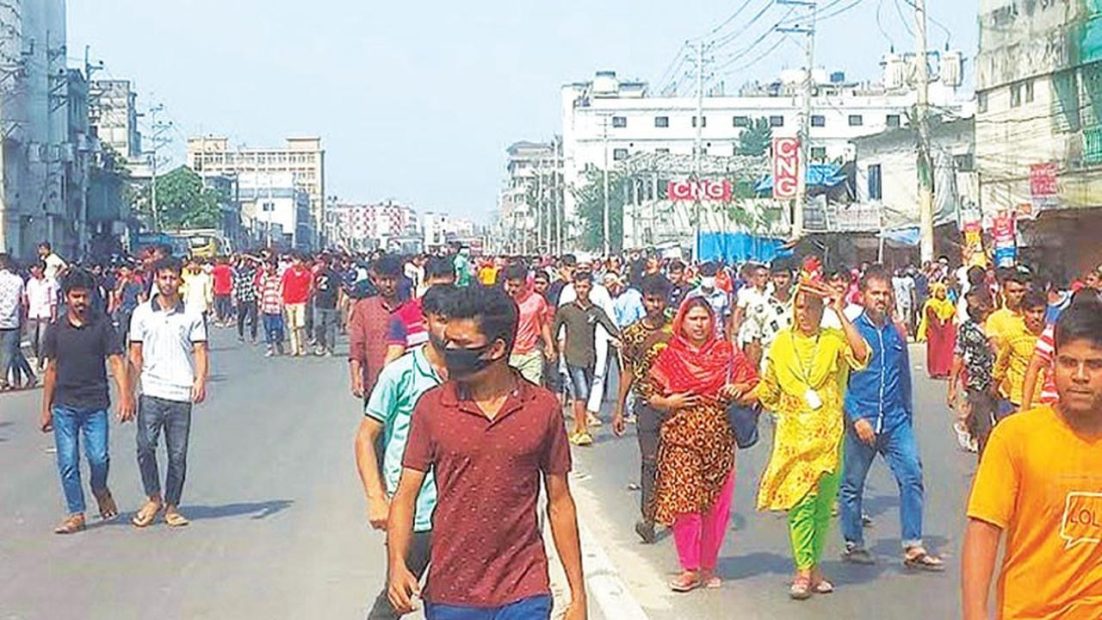
Bangladesh’s garment industry is a major part of the country’s economy. But it is now going through a difficult time. For several days, workers have been protesting in Savar, Ashulia, Gazipur and Mirpur. At the same time, factory owners are struggling to deal with the situation. Police vehicles have been set on fire, factories have been damaged and workers have clashed with police several times. This is not just unrest in one industry. It is also a serious warning for the whole economy.
Workers are demanding that the minimum monthly wage be raised to Tk 30,000. As hundreds of factories face the risk of closure, questions arise about the reasons behind the unrest. Is it only about meeting basic needs, or is there a deeper plan behind it? Most importantly, how can the country balance the industry’s ability to pay with the rising cost of workers’ living?
The main reason for the workers’ anger is their difficult living conditions. In December 2023, the minimum wage for garment workers was set at Tk 12,500. Since then, prices have continued to rise. According to the Bangladesh Bureau of Statistics, inflation has remained higher than wage growth for several years. As a result, the real income of working people has fallen.
In Dhaka and nearby industrial areas, house rents, food prices, transport and medical costs have increased sharply. It is almost impossible for a family of four to survive on Tk 12,500 a month. Research by the Global Living Wage Coalition says a family of four in Dhaka needs at least Tk 30,459 a month to meet basic living costs. Therefore, the workers’ demand for Tk 30,000 is not an unrealistic luxury. It is close to the amount needed for basic living.
In his book Poverty and Famines, economist Amartya Sen showed that people can suffer from hunger even when food is available if they cannot afford to buy it. Today, many garment workers have lost much of their purchasing power. Some have to survive on very simple meals or take loans at high interest rates. If wages cannot provide enough food and clothing for a month, the fairness of the current wage structure must be questioned.
However, factory owners also face serious problems. The industry can survive only if factories remain in business, and workers can keep their jobs only if the industry survives.
The global economic slowdown and the wars in Russia-Ukraine and the Middle East have reduced international garment orders. Bangladesh is also facing serious gas and electricity shortages. High bank loan interest rates and the rising cost of imported raw materials have further reduced factory owners’ profits.
In this situation, suddenly raising wages to Tk 30,000, more than double the current minimum, could force hundreds of small and medium-sized factories to close. Millions of workers could lose their jobs instead of receiving higher wages. The Bangladesh Garment Manufacturers and Exporters Association (BGMEA) and the Bangladesh Knitwear Manufacturers and Exporters Association (BKMEA) have warned that continued unrest could leave them with no choice but to close factories indefinitely under Section 13(1) of the Labour Act.
International buyers are also part of the problem. They talk about workers’ rights and human rights but often refuse to pay fair prices for garments. As a result, factory owners cannot always bear the full cost of a major wage increase.
Political issues have added to the crisis. The government and law enforcement agencies claim that political groups are behind the recent violence in Mirpur and Gazipur, including the burning of police vehicles and damage to factories.
The Home Minister and Labour Minister have said that a group that benefited from the former Awami League government, along with another group across the border, is trying to create instability ahead of December. The political identities of several suspects arrested by the Detective Branch (DB) in Mirpur have also added to these claims.
Genuine workers who protest for better wages would not normally set fire to the factories that provide their livelihoods. It cannot be ruled out that opportunistic political groups have joined the movement to take advantage of the situation.
The government has formed an impartial, all-party minimum wage board with representatives of both factory owners and workers. However, political groups can take advantage of unrest when public anger already exists. Low wages and rising living costs have created that anger.
At this critical time, emotions and political blame alone cannot solve the problem. Bangladesh also faces major challenges ahead. After graduating from the Least Developed Country (LDC) category, the country will no longer be able to provide the same kind of direct financial support to the garment industry. Competing in the global market through cheap labour will become increasingly difficult.
Vietnam has made progress by using technology, adding more value to products and strengthening local industries. Its total trade in goods has reached $1 trillion. Bangladesh must also move away from its dependence on cheap labour.
The efficiency wage theory of economists George Akerlof and Joseph Stiglitz shows that better wages can increase workers’ productivity and reduce waste. Factory owners should therefore invest in technology and skilled workers instead of depending on low wages.
Several steps are needed to solve the crisis.
First, the new wage board must work independently and announce a fair wage based on actual living costs. Even if the minimum wage is not set at Tk 30,000, it must be enough for workers to meet their basic needs.
Second, factory owners should consider sharing part of their profits with workers. This can improve workers’ welfare and strengthen their sense of responsibility towards their factories. The government should also use political and diplomatic pressure to encourage international buyers to pay fair prices.
Third, the government must play a greater role. As Amartya Sen’s idea of ‘public action’ suggests, the state must help address people’s basic needs. Factory owners alone cannot carry the entire burden.
Owners may be able to pay wages of Tk 16,000 to Tk 18,000, but the government should help cover the remaining living costs. It can introduce a special rationing system so workers can buy rice, lentils, oil and other daily necessities at fair prices.
The government should also build dormitories or workers’ housing in industrial areas to reduce the burden of high rents. Free medical services and schools for workers’ children should also be ensured. If the government takes responsibility for some of these costs, the pressure on factory owners will decrease.
More than 80 per cent of Bangladesh’s export earnings come from the garment industry. The hard work of garment workers also helps the country maintain its foreign currency reserves. No economy can remain strong while keeping these workers hungry and in debt.
Violence and damage to factories must be stopped. At the same time, factory owners, workers’ organisations and the government must work together to find a lasting solution.
The era of cheap labour is coming to an end. Bangladesh must accept this reality. Better technology, new markets and fair rights for workers are essential to save the garment industry and take it forward. Otherwise, the fall of this industry could cause a major crisis for the entire economy.
The writer: Journalist and columnist.
rintuanowar.com