Fish Production in Northern Bangladesh and Export Potential
Bangladesh is now more or less self-sufficient in fish production. According to the latest complete government data from the Department of Fisheries, the country produced a total of 5.018 million metric tonnes of fish in the 2023-24 fiscal year. During the same period, the annual demand for fish was around 4.893 million metric tonnes.
This means production exceeded demand by around 125,000 metric tonnes. According to informed observers, fish production in the northern region could increase significantly if India did not withdraw water upstream of the Padma and Teesta during the dry season.
However, although there is a national surplus, the regional picture is different. There is a major gap between the Rajshahi and Rangpur divisions, particularly in northern Bangladesh. Rajshahi has a surplus in fish production, while Rangpur still faces a production deficit.
Rajshahi is currently one of the country’s major freshwater fish-producing regions. According to reports citing 2026 data from the Department of Fisheries, the eight districts of the division produce around 596,467 metric tonnes of fish annually. After meeting local demand, around 150,000 tonnes of fish are sent to other parts of the country.
Earlier, a publication of the Rajshahi Divisional Fisheries Office, based on data from the 2022-23 fiscal year, reported fish production of 551,000 tonnes against demand of 446,000 tonnes. This meant the division had a surplus of around 106,000 tonnes even then.
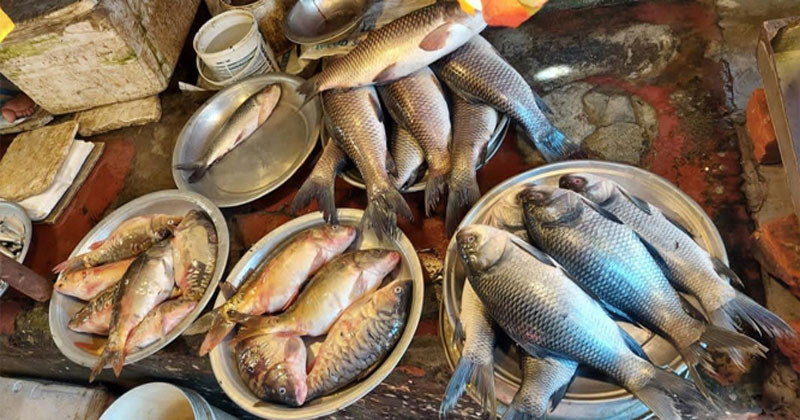
Bogra, Naogaon, Natore and Rajshahi are among the important districts in the region for surplus fish production. Various species, including rohu, catla, mrigal, silver carp, pabda, koi, shing, magur and tilapia, are being commercially produced in the region. In the 2023-24 fiscal year, rohu production in Rajshahi division was around 85,435 tonnes and catla production was 46,364 tonnes, among several species with export potential.
In contrast, Rangpur division continues to face a fish shortage. According to 2026 data from the Department of Fisheries, annual fish demand in the division’s eight districts is around 340,000 metric tonnes, while production is around 320,000 tonnes. As a result, the deficit is around 19,000 tonnes.
One of the main reasons is water scarcity. Around 60 to 65 percent of the nearly 280,000 ponds in Rangpur division do not retain water throughout the year. Many ponds contain water for only three to four months, making year-round fish farming impossible. As a result, despite having a large number of ponds, the region cannot fully utilise its production potential.
Therefore, if Rajshahi and Rangpur are considered together, northern Bangladesh can be described as a strong fish-producing region. There is an opportunity to use Rajshahi’s surplus to help address Rangpur’s deficit while also improving market management and transport infrastructure.
Fish is a highly perishable product. Therefore, along with increasing production, it is essential to expand modern cold-chain facilities, ice plants, chilling centres, pre-cooling systems, frozen storage and hygienic transport.
According to national data from the Department of Fisheries, Bangladesh has 107 fish-processing plants, of which 77 are approved by the European Union. In the 2023-24 fiscal year, the country exported around 77,408 tonnes of fish and fish products, worth approximately Tk 4,532 crore.
However, the situation in northern Bangladesh is different. Although the Rajshahi region has a surplus in fish production, a recent report said there is still no separate and fully developed fish-processing facility there. Industrial entrepreneurs have demanded the establishment of a specialised fish-processing zone.
In other words, although there are some cold-storage facilities, ice facilities and fish-storage systems in northern Bangladesh, many of them are mainly focused on other agricultural products. For export-oriented fish, facilities for HACCP-standard processing, frozen storage, vacuum packaging, filleting, grading and rapid customs certification need to be expanded.
The biggest new markets for northern Bangladesh could be northeastern India, Nepal and Bhutan. Demand for fish remains significant in northeastern India. A recent research review found that several states, including Assam, Tripura, Meghalaya, Manipur and Nagaland, have shortages between production and demand and import fish from other parts of India.
Bangladesh is already exporting fish to the Indian market. In the 2024-25 fiscal year, 13,742 tonnes of fish were exported to India through the Benapole land port alone, worth around Tk 470 crore. Of this, 13,210 tonnes were freshwater fish, including pabda, pangas, tilapia and tengra.
Another important point is that a 2025 directive from India’s Ministry of Commerce stated that certain product restrictions imposed on imports from Bangladesh at land ports in Assam, Meghalaya, Tripura and Mizoram do not apply to fish. This creates an opportunity for Bangladeshi fish to enter the northeastern Indian market.
There is also potential in Nepal and Bhutan. However, it will be difficult to transport fresh fish to distant markets unless land ports, transit facilities, sanitary certification, rapid customs clearance and refrigerated transport are ensured.
Overall, Bangladesh has a surplus in fish production at the national level. Rajshahi division produces more fish than its demand, while Rangpur still faces a deficit of around 19,000 tonnes. Therefore, northern Bangladesh can be developed not only as a fish-producing region but also as a regional hub for fish storage, processing and exports.
If modern fish cold chains, ice and chilling infrastructure, international-standard processing plants, packaging centres, laboratories, and faster health certification and customs facilities are established at border land ports in Rajshahi and Rangpur, the markets of Nepal, Bhutan, India’s Seven Sisters and Sikkim could create new commercial opportunities for fish from northern Bangladesh.
At the same time, if Rangpur’s water shortage is addressed and fish production is increased, the overall fish surplus of northern Bangladesh could grow further.