Fisheries Research Center Demanded in Barguna to Study Hilsa Migration
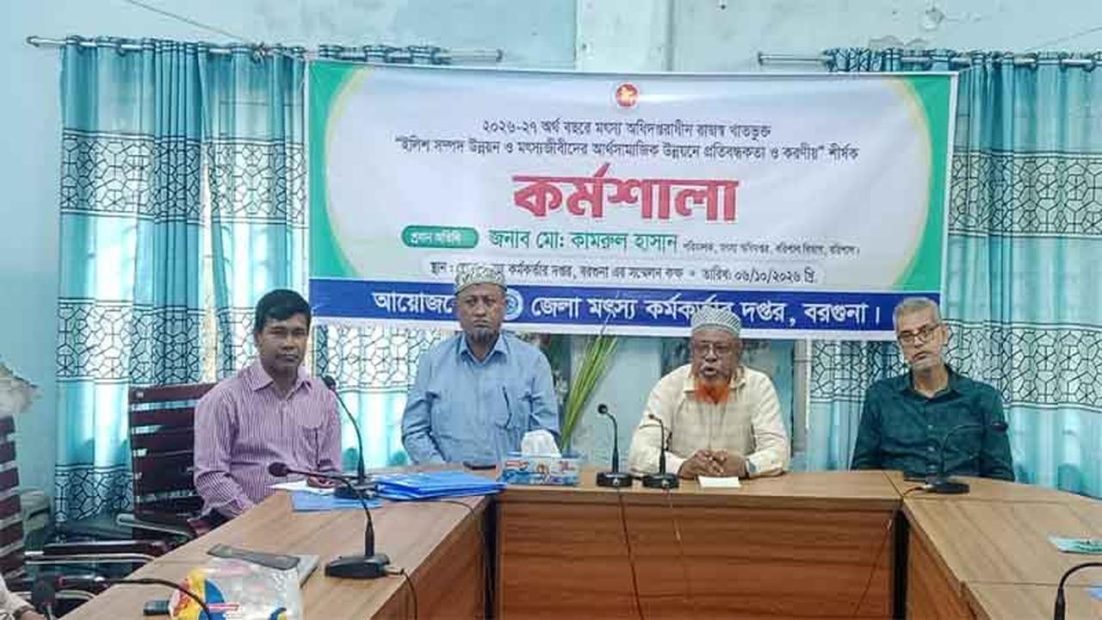
Stakeholders at a daylong workshop on Hilsa resource development and fisher livelihoods urged the establishment of a dedicated fisheries research center in coastal Barguna to conduct regular scientific studies on Hilsa migration, breeding, and overall aquatic resources.
Organized by the District Fisheries Office, the workshop took place on Tuesday at its conference room. Kamrul Hasan, Director of the Barishal Divisional Fisheries Department, attended as the chief guest, with District Fisheries Officer Mohammad Zia Uddin presiding. Key speakers included Barishal Divisional Deputy Director Mohsin, Senior Assistant Director Anisuzzaman, and Barguna Press Club President Hafizur Rahman.
Journalists and local fisheries officers, including Jahangir Kabir Mridha of Daily Inqilab, Saiful Islam Miraj of Somoy TV, Amatali Senior Upazila Fisheries Officer Tanmoy Kumar Das, and Barguna Sadar Senior Upazila Fisheries Officer Md. Maruf Hossain Minar, also spoke at the event.
A multimedia presentation outlined the migration routes of Hilsa across local rivers, including the Payra, Bishkhali, Baleshwar, Kocha, Kirtonkhola, Andharmanik, and Tetulia, as well as government initiatives to conserve marine life.
Speakers emphasized that while Barguna’s extensive coastal waters serve as critical habitats for Hilsa and other species, pressures from climate change, river siltation, illegal net usage, overfishing, and pollution threaten these ecosystems. They stressed that legal enforcement must be paired with continuous scientific research.
A specialized research center in Barguna would enable local monitoring of Hilsa migration, breeding zones, food cycles, water quality, and productivity, providing data needed to formulate effective conservation policies and support coastal livelihoods.
The workshop highlighted the importance of aligning conservation efforts with social welfare. Without alternative livelihoods and support during fishing ban periods, compliance remains challenging. Long-term socio-economic strategies grounded in research are essential.
Existing measures include task force monitoring, the annual mother Hilsa conservation campaign in October, an eight-month Jatka (juvenile Hilsa) ban from November 1 to June 30, a 65-day Bay of Bengal fishing ban from April 11 to June 15, and combined operations against illegal nets from January to April.
Official figures show that between July 2020 and May 2026, authorities conducted 218 mobile court drives and 427 raids in Barguna, seizing 1,598 illegal nets, imprisoning 115 individuals across 79 cases, and collecting BDT 1.912 million in fines.
Concluding the session, speakers underscored that Hilsa is crucial to Barguna’s economy and coastal livelihoods. Establishing a permanent research infrastructure will bridge scientific inquiry, habitat protection, fisher support, and sustainable fisheries management.