Floodwaters Rise in the Padma River
Rezaul Karim Raju, Rajshahi / Musa Mia, Chapainawabganj / Mahfuzul Alam, Daulatpur (Kushtia)
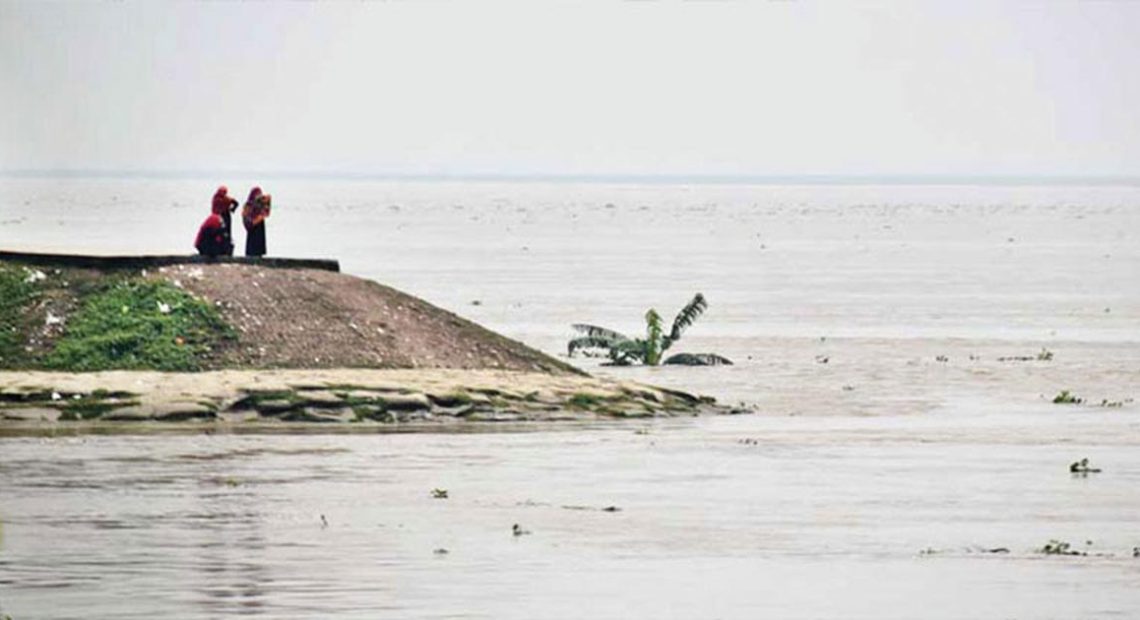
India has opened all the gates of the Farakka Barrage again to handle flooding in Bihar and pressure from water flowing downstream from Nepal. As a result, floodwaters have risen in the Padma River. The vast sandbars have been replaced by muddy currents, with the water level rising by 2-3 centimetres every day due to the upstream surge.
The Padma has risen rapidly in Rajshahi and is now close to the danger level. The water is currently flowing only 0.85 metres below the danger mark. While the danger level of the Padma in Rajshahi is 18.05 metres, the water level reached 17.20 metres on Saturday.
Although the water remains slightly below the danger level, a strong flow is coming through the Farakka gates. Erosion has already begun on both banks of the Padma in Shibganj, Chapainawabganj. Char Jagannathpur, Badshapara, Panditpara and Manoharpur are particularly vulnerable, with large areas of land already eroded into the river.
The Padma has also hit Godagari in Rajshahi. Most parts of the border-adjacent Char Khidirpur and Khanpur have been inundated. Many families in Charghat and Bagha have become waterlogged. Around 3,000 families in 15 chars of Chakrajapur Union in Bagha are now stranded by floodwaters. Crops have been submerged, leaving riverside residents worried.
Arifur Rahman Ankur, executive engineer of the Rajshahi Water Development Board (WDB), told Inqilab that although the Padma is rising, there is currently no risk to the Rajshahi city protection embankment. The WDB remains alert and will take immediate measures if any risk emerges. He said there is no reason for concern over the Padma’s water level at present. The danger level in Rajshahi is 18.50 metres, while the city protection embankment stands at 19.67 metres. However, the rising water continues to cause concern among people living along the river.
Padma Water Stable in Chapainawabganj, Mahananda and Punarbhaba Rising
Musa Mia, Chapainawabganj district correspondent, reports that after the Farakka Barrage gates were opened, water levels in the Padma and other major rivers began rising due to the upstream surge. However, the Padma has remained almost stable since Friday evening.
The Mahananda has risen by four centimetres and the Punarbhaba by one centimetre. Although the flood situation in low-lying and char areas remains unchanged, the suffering of flood-affected people is increasing, with shortages of medical services and safe drinking water. In the previous 24 hours, the Padma rose by seven centimetres, inundating low-lying areas of Narayanpur and Alatuli unions in Sadar upazila and Monakasha, Durlabhpur, Uzirpur and Paka unions in Shibganj. Around 3,000 families were stranded, while homes, farmland and educational institutions were submerged.
Classes have been suspended at 29 educational institutions, 12 in Sadar and 17 in Shibganj after floodwaters entered the premises. The institutions include government primary schools, high schools, colleges and madrasas.
The shortage of safe drinking water is causing the greatest hardship. In many areas, tube wells and other water sources have been submerged. Movement has also become difficult, making it hard to take sick people to healthcare centres. Families are particularly worried about children, elderly people and pregnant women.
Alamgir Hossain of Paka Union said water had entered his village for several days and had now reached homes. Crops have been submerged, while people are struggling to feed livestock and obtain drinking water and medicine.
Mamun Rashid of Durlabhpur Union said his home had been inundated and he had to cook at a neighbour’s house. “There is knee-deep water inside the house. We are living in these conditions. Almost everyone in the village is facing the same situation,” he said.
According to the Department of Agricultural Extension, around 400 hectares of Aman and Aus rice, summer onions and vegetables have been submerged in different parts of the district, raising fears of significant crop losses. According to WDB data, the Padma stood at 21.79 metres at the Pankha gauge station at 6pm Saturday, against a danger level of 22.05 metres. The Mahananda stood at 19.53 metres at the Khalghat gauge station, against a danger level of 20.50 metres. The Punarbhaba stood at 19.53 metres at the Rohanpur gauge station, against a danger level of 21.55 metres.
Although the Padma has remained stable, the continued rise in the Mahananda and Punarbhaba has kept concerns over the flood situation alive.
Padma Continues to Rise in Daulatpur, Suffering of Stranded People Worsens
Mahfuzul Rahman, Daulatpur (Kushtia) upazila correspondent, reports that the Padma continued to rise in Daulatpur. The river rose another three centimetres in the 24 hours from Friday to Saturday. At the Hardinge Bridge point, the water was flowing 75 centimetres below the danger level. As the water rises, the suffering of stranded people in the char areas is increasing. Snake infestations have also increased, while shortages of cattle feed have emerged.
Over the past week, the abnormal rise in the Padma has submerged most areas of Chilmari and Ramkrishnapur unions in the border-side Daulatpur upazila. More than 50,000 people in 40 villages have become stranded. Roads and large areas of cropland have been submerged. As water reached knee level in courtyards and homes, some residents have been staying on makeshift platforms inside houses and on tin roofs. Since Thursday, classes at 30 educational institutions have been locally suspended because of the inundation, although the institutions remain officially open. Flood-affected areas are facing various hardships, including increased snake activity and a shortage of safe drinking water.
Sohel Ahmed, a stranded resident of Charpara in Ramkrishnapur Union, said he had been waterlogged for nearly a week. “There is knee-deep water in the yard and inside the house. There is no way to go outside. We have to depend on boats or dinghies to travel anywhere. Our children cannot go to school by crossing the water. Overall, we are living in inhumane conditions,” he said.
Around 470 hectares of cropland in the char areas have been submerged, raising fears of extensive crop losses. Daulatpur Upazila Agriculture Officer Rehana Parvin said the Padma had risen further compared with Friday, increasing crop damage. Around 470 hectares of cropland are currently underwater.
Flood victims complained that although their suffering has increased with the rising water, adequate relief has not yet reached them. The administration allocated 10 tonnes of rice, but it could not be distributed because the allocation had not been released from the office.
Daulatpur Upazila Nirbahi Officer Anindya Guha said most of Ramkrishnapur Union and the entire Chilmari Union had been affected by the flood, leaving people in 40 villages stranded. Homes, roads and cropland have been submerged. He said dry food, safe drinking water and medicines were distributed among 350 families in affected areas on Wednesday, and additional relief had been allocated. The relief would be distributed among stranded and affected people soon.
According to the WDB, the Padma rose three centimetres in the 24 hours from 9am Friday to 9am Saturday. At the Hardinge Bridge point, the water was flowing 75 centimetres below the danger level of 13.80 metres.