From Ambassador Cup to National Wushu Training Complex
Lt. Col. (Retd.) Md Shahadat Hossain
The 8th China Ambassador Cup Wushu Championship began on September 5 at the Shaheed Suhrawardy Indoor Stadium in Mirpur. A total of 279 athletes from 19 clubs across the country are taking part. Former Air Vice Marshal Altaf Hossain Chowdhury, MP, inaugurated the competition. Li Shaopeng, Cultural Counsellor at the Chinese Embassy in Bangladesh, attended as a special guest. Md Saiful Islam Bhuiyan, president of the Bangladesh Wushu Federation, chaired the opening ceremony.
As in previous editions, I had the opportunity to attend the opening ceremony this year. Having witnessed the development of this competition over the years, I have become even more convinced that wushu deserves a more permanent and well-organised position in Bangladesh’s sports arena.
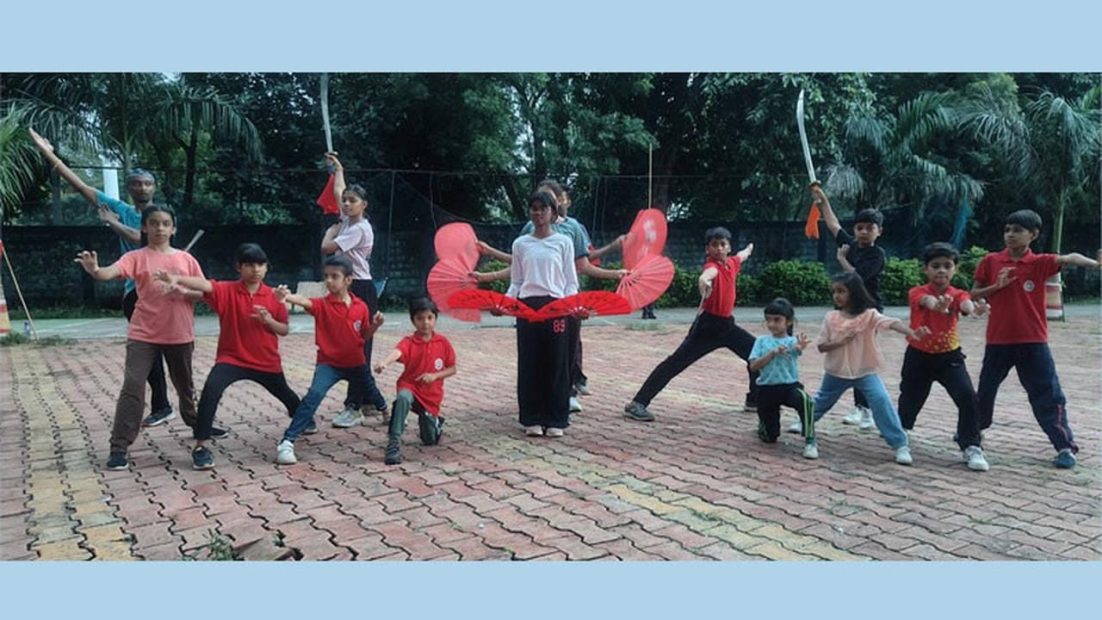
For those who are not very familiar with wushu, it is a modern Chinese martial art and competitive sport, commonly known internationally as “kung fu.” It has two major competitive disciplines—Taolu and Sanda. In Taolu, athletes demonstrate balance, flexibility, speed, control and technical skills through prescribed techniques and routines. Sanda is a combat-based discipline involving techniques such as punches, kicks, throws and wrestling.
Founded in 1990, the International Wushu Federation (IWUF) is currently the international governing body for the sport, with 164 member countries and regions. Bangladesh has also made significant progress over the past two decades. The Bangladesh Wushu Association was established in 2007 and transformed into the Bangladesh Wushu Federation in 2018. The federation currently has 93 affiliated registered clubs. Institutions such as the Bangladesh Army, Border Guard Bangladesh, Police, Ansar-VDP and BKSP are also contributing to the development of wushu.
These 93 clubs are an important asset for Bangladesh. They can be used to identify talented young athletes from different parts of the country. But organising competitions alone will not be enough to fully realise this potential. What is needed is a continuous national training and talent-development system.
China has already played an important role as a partner in this journey. The Chinese Embassy in Bangladesh has supported the organisation of the Ambassador Cup and provided training mats, performance uniforms and martial arts equipment in 2023. The embassy has also supported four editions of the Ambassador Cup so far.
China’s technical assistance has also been significant. In 2018, 40 Bangladeshi wushu athletes received specialised training from Chinese experts. More recently, with support from the Olympic Solidarity programme, 43 Bangladeshi coaches received training in Taolu, Sanda, physical fitness, techniques, rules and competition standards at a technical training course held in Dhaka in April 2026. Bangladeshi Taolu athletes are also scheduled to train in Zhengzhou, China, from September 10 to October 29 this year.
These initiatives demonstrate that Bangladesh has considerable potential for the development of wushu and that Chinese support can accelerate this progress. What is now needed is to bring these separate initiatives under a permanent national framework. A National Wushu Training Complex is needed. Bangladesh should take the initiative to establish such a complex as a matter of priority.
The complex should have separate training facilities for Taolu and Sanda, modern training floors, competition areas, strength and conditioning facilities, accommodation for athletes, classrooms, medical and physiotherapy facilities, and video-analysis facilities. There should also be separate training facilities for the development of coaches and referees.
This should not merely be a sports venue; it should serve as a national talent-development centre. The country’s 93 affiliated clubs can be used as the foundation for talent scouting and selection across the country. Promising athletes selected through this process can then receive advanced training at the national complex. Special attention should be given to junior athletes, women and talented athletes from outside Dhaka. In this way, Bangladesh can gradually move from isolated competitive successes towards a sustainable, high-level sporting structure.
The current time is also appropriate for such an initiative. Prime Minister Tarique Rahman has already emphasised the development of sports and the creation of new talent. In March, he expressed his commitment to developing new players in different sports and turning sports into a profession, and announced the nationwide “Notun Kuri” sports initiative. A National Wushu Training Complex could fit well with the broader national objective of building a confident, skilled and humane generation through sports, culture and creative activities alongside education.
After establishing the complex, Bangladesh could formally request China to send qualified wushu specialist coaches for at least the first three years. Their role would not be limited to training athletes. They could work with Bangladeshi coaches to introduce modern training methods, develop annual training plans, improve competition preparation, mentor promising athletes, and establish effective systems for developing coaches and referees.
However, the goal should be knowledge and skills transfer, not permanent dependence. By the end of three years, Bangladesh should have developed a strong local coaching structure capable of running the programme through its own capacity.
Such cooperation could also serve as an effective means of deepening people-to-people ties between Bangladesh and China. Training Bangladeshi athletes in China, visits by Bangladeshi coaches to China, Chinese experts working in Bangladesh, joint competitions and youth exchanges—these initiatives could strengthen friendship between the people of the two countries beyond the realm of sports.
It should be noted that wushu is not merely a means of winning medals. Regular wushu training develops physical fitness, discipline, concentration, confidence, perseverance and respect for others. For young people growing up in an increasingly digital environment, it can provide a healthy alternative to excessive reliance on screens and sedentary lifestyles.
If Bangladesh can combine its extensive network of 93 clubs, government support, China’s technical expertise and a specialised national training centre, wushu could become one of the country’s strongest competitive sports. The China Ambassador Cup has already demonstrated how sport can bring people together. Now is the time to build something bigger on that foundation. The Ambassador Cup has already built a bridge of friendship. Bangladesh should now build the National Wushu Training Complex on that foundation.
Writer: Graduate in Chinese language from Beijing Language and Culture University; an Adjunct Professor at the Institute of Professional Language, Bangladesh Maritime University; and the Founder, Secretary-General and Senior Research Fellow of We Speak Chinese Club Bangladesh Limited.
Email: shahadatb@gmail.com