Garment sector can thrive without foreign officials: Mahdi Amin
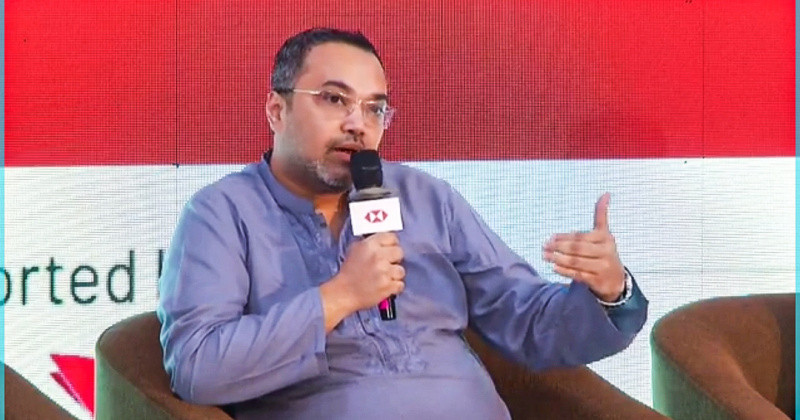
Mr. Mahdi Amin, Adviser to the Prime Minister and Spokesperson for the Prime Minister’s Office, has remarked that Bangladesh’s ready made garment and textile industry can be run entirely by skilled local manpower, reducing dependence on foreign officials. He said that in this nearly half century old industry, many factories and buying houses still employ foreigners in various roles.
He said that Bangladeshi people already possess the talent, skill and competence needed, and if these are utilized, the entire industry could be run with local manpower alone. At the same time, an education system and work environment must be built so that other countries one day compete to hire Bangladesh’s talented and skilled professionals for senior positions.
He made these remarks as chief guest at a discussion titled “Innovation in Apparel and Textile: Driving Competitiveness and Growth,” organized by the Ministry of Science and Technology on Sunday afternoon at a hall in the Novo Theatre on Bijoy Sarani in the capital.
Describing youth employment and skilled human resource development as one of the government’s main goals, Mr. Amin said the government wants to increase sustainable industrial growth and direct foreign investment on one hand, while ensuring vast and dignified employment for young people on the other. Technical education is being given top priority so that students find good livelihoods at home after their studies and also become sought after in the international labor market.
He said the education system must be designed to enhance students’ professional and communication skills alongside human values. Necessary changes are being made to the curriculum to ensure close cooperation between industry and academia and public private partnership.
The Prime Minister’s Adviser also remarked that the ready made garment and textile industry holds an emotional place for the BNP led government. He said that BNP’s founder, martyred President Mr. Ziaur Rahman, played an important role in laying the foundation of the garment industry in Bangladesh. Policies from his time, such as bonded warehouse facilities, duty free raw material imports and cash incentives, created an important base for the industry’s growth.
Highlighting women’s economic empowerment in the garment sector, Mr. Amin said ordinary women from remote areas are becoming self reliant through this industry. Garments made by a young woman in a village are reaching various corners of the world and promoting the “Made in Bangladesh” brand internationally. For this reason, the garment sector is not just an economic driver but also a symbol of the labor and sacrifice of millions of workers.
He said that the development of the garment sector is being given top priority under the current government, noting that over the past seven months, work has been ongoing to reopen closed factories, deliver incentives easily to entrepreneurs and modernize the industry through new innovation. Government policymakers are regularly holding dialogue and exchanging views with all concerned stakeholders including BGMEA and BTMA.
Mr. Amin emphasized research, development and skill enhancement to advance Bangladesh’s garment industry in global competition. He said that although Bangladesh is the world’s second largest exporter of ready made garments, there is still scope for further improvement in production capacity and efficiency. Alongside workforce, modern machinery, raw materials and management, there are plans to increase research capacity at every factory to bring innovation to garment design.
On the use of technology, he said Bangladesh will adopt new technology, but that technology must help increase workers’ skills and create new employment. Technology should never be used as an excuse to take away workers’ jobs. The country’s garment industry has reached its current position based on the long standing labor and sacrifice of workers. Therefore, the government’s goal is to coordinate technology with human resource skills.
Calling for timely and specialized courses at the university level for the garment industry, Mr. Amin said undergraduate, graduate and one year diploma programs need to be introduced. This would allow young people to gain the skills the industry needs alongside formal higher education.
He also emphasized building a bridge between university theoretical education and practical factory experience. He called for arranging internship opportunities for students at factories and institutions, and bringing successful industry figures to campuses to share experience. He also emphasized regular career fairs and guidance programs for young people.
Stating that the government is actively working to support young innovators, the Prime Minister’s Office spokesperson said the government is considering providing initial capital and funding for new startup projects. Noting that many tasks had stalled due to prolonged crisis and lack of democratic continuity, he said it is not possible to remove all crises in a short time. However, there is no shortfall in the government’s sincerity and responsibility in turning limitations into strength.
Referring to the slogan “One Nation, One Innovation,” Mr. Amin said Bangladesh will move forward by harnessing its vast youth power and entrepreneurial spirit. The government will formulate supportive policies, and the private sector will play a role in implementing them. A self reliant Bangladesh can be built through public private partnership and national unity.
He said no single industry can succeed alone. Sustainable success requires a complete ecosystem where all stakeholders work together. He described the discussion, organized by the Ministry of Science and Technology, which brought together global brands, garment and textile factory owners, university representatives, bankers, regulatory bodies and policymakers, as a complete “360 degree” initiative.
Participants in the discussion included BGMEA President Mr. Mahmud Hasan Khan, BTMA President Mr. Shawkat Aziz Russell, National Board of Revenue member for Customs, Export Bond and IT Division Ms. Farzana Afroz, Vice Chancellor of BGMEA University of Fashion and Technology Engineer Dr. Ayub Nabi Khan, H&M’s Regional Country Manager Mr. Ziaur Rahman, HSBC Bangladesh’s Country Head of Corporate and Institutional Banking and Global Network Banking Mr. Shadab Hossain, and HSBC Bangladesh’s Head of Global Apparel Supply Chain Mr. Ashfaqur Rahman.
Earlier, on Saturday morning, Prime Minister Mr. Tarique Rahman inaugurated the “Bangladesh Innovation Fair 2026,” organized by the Ministry of Science and Technology. This discussion on the garment and textile industry was held on the second day of the three day fair, themed “Innovate to Market.”