Gaza’s Rubble Becomes Both Grave and Shelter as Burial Space Runs Out
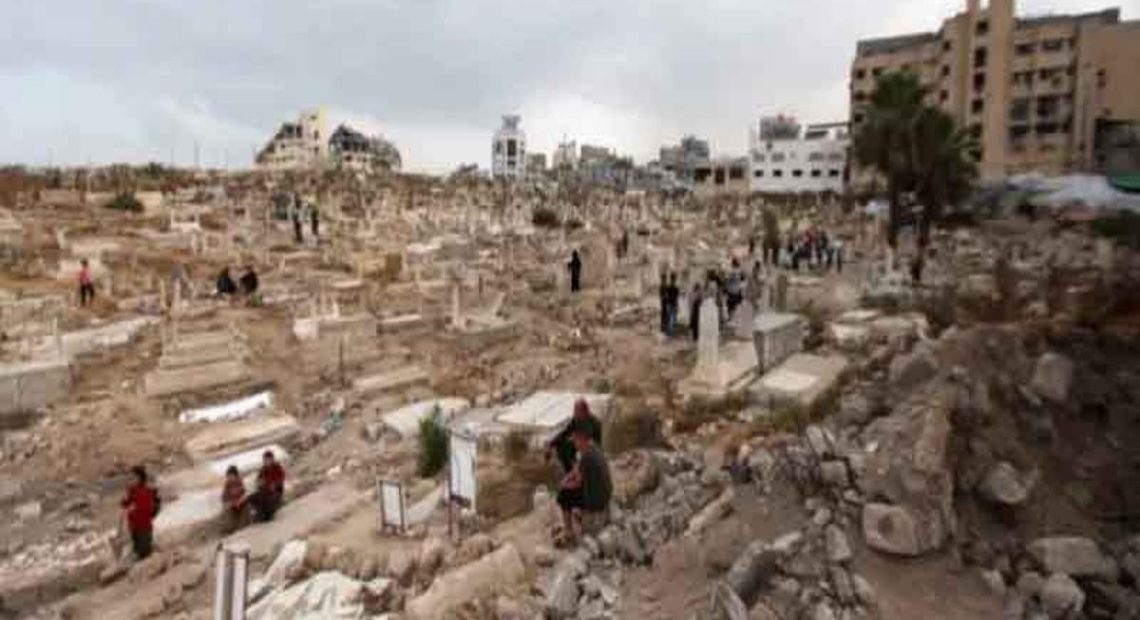
When 20-year-old Omar al-Sawhi went to Zeitoun Cemetery to bury his 40-year-old father, Mohammad, who was shot dead near the “Yellow Line,” a military zone designated by Israeli forces, he found graves packed tightly together as cemeteries struggle with a severe shortage of space. Under the pressure of war and the acute lack of land, cemeteries are also reaching their limits, making it increasingly difficult to find places for new burials. “There were piles of sand, and people had been buried underneath them,” Mr. Omar told Al Jazeera. “A grave was marked only by a stone with a piece of paper bearing the martyr’s name. There is no opportunity now to prepare graves properly as we did before the war.”
With Gaza’s services severely disrupted and the continued threat of Israeli attacks, thousands of Palestinians have had to be listed as “missing” in official records. Many have been buried in gardens, tents, displacement camps, schools or hospital grounds. As Israeli violence relatively eased following a US-mediated ceasefire in October 2025, families began recovering the remains of relatives from destroyed homes and temporary burial sites. Since the ceasefire was announced, at least 1,200 Palestinians have been killed, each requiring a place to be buried.
Gaza authorities said the remains of 529 Palestinians have been recovered from seven mass graves located within hospital compounds. The crisis reflects not only the deaths of more than 73,000 Palestinians since October 2023 but also the destruction of cemeteries. According to Gaza’s Ministry of Endowments and Religious Affairs, more than 40 cemeteries have been destroyed so far. Restrictions on access to cemeteries in areas under Israeli control have further reduced available burial space. At the same time, some cemeteries have been turned into shelters for displaced Palestinians because of Israeli bombardments and evacuation orders. Authorities said the cost of burials has risen to between 700 and 1,000 shekels, or roughly $235 to $335, due to shortages of essential materials, including grave markers. Palestinians who cannot afford the expense have been forced to use bricks and stones from destroyed buildings, mud and corrugated metal sheets to mark temporary graves.
Ikrami al-Madalal, a media official at the ministry, said many of Gaza’s 60 cemeteries had already reached capacity even before the war began. Authorities are now searching for new burial sites and trying to relocate remains from temporary graves. Fifty-year-old Tafesh Abu Hatab has worked as a gravedigger in Gaza for more than 19 years. He said this war has been the most difficult period of his career. When the war began, the Khan Younis cemetery had around 60 graves. It now has approximately 6,000. At one point, he was required to prepare about 35 graves a day. “We have never witnessed such horrific bloodshed before,” he told Al Jazeera. “There is hardly a day when dozens of martyrs are not buried.” Many of the dead are women and children, including newborns. Entire families are sometimes buried after Israeli strikes destroy buildings, vehicles or tents in which they were sheltering. “They are destroying the shelters over our heads, and we are creating our own burial grounds in the rubble of those homes,” he said.